
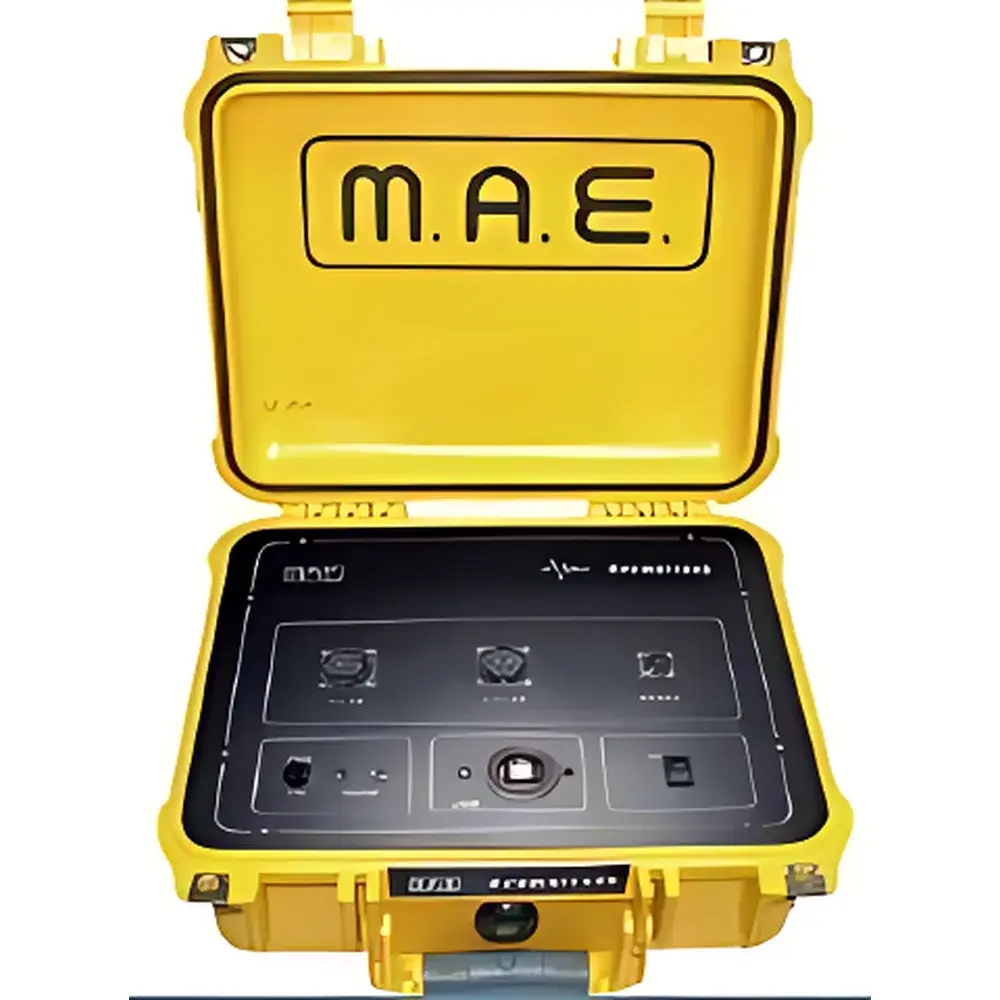
MAE A6000S Portable 24-Bit Seismograph
| Brand | MAE |
|---|---|
| Country of Origin | Italy |
| Model | A6000S |
| Instrument Type | Portable Seismograph |
| ADC Resolution | 24-bit |
| Dynamic Range | 144 dB (theoretical) |
| Total Harmonic Distortion | ±0.001% |
| Bandwidth | 2 Hz to 30 kHz |
| Common-Mode Rejection Ratio | 110 dB @ 60 Hz |
| Input Noise Floor | 27 nV |
| Trigger Accuracy | ±1/30 sampling interval |
| Input Voltage Range | ±5 V |
| Input Impedance | 20 MΩ @ 1 kS/s |
| Programmable Gain | 0, 6, 12, 18, 24, 30, 36 dB (per-channel configurable) |
| Anti-Aliasing Filter | −3 dB at 80% Nyquist frequency, −80 dB stopband attenuation |
| Sampling Intervals | 0.033 ms to 20 ms (discrete steps) |
| Sample Count per Acquisition | 1,024–21,800 (512-sample increments) |
| Pre-trigger Time | 1–500 ms (26 selectable values) |
| Channel Configuration | 12 or 24 channels (user-selectable per acquisition) |
| Acquisition Modes | Triggered (all channels), Continuous (up to 12 channels) |
| Calibration | Automatic ADC calibration prior to each acquisition |
| Digital Filtering | Auto-configured based on sampling rate |
| Data Storage | Host PC internal storage |
| Trigger Polarity | Positive or negative (software-selectable) |
| Data Format | SEG-2 (32-bit binary) or ASCII |
| Sensor Diagnostics | Real-time open-circuit, short-circuit, and sensor failure detection via cable signal analysis |
| Interfaces | USB 2.0, 10/100/1000BASE-T Ethernet, VGA video output |
Overview
The MAE A6000S is a high-fidelity, portable 24-bit seismograph engineered for precision seismic data acquisition across active and passive geophysical investigations. Based on sigma-delta analog-to-digital conversion architecture with real-time calibration and embedded sensor diagnostics, the A6000S delivers laboratory-grade dynamic range (144 dB theoretical) and ultra-low noise floor (27 nV) — critical for resolving weak ground motion signals in urban, industrial, or structural monitoring environments. Its dual-mode acquisition capability supports both triggered event capture (e.g., microseismicity, blast monitoring) and continuous waveform streaming (e.g., ambient vibration testing, structural health monitoring), making it suitable for regulatory-compliant vibration assessment per ISO 2631-2, DIN 4150-3, and BS 5228-2. Designed and manufactured in Italy, the system complies with CE marking requirements for electromagnetic compatibility (EMC Directive 2014/30/EU) and low-voltage safety (LVD Directive 2014/35/EU).
Key Features
- 24-bit sigma-delta ADC with automatic pre-acquisition calibration ensuring traceable measurement integrity
- User-configurable gain per channel (0–36 dB in 6-dB steps) enabling optimal signal-to-noise ratio across diverse sensor sensitivities (e.g., 4.5 Hz geophones, MEMS accelerometers, or broadband seismometers)
- Programmable anti-aliasing filter with −3 dB point set at 80% of Nyquist frequency and >80 dB stopband attenuation, eliminating spectral leakage in high-frequency analysis
- Real-time sensor health monitoring: automatic detection of open circuits, short circuits, and impedance anomalies in connected geophone strings or accelerometers
- Flexible timing architecture supporting pre-trigger windows from 1 ms to 500 ms in 26 discrete steps — essential for capturing precursor energy in induced seismicity studies
- Dual acquisition modes: synchronized multi-channel triggering (all 24 channels) and continuous streaming (up to 12 channels at 2/4/8 ms intervals) for long-term structural resonance characterization
- Native support for SEG-2 (32-bit binary) format — industry standard for geophysical data exchange — alongside ASCII export for interoperability with MATLAB, Python (ObsPy), and commercial processing suites
Sample Compatibility & Compliance
The A6000S interfaces with industry-standard geophysical sensors including vertical/horizontal geophones (1–100 Hz), triaxial MEMS accelerometers, and broadband force-balance seismometers. Input impedance (20 MΩ @ 1 kS/s) ensures minimal loading effects on high-impedance passive sensors. The system meets IEC 61326-1:2013 for EMC performance in industrial environments and conforms to EN 61000-6-2/6-3 for immunity and emissions. For vibration monitoring applications, raw time-series data are fully compatible with post-processing workflows required under ISO 5347 (vibration transducer calibration) and ISO 10816 (machinery vibration evaluation). All firmware and host software undergo periodic revision control aligned with GLP documentation practices.
Software & Data Management
Acquisition and configuration are managed via MAE SeismoControl v4.x — a Windows-based application supporting real-time spectral display, trigger threshold optimization, and batch metadata tagging (project ID, location coordinates, sensor layout). The software enforces audit-trail logging of all parameter changes, acquisition start/stop timestamps, and calibration events — satisfying traceability requirements under ISO/IEC 17025:2017 Clause 7.7. Data files include embedded header information compliant with SEG-Y Rev 2.0 metadata conventions. Export modules support direct ingestion into Petrel, OpendTect, and SeisWare platforms. Remote operation via Ethernet enables integration into centralized environmental monitoring networks using standard TCP/IP protocols.
Applications
- Active-source seismic refraction and reflection surveys (e.g., shallow bedrock mapping, void detection)
- Passive seismic monitoring for microseismic event location (mining, geothermal, CO₂ storage)
- Structural vibration analysis of bridges, dams, historical buildings, and wind turbine foundations
- Construction vibration impact assessment (piling, blasting) per DIN 4150-3 and BS 7385
- Ambient vibration testing (AVT) for operational modal analysis (OMA) and natural frequency identification
- Regulatory compliance monitoring for industrial facilities subject to local environmental protection agency (EPA) or EU Environmental Noise Directive (2002/49/EC) reporting
FAQ
What sensor types are supported by the A6000S?
The A6000S accepts standard 375 Ω or 375–1000 Ω geophones, MEMS accelerometers with IEPE or charge output, and broadband seismometers with ±5 V output range.
Is the system compatible with third-party data processing software?
Yes — native SEG-2 and ASCII exports ensure full compatibility with ObsPy, SAC, Geopsy, ReflexW, and commercial interpretation platforms.
Does the A6000S meet FDA or pharmaceutical industry standards?
No — it is not designed for GxP-regulated environments; however, its calibration traceability and audit logging align with general ISO/IEC 17025 quality management principles.
Can the device operate autonomously without a connected PC?
No — the A6000S requires an external host PC for power, control, and data storage; all processing and buffering occur on the host system.
How is time synchronization handled across multiple units?
GPS timing is not built-in; precise inter-unit synchronization requires external IEEE 1588 PTP-capable network switches or shared hardware triggers via BNC inputs.







