
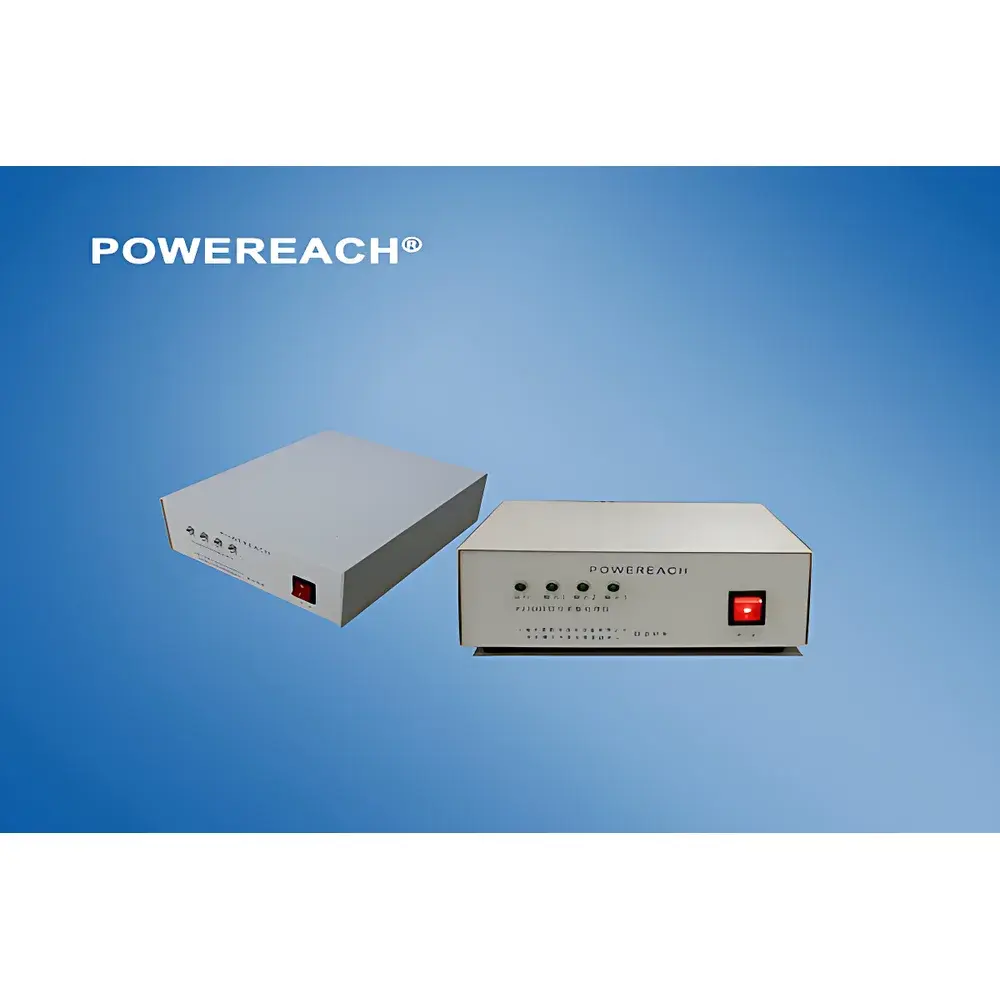
POWEREACH FJ3003 Electrochemical Workstation
| Brand | POWEREACH |
|---|---|
| Origin | Shanghai, China |
| Model | FJ3003 |
| Instrument Type | Single-Channel Electrochemical Workstation |
| Analog Input Channels | 2 (auto-ranging: ±0.2 V, ±2 V, ±20 V) |
| Input Impedance | >10 MΩ |
| Sampling Rate | 100 MS/s |
| Display & Measurement Resolution | 4 significant digits |
| Temperature Measurement Accuracy | ±0.01 °C |
| Temperature Control Range | 15 °C above ambient to 100 °C |
| Temperature Setpoint Range | 0–100 °C |
| Temperature Control Accuracy | ±0.1 °C |
| Temperature Output Actuation | Zero-crossing triggered thyristor |
| Control Output | 5-step power output (max. 300 W) |
| Electrical Isolation | Analog-to-digital and overvoltage protection integrated |
| Compliance | Designed for academic lab environments |
Overview
The POWEREACH FJ3003 Electrochemical Workstation is a single-channel, PC-based electrochemical data acquisition and control system engineered for precision in both undergraduate teaching laboratories and applied research settings. Unlike modular potentiostats with embedded firmware, the FJ3003 operates as a hardware interface layer that integrates with host software to execute standardized electrochemical techniques—including cyclic voltammetry (CV), chronoamperometry (CA), chronopotentiometry (CP), and impedance spectroscopy (EIS)—via configurable parameter sets. Its architecture follows classical analog signal conditioning principles: differential input stages with programmable gain, galvanically isolated analog-to-digital conversion, and real-time digital filtering to suppress common-mode noise. The system’s core function is not autonomous analysis but deterministic, low-latency acquisition of electrode potential and current signals under user-defined stimulus protocols—making it particularly suitable for pedagogical validation of Faradaic kinetics, thermodynamic reversibility, and diffusion-controlled processes.
Key Features
- Two high-impedance analog input channels (≥10 MΩ) supporting three auto-switching voltage ranges: ±0.2 V, ±2 V, and ±20 V—optimized for microelectrode measurements, bulk solution redox couples, and high-impedance reference electrode monitoring.
- Real-time sampling at up to 100 million samples per second (MS/s), enabling transient capture of fast electrochemical events such as double-layer charging or nucleation bursts without aliasing.
- Integrated overvoltage protection and opto-isolated signal paths ensure robust operation during accidental open-circuit or short-circuit conditions—critical for student labs and long-term unattended experiments.
- Dedicated temperature sensing and closed-loop control subsystem: Pt100-compatible input with ±0.01 °C measurement resolution and ±0.1 °C stability over 0–100 °C range; thyristor-based zero-crossing power delivery ensures EMI-minimized heating control.
- Five-level programmable control output (300 W max) supports external actuators including Peltier modules, magnetic stirrers, solenoid valves, and auxiliary heaters—facilitating multi-variable reaction control schemes.
Sample Compatibility & Compliance
The FJ3003 interfaces with standard three-electrode electrochemical cells (working, counter, reference) using BNC or banana-jack terminations. It accommodates aqueous and non-aqueous electrolytes, solid-state ion conductors, and corrosion test coupons when paired with appropriate cell stands and shielding. While not certified to IEC 61010-1 or UL 61010B for industrial deployment, its design adheres to academic laboratory safety norms: reinforced insulation barriers, current-limited outputs, and thermal cutoffs on the temperature control circuitry. Data generated meets minimum requirements for GLP-compliant reporting when used with validated acquisition software—supporting audit trails, electronic signatures, and metadata tagging (e.g., timestamp, operator ID, calibration status) via host application integration.
Software & Data Management
The workstation operates under Windows-based acquisition software compatible with MATLAB, LabVIEW, and Python (via PyVISA or custom DLL wrappers). Raw time-series data is exported in ASCII or HDF5 format, preserving full 4-digit resolution across voltage, current, and temperature channels. Software modules include preconfigured experiment templates for common curricula—e.g., “Oscillation Kinetics” (Briggs–Rauscher reaction monitoring), “Solution Enthalpy Determination” (calorimetric integration of heat flow vs. dissolution time), and “Electrodeposition Nucleation Analysis”. All datasets retain embedded hardware configuration logs (gain settings, sampling clock source, filter cutoff), satisfying traceability requirements for internal method validation and inter-lab reproducibility studies.
Applications
- Undergraduate physical chemistry labs: quantitative analysis of electron transfer rates, determination of diffusion coefficients from Randles–Sevcik plots, and evaluation of electrode surface heterogeneity via peak separation analysis.
- Materials science research: in situ monitoring of Li-ion battery electrode degradation, polymer film formation during electropolymerization, and passivation layer growth on stainless steel in chloride media.
- Environmental electroanalysis: amperometric detection of heavy metals (e.g., Pb²⁺, Cd²⁺) using mercury-film electrodes, and redox titration of dissolved oxygen in wastewater effluents.
- Corrosion engineering education: potentiodynamic polarization curve acquisition to calculate corrosion current density (icorr) and pitting potential (Epit) per ASTM G5/G59 guidelines.
- Interdisciplinary projects: coupling with optical sensors (e.g., fiber-optic pH probes) or mass spectrometers for hyphenated electrochemical–analytical workflows.
FAQ
Is the FJ3003 compliant with FDA 21 CFR Part 11 for regulated pharmaceutical testing?
No—the FJ3003 is designed for educational and exploratory research use, not GMP-regulated production environments. It lacks built-in electronic signature enforcement, audit trail encryption, or role-based access control required by Part 11.
Can multiple FJ3003 units be synchronized for multi-electrode array experiments?
Not natively. The device operates as an independent USB-connected node; synchronization requires external TTL triggering or master–slave timing via host PC software—latency must be characterized empirically for time-critical applications.
What calibration standards are recommended for routine verification?
A 1 kΩ precision resistor (±0.01%) and 10 mV DC reference source are sufficient to verify current compliance and potential accuracy. Temperature calibration should use NIST-traceable PT100 probe standards at 25 °C and 75 °C.
Does the system support impedance spectroscopy up to 1 MHz?
No—the analog front-end bandwidth and sampling architecture are optimized for DC–10 kHz electrochemical transients. High-frequency EIS requires dedicated frequency response analyzers with phase-locked loop (PLL) excitation.
Is firmware upgrade capability available?
Firmware updates are distributed exclusively through POWEREACH technical support and require Windows-based utility software; no field-upgradable bootloader is exposed to end users.
Related Products



