
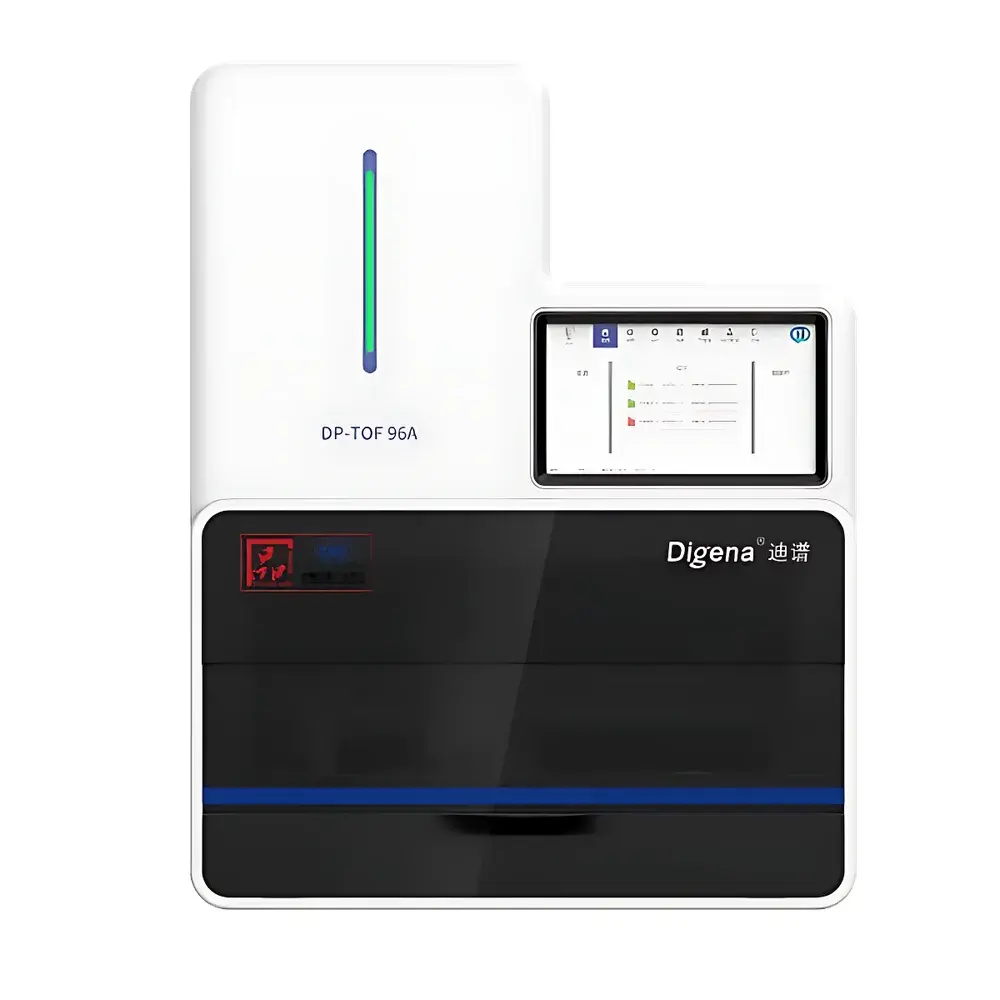
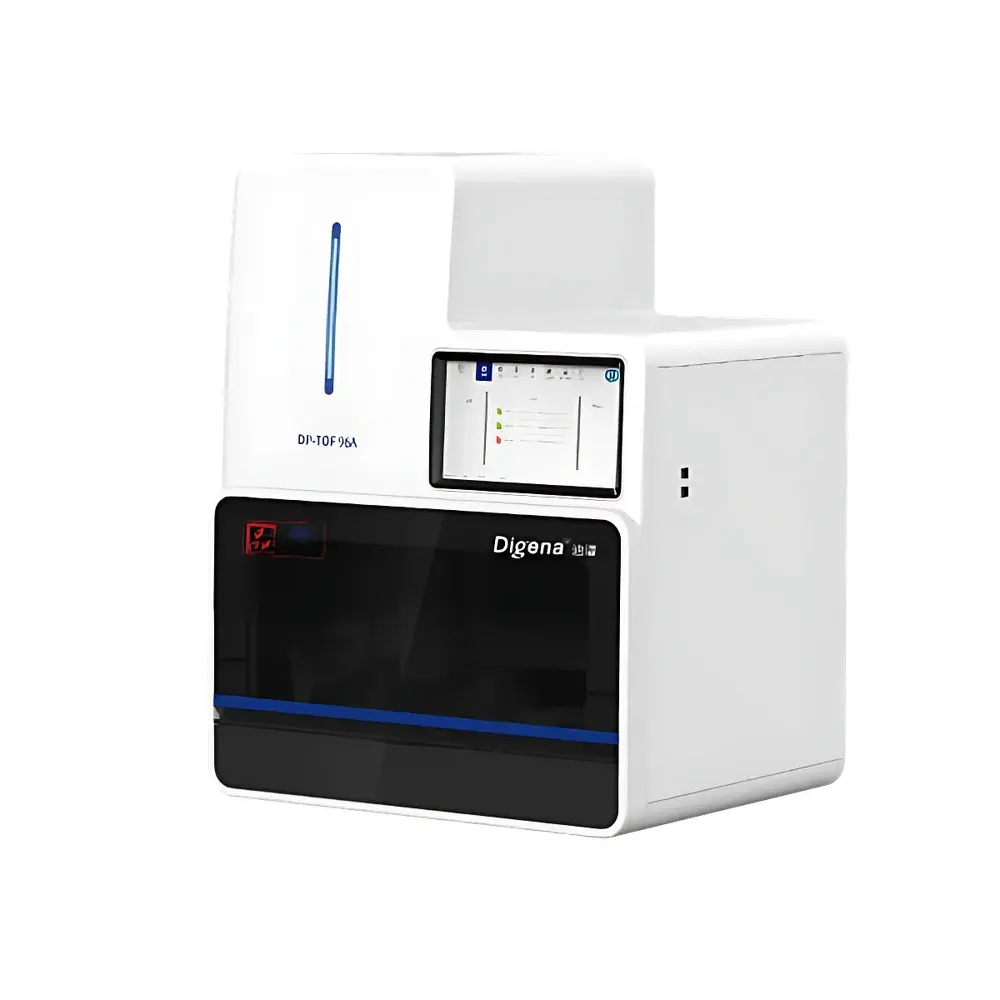
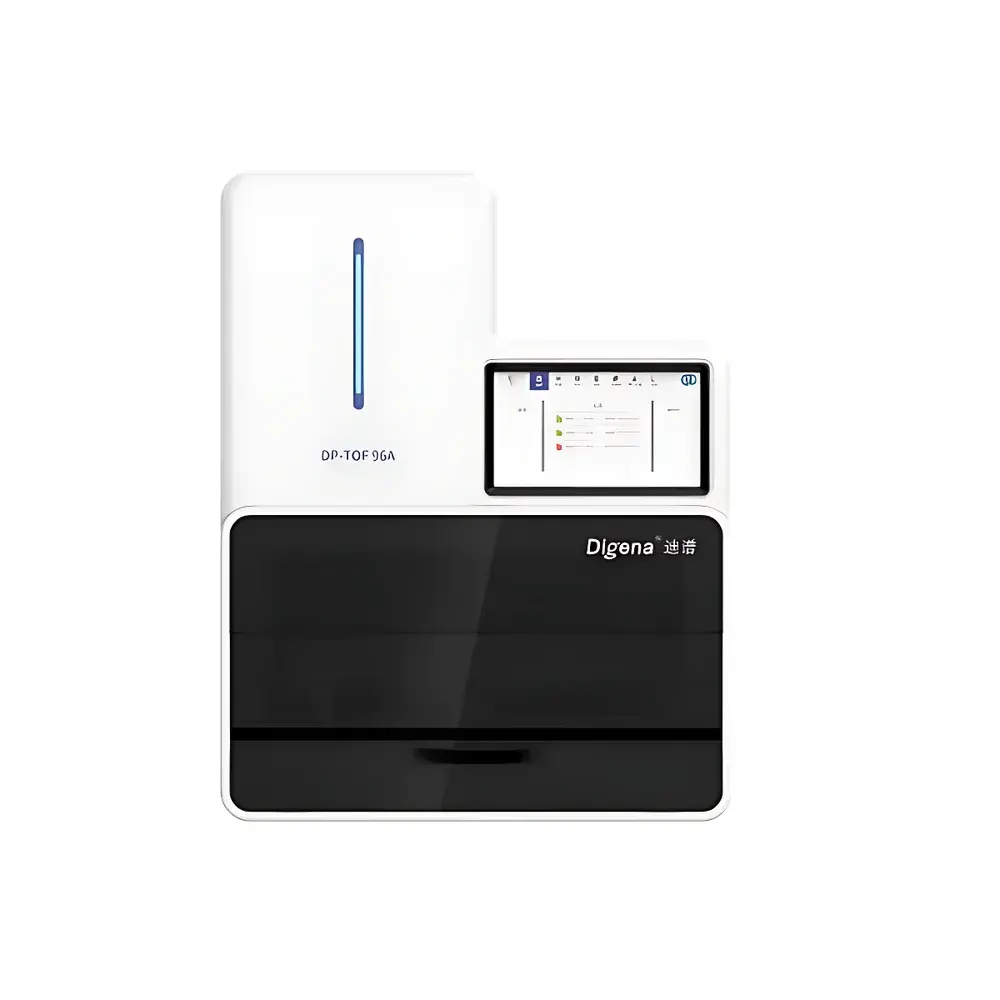
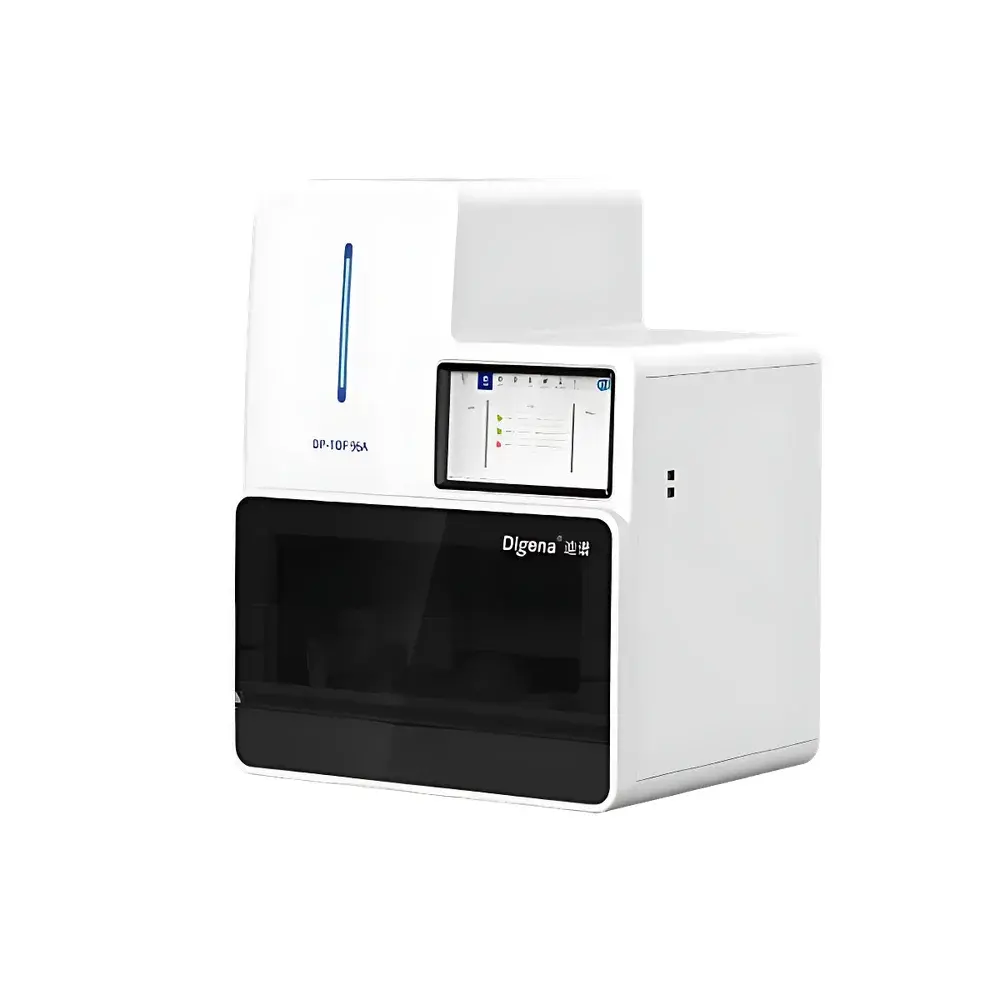
Digena DP-TOF 96A Time-of-Flight Mass Spectrometer
| Brand | Digena |
|---|---|
| Origin | Zhejiang, China |
| Manufacturer Type | OEM Manufacturer |
| Instrument Type | TOF Mass Spectrometer |
| Model | DP-TOF 96A |
| Resolution | Mass resolution >700 (FWHM at m/z 500) |
| Sensitivity | ≤0.012 µmol (for oligonucleotide standards) |
| Mass Accuracy | ≤5×10⁻⁴ relative error (m/z) |
| Mass Stability | Relative m/z drift ≤±3×10⁻⁴ over 8 h |
| Sampling Rate | 1 GHz digitizer |
| Regulatory Status | Registered with Zhejiang Medical Device Administration (Registration No.: Zhejiang MD Registration No. 20232221555) |
| Intended Use | In vitro diagnostic (IVD) applications in clinical molecular laboratories, supporting nucleic acid-based assays including SNP genotyping, methylation analysis, and pathogen identification |
Overview
The Digena DP-TOF 96A is a dedicated time-of-flight (TOF) mass spectrometer engineered for high-throughput, quantitative nucleic acid analysis in regulated clinical and translational research environments. Unlike quadrupole or ion trap platforms, the DP-TOF 96A employs orthogonal acceleration TOF technology—where ions are pulsed into a field-free flight tube and separated based on their time-of-flight proportional to the square root of their mass-to-charge ratio (m/z). This principle enables simultaneous detection of multiple analytes without scanning, delivering inherent speed, wide dynamic range, and excellent mass accuracy for short-to-medium length oligonucleotides (typically 8–50 mer). The system is purpose-built for matrix-assisted laser desorption/ionization (MALDI) workflows, integrating tightly with solid-phase sample preparation chemistries optimized for DNA extension, cleavage, and purification. Its design prioritizes reproducibility across batches and compliance with IVD quality management systems, including alignment with ISO 13485:2016 and applicable clauses of FDA 21 CFR Part 820.
Key Features
- Orthogonal-acceleration TOF architecture with 1 GHz high-speed digitizer for sub-nanosecond temporal resolution and improved peak shape fidelity
- Dedicated MALDI source optimized for low-abundance nucleic acid ionization, featuring automated laser focus calibration and energy stabilization
- Integrated contamination control: HEPA-filtered instrument enclosure, disposable sample target plates, and UV-based chamber decontamination cycles between runs
- Automated workflow engine supporting end-to-end operation—from plate loading to spectral acquisition and base-calling—with minimal manual intervention
- Embedded real-time spectral QC: automatic signal-to-noise assessment, peak width monitoring, and m/z calibration lock using internal reference standards
- Compact footprint (W × D × H: 850 × 720 × 630 mm) designed for ISO Class 7 (10,000) cleanroom-compatible laboratory spaces
Sample Compatibility & Compliance
The DP-TOF 96A accepts standard 96-well format MALDI targets pre-spotted with desalted, crystallized nucleic acid samples—compatible with common IVD enzymatic chemistries (e.g., iPLEX®, MassARRAY®-compatible extension/cleavage protocols). It supports both single-base extension (SBE) and primer extension coupled with base-specific cleavage (e.g., RNase A/H digestion). All hardware and firmware components comply with electromagnetic compatibility (EMC) per IEC 61326-1:2013 and electrical safety per IEC 61010-1:2010. The device is registered as a Class II medical device in China (Zhejiang MD Reg. No. 20232221555), and its software architecture supports audit trails, electronic signatures, and data integrity controls aligned with ALCOA+ principles. Full traceability of calibration events, maintenance logs, and user actions is retained for GLP/GMP and CAP/CLIA audit readiness.
Software & Data Management
The proprietary Digena SpectraLink™ Suite (v4.2+) provides a validated, 21 CFR Part 11-compliant environment for method setup, spectral acquisition, peak integration, genotype calling, and report generation. Key modules include: (1) Method Studio for assay configuration and internal standard assignment; (2) AutoQC Engine that flags spectra failing predefined SNR, resolution, or mass deviation thresholds; (3) Batch Manager supporting LIMS integration via ASTM E1384-compliant HL7 v2.5.1 messaging; and (4) Secure Archive Module with AES-256 encryption and immutable WORM storage options. Raw data (.dpa binary format) and processed results (.csv, .pdf, .xml) are stored with SHA-256 checksums and version-controlled metadata.
Applications
The DP-TOF 96A is routinely deployed in clinical molecular diagnostics laboratories for: multiplexed SNP genotyping in pharmacogenomics (e.g., CYP2C19, VKORC1); methylation profiling of tumor suppressor gene promoters (e.g., MGMT, CDKN2A); detection of antimicrobial resistance markers (e.g., rpoB mutations in Mycobacterium tuberculosis); and rapid identification of viral variants (e.g., SARS-CoV-2 spike protein SNPs). Its throughput—up to 96 samples per 25-minute run—supports batch testing in high-volume hospital labs and reference centers. The platform also serves academic core facilities conducting biomarker discovery studies requiring precise mass measurement of modified nucleotides (e.g., 5-methylcytosine, N6-methyladenine).
FAQ
Is the DP-TOF 96A compliant with FDA 21 CFR Part 11 requirements?
Yes—the SpectraLink™ software includes role-based access control, electronic signatures with biometric or token-based authentication, full audit trail generation, and data immutability features validated per Annex 11 and Part 11 guidance.
What sample preparation kits are validated for use with this instrument?
Digena provides CE-IVD marked nucleic acid extension and cleavage reagent kits optimized for MALDI-TOF detection; third-party kits compatible with MassARRAY® chemistry may be used subject to lab-specific verification per CLSI EP12-A2.
Does the system support quantitative analysis of nucleic acid modifications?
Yes—when paired with isotopically labeled internal standards and calibrated against certified reference materials, the DP-TOF 96A achieves quantification linearity (R² ≥ 0.995) across three orders of magnitude for methylated vs. unmethylated alleles.
What maintenance intervals are recommended for routine operation?
Laser optics cleaning and vacuum system inspection every 250 hours; reflectron alignment and detector gain calibration every 6 months; full source rebuild recommended annually or after 1,000 operational hours.
Can raw data files be exported for third-party bioinformatics analysis?
Yes—proprietary .dpa files can be converted to open-format mzML via the included Digena Converter Tool, preserving all acquisition metadata and calibration parameters required for downstream processing in tools such as OpenMS or Skyline.




