
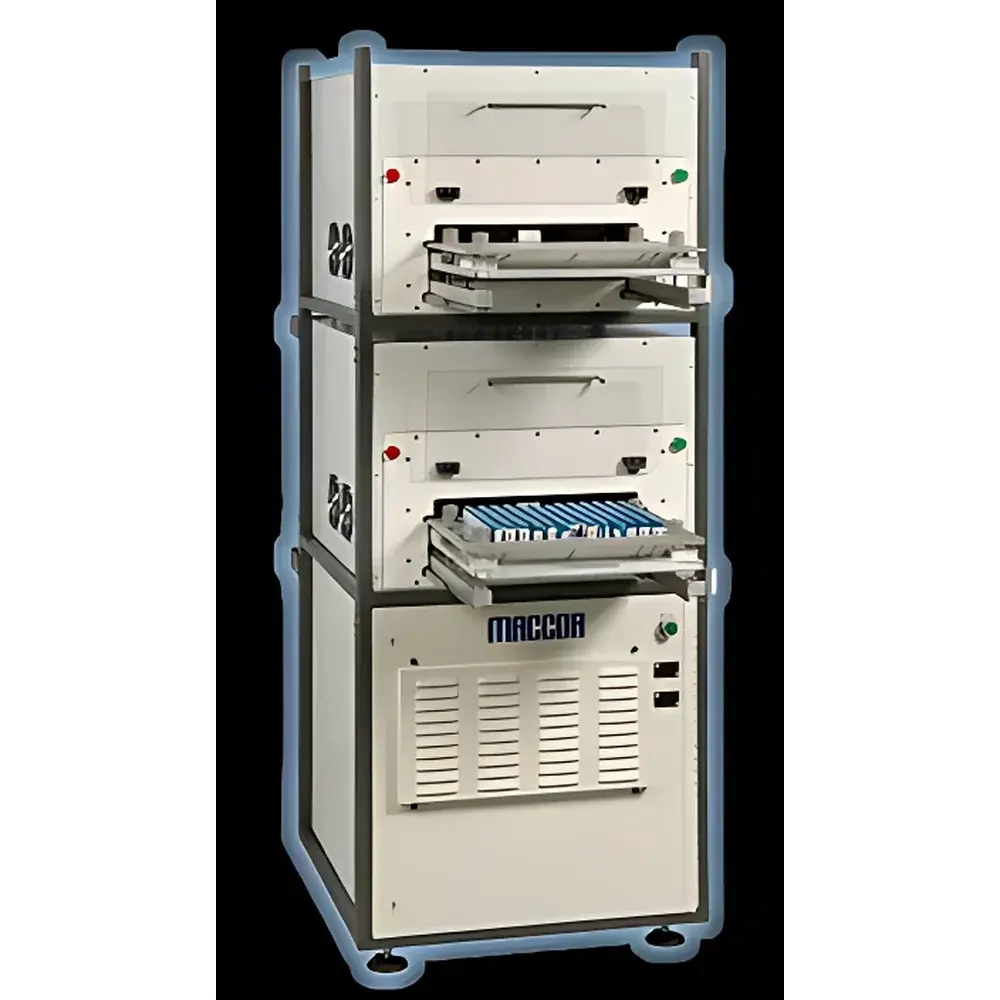
MACCOR Model 5300 Battery Formation and Testing System
| Origin | USA |
|---|---|
| Manufacturer Type | Authorized Distributor |
| Origin Category | Imported |
| Model | 5300 |
| Pricing | Upon Request |
| Channel Count | 256–100,000 (in multiples of 256) |
| Voltage Range | 0–5.0 V |
| Max Charge Current | 1.5 A or 2.5 A |
| Max Discharge Current | 2.5 A |
| Voltage Accuracy | ±5 mV |
| Current Accuracy | ±2 mA |
| Energy Accuracy | ±0.2 mAh/hour |
| Min Discharge Cutoff Voltage | 2.0 V |
| Max Charge Voltage Limit | 5.0 V |
| Termination Criteria | 16 programmable conditions including time, voltage, current, dV/dt, capacity, coulombic efficiency, and ΔV |
| Data Logging Interval | As low as 1 minute per cell |
| Independent Channel Control | Yes |
Overview
The MACCOR Model 5300 Battery Formation and Testing System is an industrial-grade, high-channel-count electrochemical test platform engineered for precision formation, cycling, and characterization of rechargeable batteries. Designed around a modular architecture with distributed channel control, the system implements galvanostatic and potentiostatic protocols in accordance with fundamental electrochemical principles—specifically, controlled-current (CC) and controlled-voltage (CV) charge/discharge profiles governed by Faraday’s laws and Ohm’s law. It supports standardized battery chemistries including lithium-ion (LiCoO₂, NMC, LFP), lithium-polymer, nickel-metal hydride (NiMH), and nickel-cadmium (NiCd). The Model 5300 is deployed in R&D laboratories, pilot-line production facilities, and quality assurance environments where traceability, repeatability, and compliance with electrochemical testing standards—including ASTM F1974 (Standard Practice for Battery Cycle Life Testing), IEC 61960, and UL 1642—are required.
Key Features
- Scalable channel architecture supporting 256 to 100,000 independent test channels—configured in increments of 256—to accommodate small-batch validation through full-scale manufacturing line integration.
- Per-channel digital signal processing with real-time feedback control ensures consistent current and voltage regulation across all active channels, minimizing inter-channel crosstalk and thermal drift.
- Dual current range options (1.5 A and 2.5 A) allow optimization between high-resolution low-current formation (e.g., SEI layer stabilization in Li-ion cells) and high-throughput capacity verification.
- Programmable termination logic includes 16 discrete criteria: time-based cutoff, voltage thresholds (min/max), current decay rate (dI/dt), capacity limits (Ah), coulombic efficiency deviation, delta-V detection, and user-defined state-of-charge (SOC) windows.
- High-fidelity analog-to-digital conversion delivers ±5 mV voltage accuracy and ±2 mA current accuracy—calibrated traceably to NIST-traceable references—and supports energy calculation accuracy of ±0.2 mAh/hour over extended test durations.
- Robust hardware design features isolated channel power stages, redundant thermal monitoring, and fail-safe discharge termination to meet functional safety requirements aligned with ISO 13849-1 (PL e) for industrial equipment.
Sample Compatibility & Compliance
The Model 5300 accommodates cylindrical (18650, 21700), prismatic, pouch, and coin-cell formats via configurable fixture interfaces and optional cell-contact modules. All hardware and firmware comply with CE marking directives (EMC 2014/30/EU, LVD 2014/35/EU) and RoHS 2011/65/EU. Software operation adheres to FDA 21 CFR Part 11 requirements for electronic records and signatures when configured with audit trail, user authentication, and electronic signature modules. Test protocols may be structured to satisfy GLP and GMP documentation workflows, including automated report generation compliant with ISO/IEC 17025 calibration record templates.
Software & Data Management
The system operates under MACCOR’s proprietary TestPoint™ software—a Windows-based application supporting script-driven test sequencing, real-time multi-parameter visualization (voltage, current, temperature, dV/dt, resistance), and hierarchical data export in CSV, Excel, and HDF5 formats. Each channel maintains autonomous logging at user-selectable intervals down to 1-minute resolution, with timestamped metadata (operator ID, batch ID, environmental conditions) embedded per record. Database integrity is enforced via ACID-compliant SQLite or optional Microsoft SQL Server backends. Raw data files include cryptographic checksums for forensic validation, and software update history is retained in immutable logs for regulatory review.
Applications
- Lithium-ion cell formation: SEI layer development, electrolyte wetting verification, and initial capacity stabilization under CC-CV protocols.
- Production line QA/QC: End-of-line capacity grading, internal resistance screening, and cycle life sampling per AEC-Q200 or JIS C 8714 specifications.
- Material R&D: Electrode formulation evaluation, binder performance assessment, and electrolyte additive screening via differential voltage analysis (dV/dQ).
- Battery module pre-qualification: Cell matching based on capacity, impedance, and voltage hysteresis prior to pack assembly.
- Regulatory certification testing: UN 38.3 thermal, vibration, and altitude simulation preconditioning cycles; IEC 62133 safety compliance cycling.
FAQ
What battery chemistries does the Model 5300 support?
It supports lithium-ion, lithium-polymer, nickel-metal hydride, and nickel-cadmium chemistries, with protocol flexibility for emerging systems such as solid-state and lithium-sulfur.
Can test parameters be changed during an ongoing cycle?
Yes—dynamic parameter modification is supported via software API or manual override without interrupting channel operation or data continuity.
Is remote monitoring and control available?
Yes—the system integrates with Ethernet/IP and Modbus TCP protocols, enabling integration into factory SCADA systems and secure remote access via TLS-encrypted web interface.
How is calibration maintained across large channel counts?
Each 256-channel rack includes integrated reference standards and auto-calibration routines executed during idle periods; NIST-traceable calibration certificates are issued per rack annually.
Does the system support custom termination algorithms?
Yes—TestPoint™ allows Python-based scripting for user-defined termination logic, including machine learning–informed end-of-charge detection using real-time dV/dQ slope analysis.



