
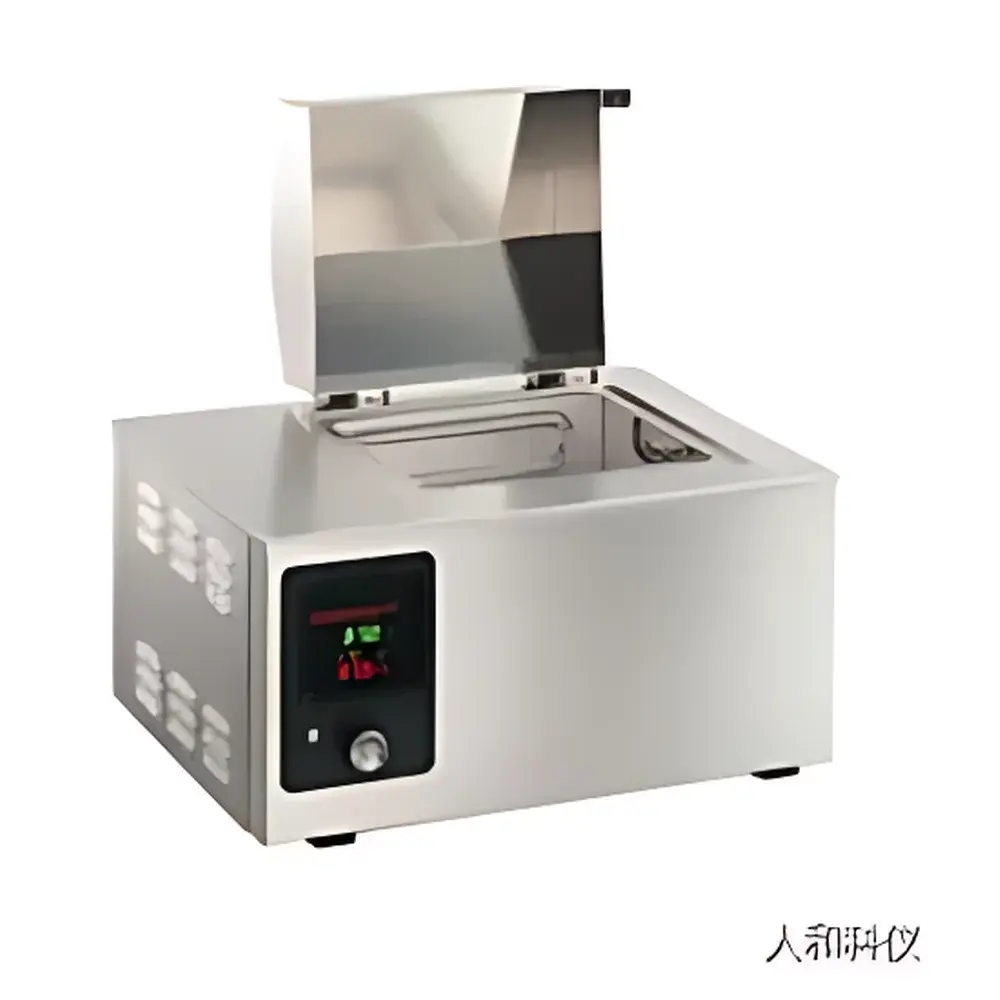
MEMMERT WNB7 Precision Water Bath
| Brand | MEMMERT |
|---|---|
| Origin | Germany |
| Model | WNB7 |
| Temperature Range | 10–95 °C (with dedicated boiling mode at 100 °C) |
| Display & Setpoint Resolution | 0.1 °C |
| Heating Power | 1200 W |
| Bath Capacity | 7 L |
| Internal Dimensions (L×W×H) | 240 × 210 × 140 mm |
| External Dimensions (with flat lid) | 468 × 356 × 238 mm |
| External Dimensions (with gabled lid) | 468 × 356 × 337 mm |
| Construction | Stainless steel inner bath and outer housing |
| Safety Certifications | CE-compliant, tested to EN 61010-1 and EN 61326-1 |
| Overtemperature Protection | Dual (B-type) or Triple (E-type) independent safety circuits |
| Timer Range | B-type: 1 min – 99 h 59 min |
| E-type | 1 min – 999 h |
| Temperature Sensor | Four-wire Pt100 (1 sensor standard on B-type |
| Optional Accessories | Flat/gabled lids, orbital shaker module, conical flask holders (100–500 mL), tube racks (14.5–32 mm diameter), liquid-level controller, adjustable-height stands |
Overview
The MEMMERT WNB7 Precision Water Bath is a laboratory-grade thermostatic immersion system engineered for stable, reproducible temperature control in routine and regulated applications. Operating on the principle of convective heat transfer through a thermally homogeneous water medium, the WNB7 maintains setpoint accuracy within ±0.1 °C across its operational range of 10–95 °C — with an additional dedicated 100 °C boiling mode for rapid solvent evaporation or sterilization support. Its stainless steel bath (7 L capacity, 240 × 210 × 140 mm internal volume) ensures corrosion resistance, mechanical durability, and compatibility with aqueous and mild chemical environments common in pharmaceutical QC, clinical diagnostics, molecular biology, and synthetic chemistry workflows. Designed and manufactured in Germany, the unit complies with IEC/EN 61010-1 (safety requirements for electrical equipment) and EN 61326-1 (EMC for laboratory instrumentation), and carries full CE marking for use in EU and internationally harmonized regulatory settings.
Key Features
- High-precision four-wire Pt100 temperature sensing: Standard on all models; E-type variants include dual independent Pt100 probes for redundancy and cross-verification of thermal uniformity.
- Adaptive PID temperature regulation with real-time self-diagnostic monitoring — continuously verifies sensor integrity, heater functionality, and control loop stability.
- Dual- or triple-stage overtemperature protection architecture: B-type units integrate electronic (ΔT = +10 °C above setpoint) and mechanical (TB cutoff at +30 °C above bath max rating) safeguards; E-type adds user-configurable electronic limit (TWW/TWB) for application-specific thermal boundaries.
- Intuitive LED interface with alarm indication: Supports simultaneous display of actual temperature, setpoint, elapsed time, and active operational mode (Start, Delay Start, Hold, or Time-Dependent Hold).
- Extended timer capability: B-type supports up to 99 h 59 min; E-type extends to 999 h — enabling unattended overnight or multi-day incubation, dissolution testing, or enzymatic reaction profiling.
- Robust 1200 W heating system with optimized thermal distribution: Ensures rapid equilibration (<15 min from 20 °C to 37 °C) and minimal spatial gradient (<±0.3 °C across bath volume per ASTM E1112).
Sample Compatibility & Compliance
The WNB7 accommodates a broad spectrum of sample vessels including standard glassware (Erlenmeyer flasks up to 500 mL, test tubes up to 32 mm diameter), microcentrifuge tubes, and sealed reaction vials. Optional accessories — such as conical flask holders (12×100 mL, 6×200/300 mL, 5×500 mL), modular tube racks (up to 110 positions for 14.5 mm tubes), and orbital shaker integration — extend usability to cell culture warming, enzyme kinetics, and gentle agitation protocols. The stainless steel construction meets ISO 8573-1 (purity class 4) surface finish standards for cleanroom-adjacent labs and satisfies material traceability requirements under GMP Annex 15 and USP . All firmware and hardware design documentation is retained for audit readiness in FDA 21 CFR Part 11–aligned environments.
Software & Data Management
While the WNB7 operates as a standalone instrument, its E-type controller supports optional RS232/RS485 serial interface (via accessory module) for integration into centralized lab management systems. Logged data — including timestamped temperature readings, setpoint changes, alarm events, and timer status — can be exported in CSV format for traceability. The embedded event log retains ≥1000 entries with automatic timestamping, supporting GLP-compliant record retention without external software dependency. Firmware updates are performed via secure USB interface, with version history and checksum verification maintained per ICH GCP E6(R3) Annex 11 guidance.
Applications
- Pharmaceutical quality control: Dissolution testing (USP ), stability studies (ICH Q1A), and reagent pre-warming prior to HPLC or ELISA assay setup.
- Clinical and diagnostic laboratories: Serum sample thawing, antigen retrieval in immunohistochemistry, and controlled DNA denaturation/annealing steps.
- Academic and industrial research: Enzyme activity assays, polymerase chain reaction (PCR) component equilibration, and low-temperature crystallization trials.
- Chemistry and materials science: Solvent reflux support, hydrolysis reactions, and viscosity calibration of reference oils using capillary viscometers.
- Biotechnology: Cell line maintenance during transfection protocols, hybridization buffer conditioning, and gel electrophoresis buffer pre-heating.
FAQ
What is the minimum ambient temperature required for stable operation at 10 °C?
The WNB7 requires ambient conditions ≥5 °C below the target setpoint; therefore, operation at 10 °C necessitates an ambient temperature ≤5 °C.
Can the WNB7 be used with oil or other non-aqueous media?
No — the WNB7 is validated exclusively for water-based operation. For oil or silicone fluid applications, MEMMERT’s OB7 oil bath series is recommended.
Is the shaker module compatible with all lid configurations?
The orbital shaker accessory requires the gabled (V-shaped) lid (order code L1) and is not supported with the flat lid configuration.
Does the WNB7 support external temperature probe input for vessel-specific monitoring?
No — the unit relies solely on integrated Pt100 bath sensors. External probe input is not available; however, E-type models’ dual-sensor architecture permits internal spatial validation.
How often should the water bath be cleaned and descaled?
MEMMERT recommends weekly visual inspection, biweekly draining and wiping, and monthly descaling with citric acid solution (10 g/L, 60 °C, 30 min) when operated above 60 °C or with hard water sources.



