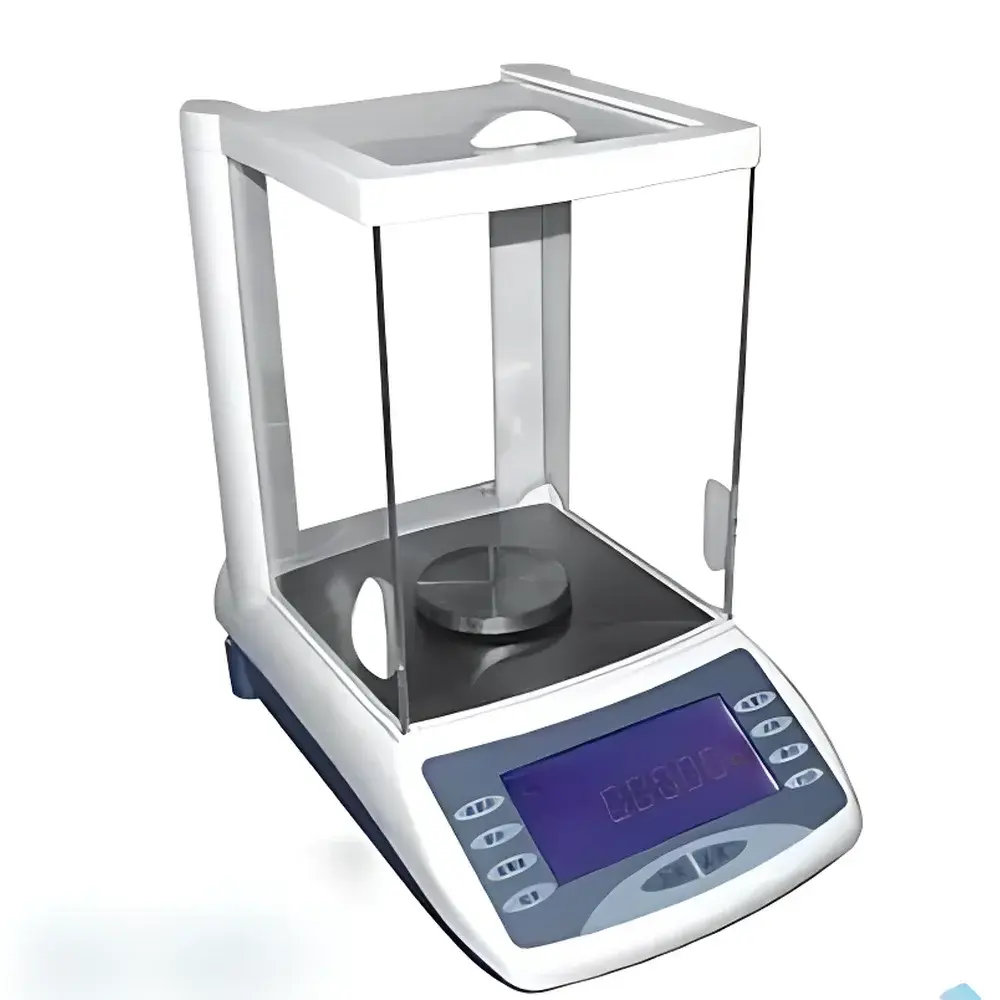
FA2204B Electronic Analytical Balance
| Capacity | 220 g |
|---|---|
| Readability | 0.1 mg |
| Pan Size | 80 mm diameter |
| Clear Height under Draft Shield | 240 mm |
| Dimensions (W×D×H) | 350 × 215 × 340 mm |
| Net Weight | 7.5 kg |
| Power Supply | 220 V, 50 Hz |
| Display | Backlit LCD (120 × 55 mm) |
| Interface | RS232 standard port |
| Calibration | Internal motorized auto-calibration with external calibration weight |
| Environmental Protection | Four-sided antistatic coated glass draft shield |
| Weighing Units | g, oz, ct |
| Sensor Technology | Electromagnetic force compensation (EMFC) principle |
Overview
The FA2204B Electronic Analytical Balance is a high-precision laboratory weighing instrument engineered for reproducible mass measurement in regulated and research-intensive environments. Built upon the electromagnetic force compensation (EMFC) principle, it achieves stable, drift-free operation by dynamically balancing the gravitational force on the sample against a precisely controlled electromagnetic counterforce—eliminating mechanical wear and enabling long-term metrological stability. With a maximum capacity of 220 g and readability of 0.1 mg (100 µg), the balance meets Class I accuracy requirements per OIML R 76-1 and complies with ISO/IEC 17025 calibration traceability frameworks. Its robust architecture includes an integrated motorized auto-calibration system triggered by temperature drift or time-based schedules, ensuring consistent performance across daily operational cycles without manual intervention.
Key Features
- Electromagnetic force compensation sensor technology—provides zero-mechanical-hysteresis response and superior linearity over full range
- Motorized internal auto-calibration with external reference weight—supports scheduled, temperature-triggered, and user-initiated recalibration
- Four-sided antistatic coated glass draft shield—minimizes electrostatic interference while maintaining optical clarity and ergonomic access
- Large backlit LCD display (120 × 55 mm)—enables clear visualization of weight, unit, status, and real-time stability indicators under varied ambient lighting
- RS232 serial interface—facilitates direct data export to printers, LIMS, or laboratory information systems; compatible with ASCII protocol for seamless integration
- Multi-unit weighing support—switchable between grams (g), ounces (oz), and carats (ct) without recalibration or resolution loss
- Full-range tare function with memory retention—preserves tare value across power cycles when enabled via configuration mode
- Four-level shock absorption system—dampens floor vibrations and acoustic disturbances typical in shared lab spaces or near centrifuges and HVAC units
Sample Compatibility & Compliance
The FA2204B accommodates a broad spectrum of solid and powdered samples—including pharmaceutical actives, reference standards, catalysts, and micro-scale reaction products—within its 80 mm diameter stainless steel weighing pan and 240 mm vertical clearance under the draft shield. Its design conforms to Good Laboratory Practice (GLP) and Good Manufacturing Practice (GMP) documentation requirements: all calibrations are timestamped and logged internally, with optional audit trail export via RS232. While not inherently 21 CFR Part 11 compliant out-of-the-box, the balance supports ALCOA+ data integrity principles when paired with validated third-party data capture software. It satisfies ISO 9001 quality management system inputs for weighing process control and aligns with ASTM E898–22 for analytical balance verification protocols.
Software & Data Management
No proprietary software is bundled; however, the RS232 interface operates in standard asynchronous mode (9600 baud, 8N1, no handshake), allowing compatibility with generic terminal emulators, Excel-based macros, or enterprise-grade LIMS platforms. All weighing events—including gross, net, tare, calibration logs, and error codes—are transmitted as plain-text ASCII strings with configurable prefixes (e.g., “WGT:”, “CAL:”). Optional firmware updates may be applied via manufacturer-provided utilities to enhance communication reliability or extend logging depth. Internal non-volatile memory retains up to 100 calibration records and 200 weighing sessions, accessible through menu navigation for on-device review prior to export.
Applications
The FA2204B serves critical roles in quality control laboratories performing USP balance verification, raw material assay quantification, and formulation batch release testing. It is routinely deployed in university chemistry departments for stoichiometric reagent preparation, in materials science labs for nanoparticle yield determination, and in environmental testing facilities for filter-weight differential analysis (e.g., PM2.5 gravimetric sampling). Its thermal stability and anti-static shielding make it suitable for humidity-sensitive operations such as hygroscopic standard handling or low-mass moisture content determination using loss-on-drying workflows.
FAQ
What calibration standards are required for routine verification?
A certified Class E2 or better 200 g reference weight is recommended for daily performance checks per USP . Full calibration requires the supplied external 200 g weight and must be performed at ambient temperature equilibrium (±0.5 °C over 2 hours).
Is the balance suitable for use in ISO Class 5 cleanrooms?
Yes—the sealed draft shield, static-dissipative housing, and absence of moving parts beyond the calibration motor meet particle generation thresholds for ISO 14644-1 Class 5 when operated with appropriate gowning and airflow protocols.
Can the RS232 output be configured for automatic print-on-stable?
Yes—via parameter P32 in the service menu, users can enable auto-print mode that triggers data transmission only after stability confirmation (±0.0001 g for ≥2 seconds).
Does the balance support GLP-compliant audit trails?
Internal logs include date/time stamps, operator ID (if entered), event type, and measured values—but full electronic signature and change-control functionality require integration with validated external data management software.
What is the warm-up time to achieve specified repeatability?
Minimum 30 minutes at stable ambient temperature (20–25 °C, <60% RH); optimal metrological performance is achieved after 60 minutes of continuous operation.