
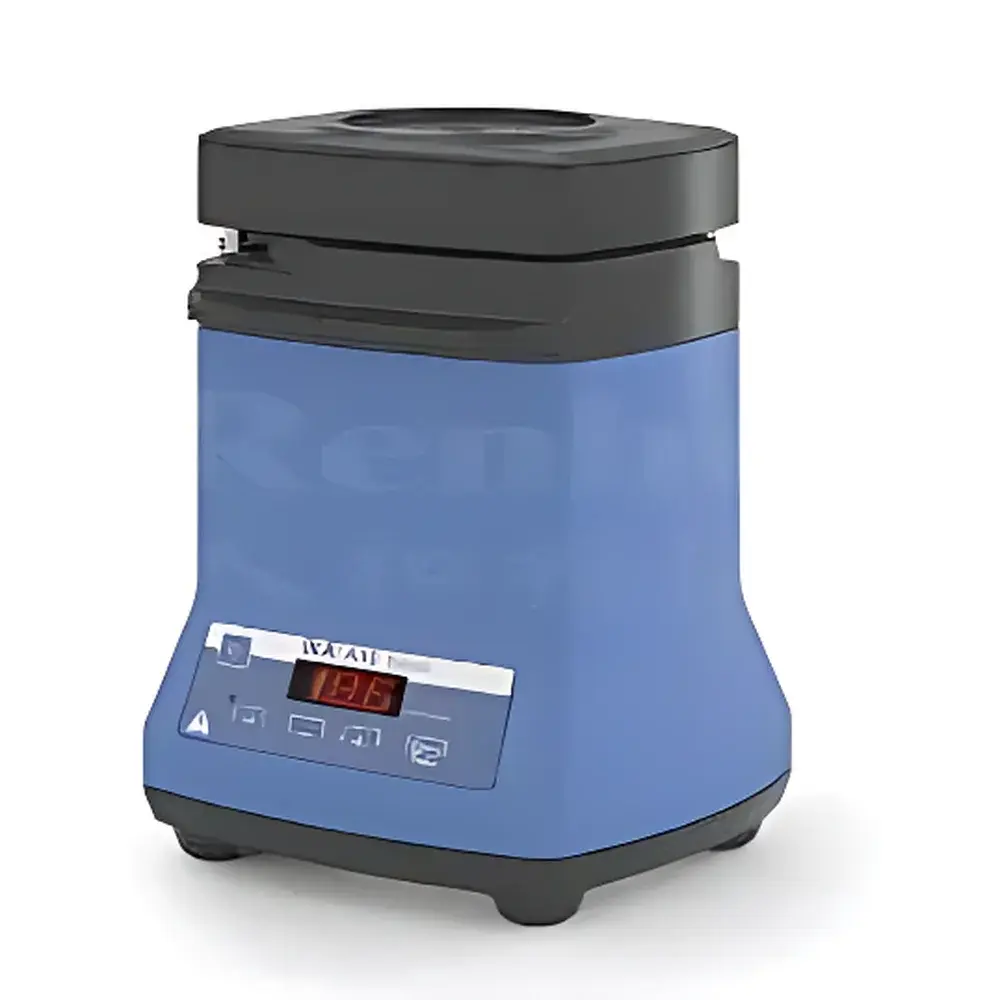
IKA A 10 basic Batch Grinder
| Brand | IKA |
|---|---|
| Origin | Germany |
| Model | A 10 basic |
| Grinding Type | Batch |
| Motor Input Power | 300 W |
| Motor Output Power | 240 W |
| Max Speed | 25,000 rpm |
| Speed Tolerance | ±500 rpm |
| Max Peripheral Speed | 73 m/s |
| Max Feed Hardness | 5 Mohs |
| Max Feed Size | 6 mm |
| Final Particle Size | 125–250 µm |
| Minimum Output Size | >0.5 mm |
| Batch Capacity | 50 mL |
| Grinding Chamber Material | Stainless Steel 1.4301 |
| Cutting/Impact Blade Material | Stainless Steel 1.4034 |
| Cooling Options | Water, Dry Ice, Liquid Nitrogen |
| Duty Cycle | 5 min ON / 10 min OFF |
| Dimensions (W×H×D) | 130 × 250 × 145 mm |
| Weight | 2.9 kg |
| Ambient Temperature Range | 5–40 °C |
| Relative Humidity Limit | 80 % |
| Ingress Protection | IP 41 (DIN EN 60529) |
| Voltage | 220–240 V AC |
| Frequency | 50/60 Hz |
| Safety Interlock | Yes |
| Timer Display | Digital |
| Drive Type | Brushless Electronic Motor |
| Lid Locking Mechanism | Snap-fit Quick-Release |
| Blade Exchange | Tool-free |
| Compliance | CE, RoHS, IEC 61000-6-3, IEC 61000-6-4 |
Overview
The IKA A 10 basic is a compact, safety-engineered batch grinder designed for reproducible size reduction of heterogeneous laboratory samples under controlled conditions. It operates on a dual mechanical principle—combining high-speed impact and shear forces generated by a rotating stainless steel blade within a fixed grinding chamber. The rotor achieves up to 25,000 rpm, delivering a peripheral speed of 73 m/s, sufficient to fracture brittle materials (up to 5 Mohs hardness) while accommodating soft, fibrous, oily, or aqueous matrices. Unlike continuous-feed grinders, the A 10 basic processes discrete sample volumes (up to 50 mL per cycle), ensuring consistent energy input and minimizing cross-contamination between batches. Its design prioritizes operator safety through a certified mechanical interlock system: motor activation is only possible when the lid is fully engaged, and the chamber cannot be opened until rotational motion has ceased completely. This architecture complies with essential requirements of EN 61000-6-3 (EMC emission) and EN 61000-6-4 (EMC immunity), as well as RoHS and CE directives.
Key Features
- Brushless electronic motor ensures extended service life, reduced acoustic noise (<75 dB(A) at 1 m), and stable speed control without carbon brush wear.
- Digital timer with real-time display enables precise control over grinding duration (0–999 s), supporting method standardization across users and labs.
- Quick-release snap-fit lid mechanism allows tool-free access to the grinding chamber—reducing setup time and improving workflow efficiency.
- Interchangeable blade configurations—including standard impact blades (A10.1) and reduced-volume cutting inserts—permit optimization for sample type and target particle distribution.
- Integrated cooling interface supports three thermal management modes: ambient air, external water circulation, or cryogenic treatment using dry ice or liquid nitrogen—critical for thermolabile or low-melting-point materials.
- Robust construction using DIN 1.4301 (AISI 304) stainless steel for the grinding chamber and DIN 1.4034 (martensitic stainless) for blades ensures corrosion resistance, mechanical durability, and compatibility with cleaning validation protocols.
Sample Compatibility & Compliance
The A 10 basic accommodates a broad spectrum of sample categories: hard and brittle substances (e.g., minerals, ceramics, pharmaceutical tablets), soft tissues, plant fibers, polymers, and moisture-rich biological matrices. Its maximum feed size of 6 mm and final particle size range of 125–250 µm make it suitable for preparatory grinding prior to analytical techniques such as X-ray fluorescence (XRF), inductively coupled plasma (ICP) analysis, or sieve-based particle size distribution assessment. All operational parameters—including duty cycle (5 min ON / 10 min OFF) and thermal limits—are aligned with ISO 17025-relevant equipment qualification criteria. While the unit does not feature RS-232, USB, or analog outputs, its mechanical repeatability and physical traceability (via digital timer logs and manual SOP documentation) support GLP-compliant workflows where electronic data capture is not mandated.
Software & Data Management
The IKA A 10 basic operates as a standalone electromechanical instrument without embedded firmware, network connectivity, or proprietary software. Data integrity relies on user-recorded metadata—including batch ID, start/stop times, blade type, cooling mode, and visual inspection notes—entered into laboratory notebooks or LIMS-compatible templates. For laboratories requiring audit trails compliant with FDA 21 CFR Part 11, integration is achieved externally via time-stamped video recording of operation cycles or synchronized environmental monitoring systems. No calibration certificate is supplied ex-factory; however, speed verification can be performed using an optical tachometer traceable to national standards, and routine performance checks (e.g., grind time vs. particle size output) are recommended per ASTM E11-22 (Standard Specification for Woven Wire Test Sieve Cloth and Test Sieves).
Applications
- Preparation of homogenized reference materials for elemental analysis (XRF, ICP-OES/MS).
- Reduction of tablet or capsule fragments for content uniformity testing per USP <905>.
- Size reduction of botanical samples prior to extraction or HPLC analysis.
- Fragmentation of polymer pellets for melt flow index (MFI) sample conditioning.
- Cryogenic grinding of frozen tissue for proteomic or genomic workflows requiring minimal thermal degradation.
- Quality control grinding of ceramic or mineral powders in raw material certification protocols.
FAQ
Is the A 10 basic suitable for grinding heat-sensitive samples?
Yes—when equipped with dry ice or liquid nitrogen cooling channels, the unit maintains sub-zero grinding temperatures, suppressing thermal degradation in proteins, enzymes, or volatile organics.
Can the grinding chamber be sterilized?
The stainless steel chamber (1.4301) is autoclavable at 121 °C for 20 minutes; however, blade assemblies must be disassembled and cleaned separately to preserve edge geometry and balance.
What maintenance is required for long-term reliability?
Monthly inspection of blade sharpness and chamber sealing surfaces is advised. Lubrication is not required—the brushless motor contains no grease points. Replace blades after ~200 grinding cycles involving abrasive materials.
Does IKA provide application support for method development?
IKA’s technical documentation includes validated protocols for common matrices (e.g., soil, feed, pharmaceutical excipients); additional guidance is available via regional application specialists upon request.
How is compliance with ISO/IEC 17025 addressed during instrument qualification?
The A 10 basic supports installation qualification (IQ) via dimensional verification and electrical safety checks, operational qualification (OQ) via speed accuracy and interlock function testing, and performance qualification (PQ) using certified reference materials with known particle size distributions.



