
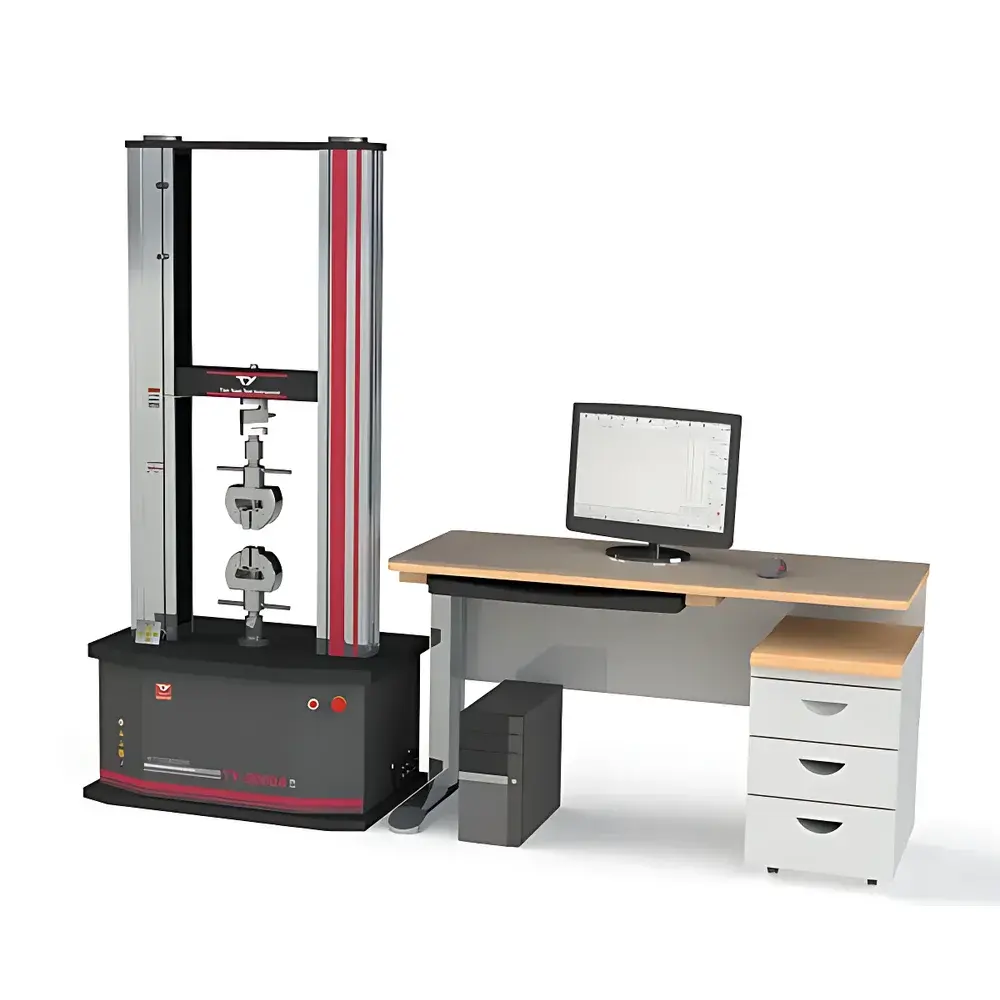
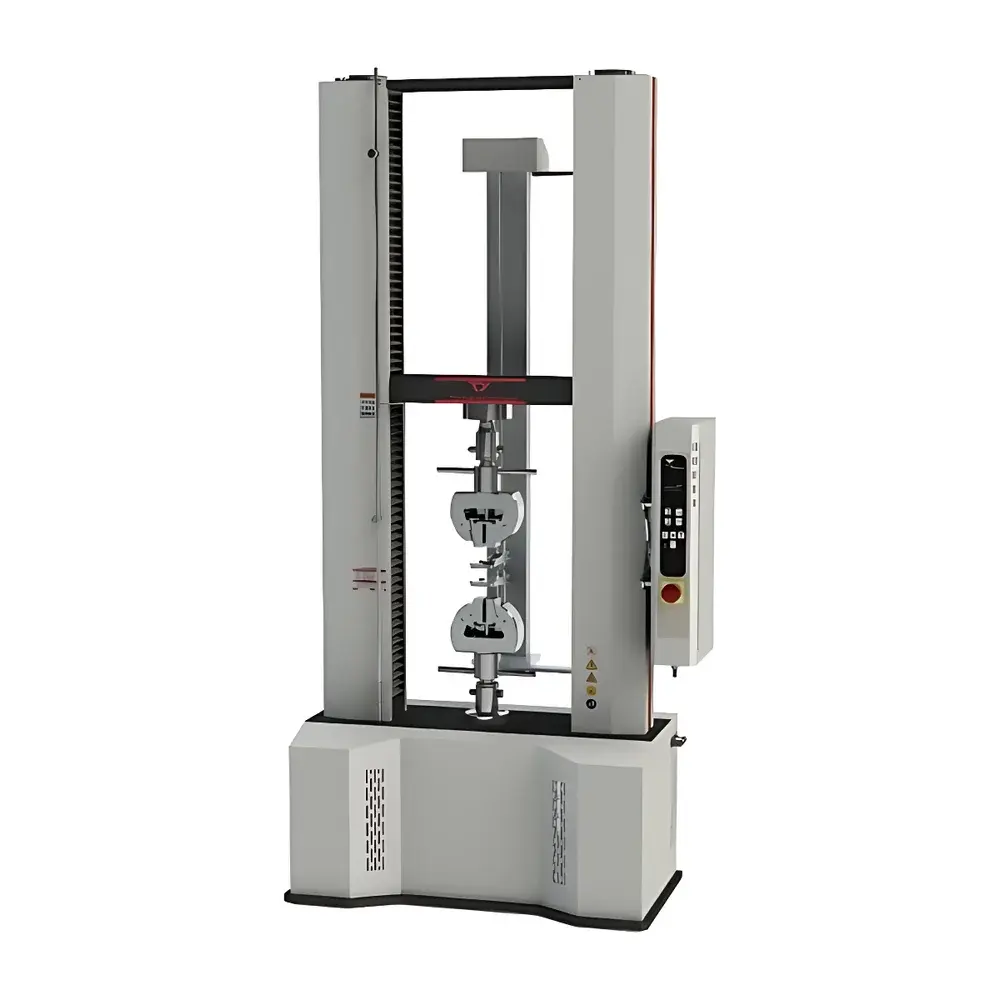
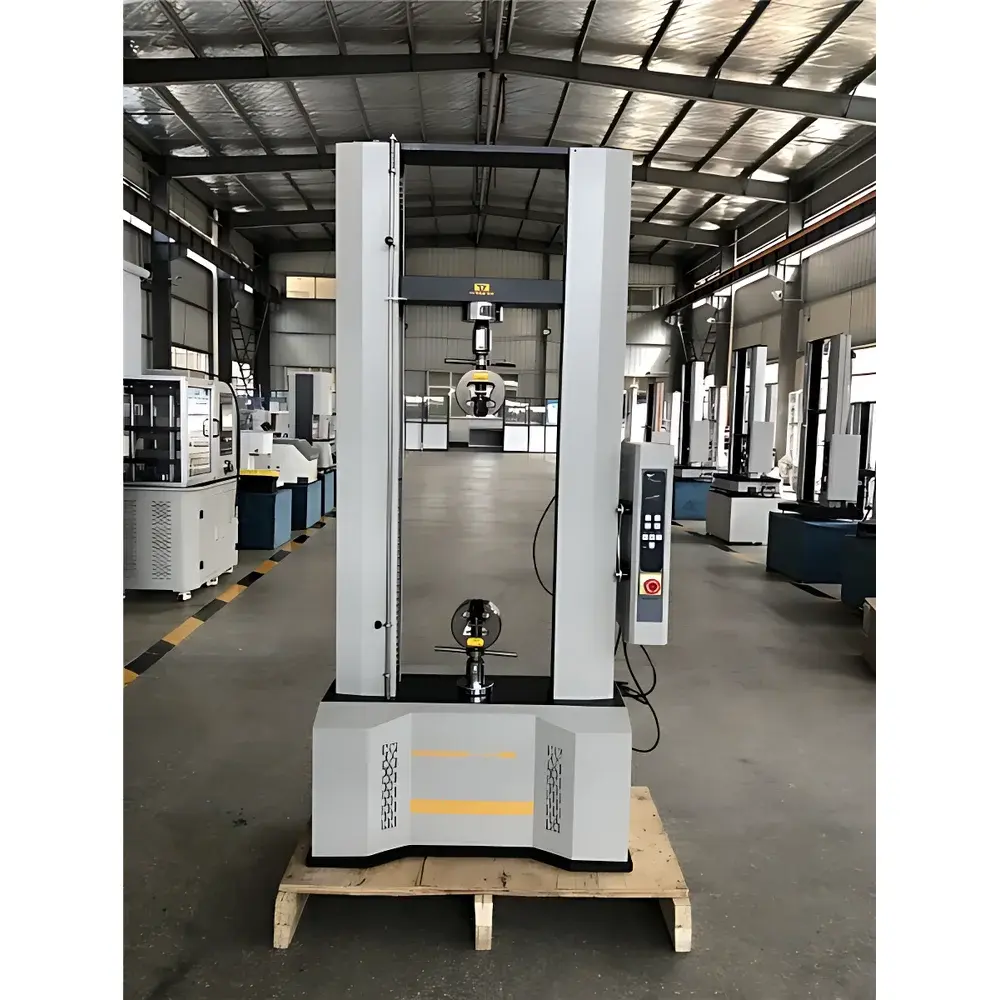
TianYuan TY8000-B CRE Constant Rate of Extension Tensile Tester
| Brand | TianYuan |
|---|---|
| Origin | Jiangsu, China |
| Manufacturer Type | Direct Manufacturer |
| Regional Category | Domestic (China) |
| Model | TY8000-B CRE |
| Instrument Type | Electromechanical Universal Testing Machine |
| Load Capacity Options | 20 kN, 30 kN, 50 kN |
| Unit Conversion | kg, lb, N, kN |
| Load Resolution | 1/60,000 FS |
| Load Accuracy | ≤ ±0.8% FS |
| Maximum Travel (Excl. Fixtures) | 1000 mm |
| Effective Test Width | 420 mm |
| Speed Range | 0.1–500 mm/min |
| Speed Accuracy | ≤ ±0.8% |
| Displacement Resolution | 0.001 mm |
| Drive System | Servo Motor + Planetary Reducer + Ball Screw |
| Dimensions (W×D×H) | 920 × 430 × 1850 mm |
| Weight | 260 kg |
| Power Supply | 220 V ±10%, 50 Hz, 800 W |
| Compliant Standards | ASTM D638, ASTM D790, ASTM D3763, ISO 527-1, ISO 178, ISO 6892-1, GB/T 528–1998, GB/T 529–1999, GB/T 6344–2008, JIS K 6251, DIN 53455 |
Overview
The TianYuan TY8000-B CRE Constant Rate of Extension Tensile Tester is an electromechanical universal testing machine engineered for high-reproducibility mechanical characterization of metallic and non-metallic materials under uniaxial loading conditions. Operating on the fundamental principle of constant crosshead displacement rate (CRE), this system applies controlled, linearly increasing separation between grips to generate stress–strain responses in accordance with internationally recognized quasi-static test protocols. Designed for compliance with ASTM, ISO, GB/T, JIS, and DIN standards—including ASTM D638 (tensile properties of plastics), ISO 527-1 (determination of tensile properties), and GB/T 528–1998 (rubber vulcanized or thermoplastic—determination of tensile stress–strain properties)—the TY8000-B delivers traceable, audit-ready data for R&D laboratories, quality control departments, and certification bodies engaged in material qualification, process validation, and regulatory submission.
Key Features
- Modular load frame architecture supporting selectable capacities of 20 kN, 30 kN, and 50 kN—optimized for structural integrity and minimal deflection during high-force testing.
- Precision servo-motor-driven actuation system integrated with planetary reduction gearbox and preloaded ball screw transmission—ensuring smooth motion control, low backlash (<0.02°), and long-term repeatability.
- High-resolution displacement measurement (0.001 mm) and load resolution up to 1/60,000 full scale, enabling accurate detection of yield onset, necking behavior, and fracture energy absorption.
- Wide speed range (0.1–500 mm/min) with closed-loop velocity feedback and ≤±0.8% speed accuracy—suitable for both slow-rate creep evaluation and rapid tensile-to-failure protocols.
- Robust 420 mm effective test width and 1000 mm maximum travel (excluding fixtures) accommodate standardized specimens per ASTM E8/E8M and ISO 6892-1, as well as custom geometries for composite laminates or elastomeric components.
- Multi-unit support (N, kN, kgf, lbf) with real-time conversion and SI-traceable calibration paths aligned with ISO/IEC 17025 requirements.
Sample Compatibility & Compliance
The TY8000-B accommodates a broad spectrum of specimen types—including metallic rods, polymer films, rubber sheets, textile yarns, geotextiles, adhesives, biomedical sutures, and fiber-reinforced composites—using interchangeable wedge-action, pneumatic, or hydraulic grips. Its mechanical design satisfies essential safety and metrological criteria for GLP-compliant environments, including mechanical interlocks, emergency stop circuitry per IEC 60204-1, and load cell calibration traceability to national standards (e.g., CNAS-accredited reference laboratories). All test configurations adhere to clause-specific requirements of ASTM D3763 (impact resistance), ISO 178 (flexural properties), and GB/T 6344–2008 (foam tensile testing), ensuring data acceptability in third-party audits and regulatory submissions.
Software & Data Management
Controlled via Windows-based software compatible with Windows 10/11 and Visit platform extensions, the TY8000-B supports automated test sequencing, real-time curve overlay, and post-test reprocessing—including curve smoothing, modulus calculation (secant/tangent), yield point identification (0.2% offset), and energy integration (area under stress–strain curve). Raw data export is available in CSV, Excel, and XML formats; graphical outputs include load vs. displacement, stress vs. strain, load vs. time, and extension vs. time plots. The software maintains full audit trails per FDA 21 CFR Part 11 requirements—recording user actions, parameter changes, calibration events, and test result modifications—with electronic signature capability and role-based access control.
Applications
- Tensile property evaluation of thermoplastics, thermosets, and elastomers per ASTM D638 and ISO 527-2.
- Compression testing of foams, ceramics, and honeycomb structures per ASTM D3574 and ISO 844.
- Bending and flexural modulus determination for rigid polymers and composites per ASTM D790 and ISO 178.
- Peel, tear, and delamination strength assessment of laminates and adhesive joints per ASTM D903 and ASTM D1876.
- Quality assurance screening in automotive, aerospace, medical device, and packaging manufacturing lines.
- Material development support for additive manufacturing feedstocks, recycled polymers, and bio-based composites.
FAQ
What standards does the TY8000-B support out-of-the-box?
The system is preconfigured for ASTM D638, ISO 527-1, GB/T 528–1998, and related tensile, flexural, and compression standards; custom test methods can be programmed via script-based protocol editor.
Is the load cell calibrated and traceable?
Yes—each unit ships with a factory calibration certificate traceable to CNAS-accredited standards; optional ISO/IEC 17025-certified recalibration services are available.
Can the software generate compliant test reports for ISO 9001 or IATF 16949 audits?
Absolutely—the reporting module includes configurable templates with automatic inclusion of operator ID, equipment ID, calibration dates, environmental conditions, and statistical summaries required by QMS frameworks.
Does the system support multi-step cyclic testing?
While the base CRE mode is optimized for monotonic loading, optional firmware upgrade enables programmed stepwise displacement control and dwell sequences for fatigue pre-conditioning and hysteresis analysis.
What maintenance intervals are recommended?
Lubrication of ball screw and guide rails every 500 operational hours; annual verification of load cell linearity and displacement encoder accuracy using certified reference standards.



