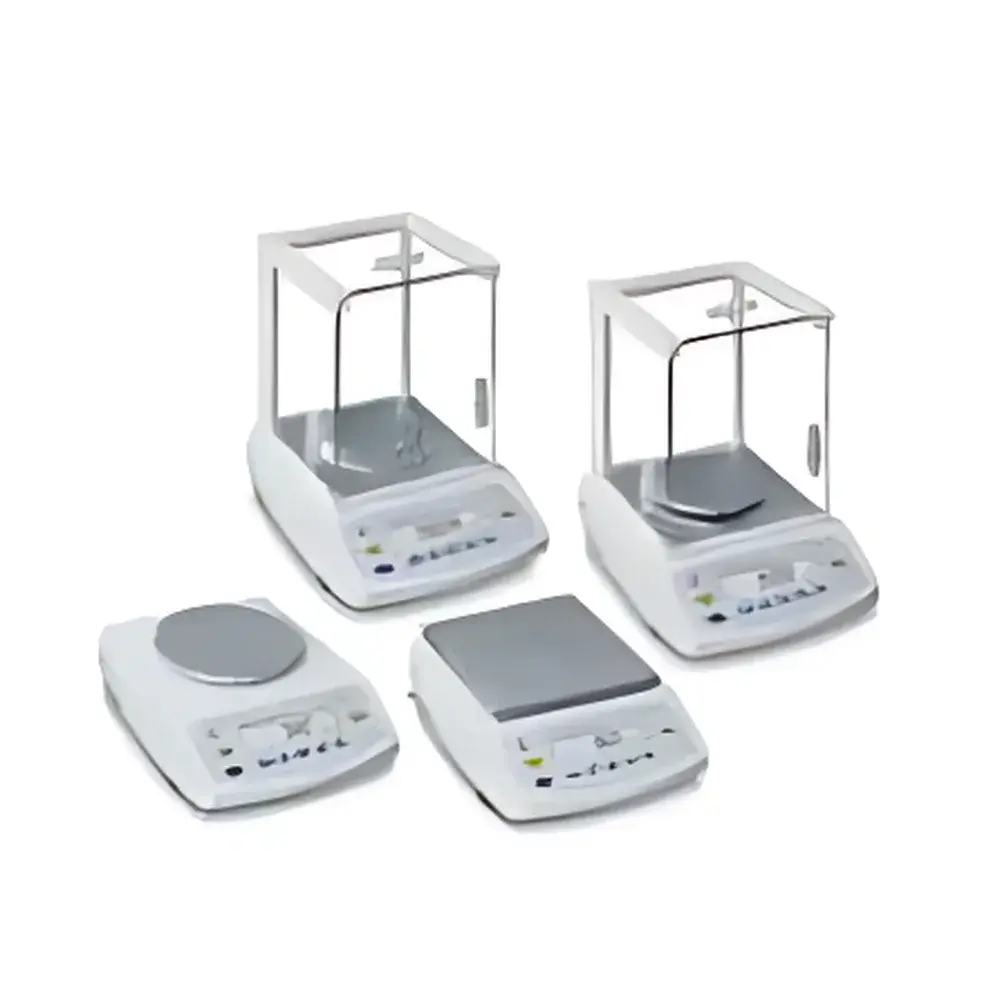
Sartorius BSA-CW Series Automatic Internal Calibration Precision Balance
| Brand | Sartorius |
|---|---|
| Origin | Germany |
| Model | BSA2202S-CW |
| Type | Precision Balance |
| Maximum Capacity | 2200 g |
| Readability | 10 mg |
| Repeatability | 10 mg |
| Calibration | Motor-Driven Internal Calibration |
| Display | Backlit LCD with 15 mm character height |
| Interface | RS-232C bidirectional |
| Pan Size | 180 × 180 mm |
| GLP/ISO Compliance | Yes (print output enabled) |
| Operating Languages | 5 selectable |
| Optional Accessories | Sartorius printers, USB-RS232 cable, external ionizer |
Overview
The Sartorius BSA-CW Series is a line of high-reliability precision balances engineered for routine laboratory weighing tasks requiring consistent accuracy, traceable calibration, and operational transparency. Designed and manufactured in Germany, these balances operate on electromagnetic force compensation (EMFC) principle — a standard architecture for analytical and precision balances that delivers stable, drift-resistant measurement performance under variable environmental conditions. The BSA2202S-CW model offers a maximum capacity of 2200 g with a readability of 10 mg, making it suitable for applications ranging from formulation and quality control to sample preparation and inventory management in pharmaceutical, chemical, food, and academic laboratories. Its fully automatic internal calibration system—driven by a motorized internal weight—is activated at user-defined intervals or manually via a single key press, ensuring continuous metrological integrity without operator intervention or external calibration masses.
Key Features
- Motor-driven internal calibration mechanism compliant with ISO 9001 and ISO/IEC 17025 traceability requirements; eliminates dependency on external weights and reduces calibration-related downtime.
- Backlit LCD display with 15 mm high-contrast characters—optimized for legibility under low ambient light, fluorescent lighting, or direct sunlight conditions.
- Intuitive menu-driven interface with five language options (English, German, French, Spanish, Chinese), enabling rapid configuration and operation across multinational lab environments.
- Touch-sensitive keypad with tactile feedback and logically grouped function keys—minimizing input errors and supporting ergonomic, glove-compatible operation.
- RS-232C bidirectional serial interface as standard; supports seamless data transfer to PCs, LIMS, or Sartorius-certified printers (e.g., PR 5000 series) with configurable print formats including date/time stamp, ID number, and GLP-compliant metadata.
- GLP-compliant data output functionality: automatic inclusion of balance ID, calibration status, date/time, and operator ID (when integrated with Sartorius LabX software or compatible third-party systems).
Sample Compatibility & Compliance
The BSA-CW series accommodates a wide range of sample types—from powders and granules to packaged reagents and small containers—thanks to its 180 × 180 mm stainless steel weighing pan and optimized draft shield compatibility (sold separately). Its robust mechanical design meets IP42 ingress protection standards, offering resistance to dust and incidental splashes during daily use. All models comply with international regulatory frameworks including ISO 9001, ISO/IEC 17025, and EU Directive 2014/32/EU (Measuring Instruments Directive, MID Class II). When used in GxP environments, the balance supports audit trail generation and electronic signature readiness when paired with Sartorius LabX software—meeting FDA 21 CFR Part 11 requirements for data integrity and record retention.
Software & Data Management
While the BSA-CW operates independently as a standalone instrument, its RS-232C interface enables integration into centralized laboratory informatics ecosystems. Sartorius LabX software (optional) provides full remote control, automated data capture, customizable reporting templates, and electronic signature workflows aligned with ALCOA+ principles. Raw weighing data—including tare values, net weights, and calibration logs—can be exported in CSV, TXT, or XML formats. The balance stores up to 99 calibration events locally, each timestamped and annotated with calibration deviation values, supporting internal audits and external inspections per ISO 17025 clause 7.7.
Applications
- Pharmaceutical QC labs: Weighing active pharmaceutical ingredients (APIs), excipients, and reference standards prior to dissolution or assay preparation.
- Chemical manufacturing: Batch formulation verification, raw material receipt inspection, and intermediate product sampling.
- Food testing laboratories: Moisture content determination support, nutrient labeling compliance checks, and portion control validation.
- Academic research: General-purpose weighing in chemistry, biology, and materials science teaching labs where reproducibility and ease-of-use are critical.
- Regulated production environments: In-process checks meeting USP , EP 2.1.3, and JP 2.02 criteria for repeatability and accuracy verification.
FAQ
What does “CW” stand for in the BSA-CW model designation?
The “CW” suffix denotes “Calibration with motor-driven internal weight”—indicating full automatic internal calibration capability.
Is external calibration required after internal calibration?
No. Internal calibration satisfies routine verification needs; however, periodic external verification using certified reference weights is recommended per ISO/IEC 17025 clause 6.5 for accreditation purposes.
Can the balance store multiple user profiles?
User identification is managed externally via LabX or integrated LIMS; the balance itself does not store user profiles but transmits operator ID fields upon request.
Does the BSA-CW support connectivity to modern USB-only computers?
Yes—via optional Sartorius USB-to-RS232 adapter cables (e.g., YC-USB-01), which maintain full bidirectional communication and firmware update compatibility.
How often should internal calibration be performed?
Sartorius recommends initiating internal calibration at startup, after significant temperature fluctuations (>2 °C), and at user-defined time intervals (e.g., every 2–4 hours in high-precision workflows).