
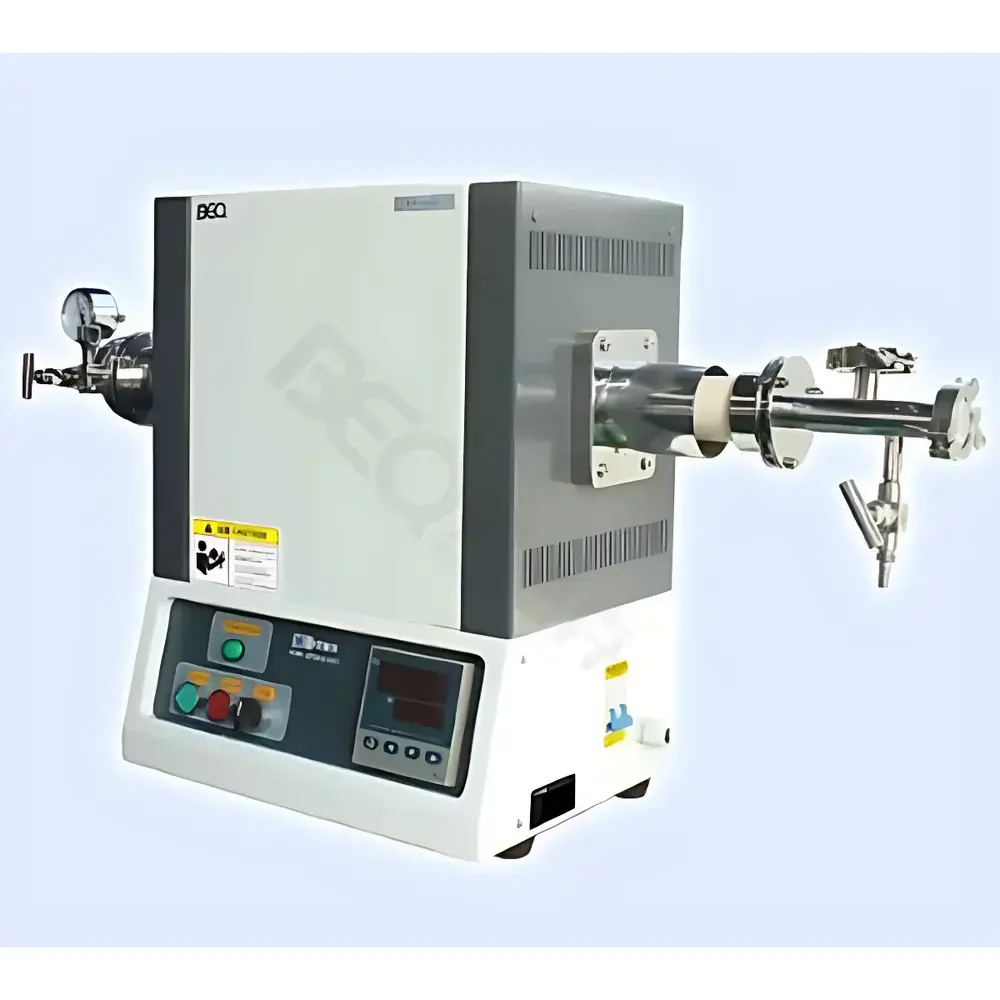
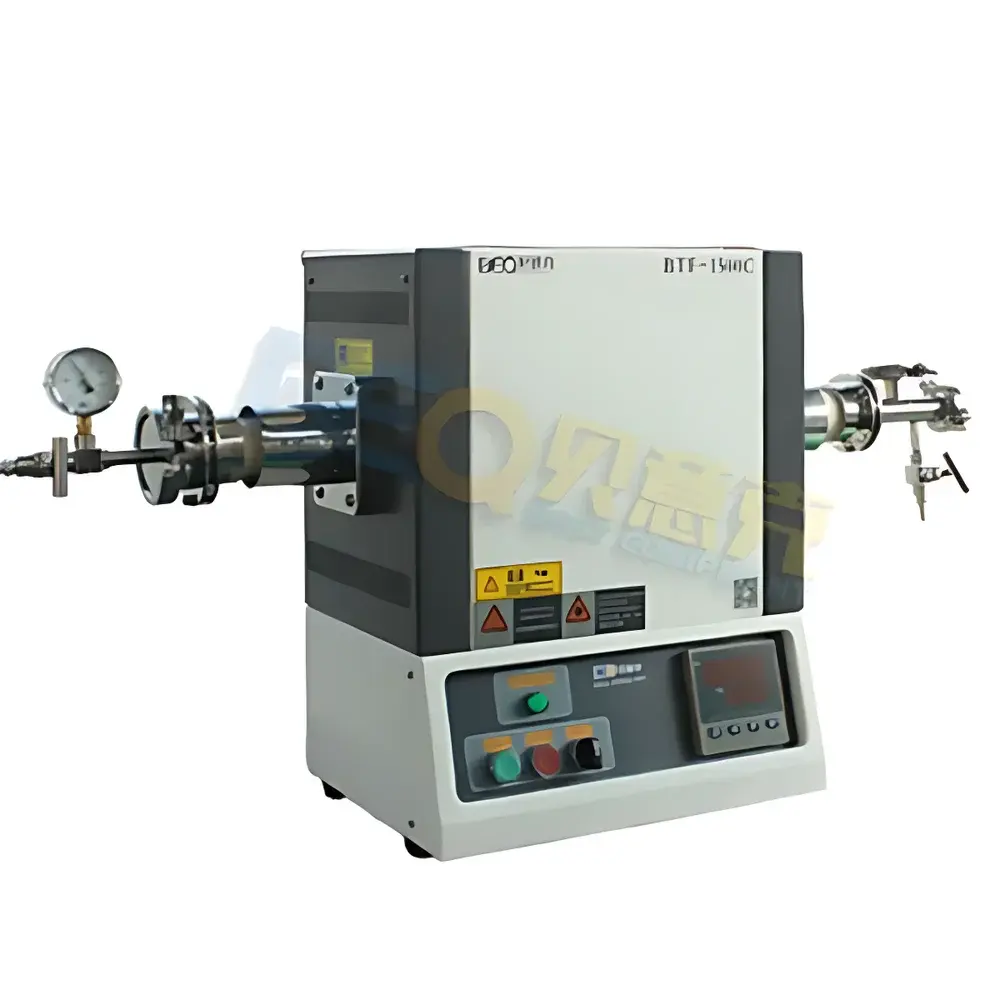
BEQ BTF-1500C Vacuum High-Temperature Tube Furnace
| Brand | BEQ |
|---|---|
| Origin | Anhui, China |
| Model | BTF-1500C |
| Maximum Temperature | 1500 °C |
| Temperature Control Accuracy | ±1 °C |
| Rated Power | 2.5 kW |
| Heating Rate (to Max Temp) | ≤10 °C/min |
| Heating Element | Silicon Carbide (SiC) Rods |
| Control System | Fully Automatic PID Controller with Self-Tuning Functionality |
| Thermocouple Type | Type S (Platinum/Rhodium) |
| Over-Temperature & Thermocouple Break Protection | Yes |
| Tube Inner Diameter | Φ50 mm |
| Furnace Tube Material Compatibility | Quartz, Alumina, or Molybdenum (with appropriate vacuum/ambient gas configuration) |
| Insulation | High-Purity Alumina Ceramic Fiber + Dual-Layer Water-Cooled Stainless Steel Shell |
Overview
The BEQ BTF-1500C Vacuum High-Temperature Tube Furnace is an engineered solution for controlled thermal processing under inert, reducing, or vacuum atmospheres up to 1500 °C. Designed around Couette-type axial thermal uniformity principles and optimized radial heat distribution, this furnace employs silicon carbide (SiC) heating elements arranged in a symmetric, high-density configuration along the furnace length. The result is a certified uniform temperature zone exceeding 200 mm in length—critical for reproducible sintering, crystal growth, annealing, and precursor decomposition experiments. Its dual-layer stainless steel shell incorporates an integrated forced-air cooling system to maintain external surface temperatures below 60 °C during continuous operation at maximum setpoint, ensuring operator safety and long-term mechanical stability. The furnace is compatible with standard vacuum systems (up to 10−3 mbar with optional turbomolecular pump) and gas flow manifolds (N2, Ar, H2, forming gas), enabling precise atmosphere control per ASTM E29-23 and ISO 8573-1 requirements.
Key Features
- High-purity α-alumina (99.7% Al2O3) ceramic tube furnace chamber, coated with proprietary US-sourced high-emissivity alumina-based refractory enamel to enhance radiative efficiency and suppress thermal degradation at prolonged dwell times above 1300 °C
- Robust mechanical design featuring flanged support brackets that decouple tube weight from the heating zone—reducing thermal stress-induced bending and maintaining concentric alignment during repeated thermal cycling
- Intelligent temperature regulation via fully automatic PID controller with real-time self-tuning algorithm; supports ramp-hold programming with up to 30 segments and user-defined cooling profiles
- Type S (Pt–10% Rh / Pt) thermocouple embedded in the hot zone for traceable calibration against NIST-traceable reference standards; integrated hardware-level over-temperature cutoff and open-circuit (break) detection
- Modular vacuum/gas interface with CF-35 or KF-25 flanges (optional), compliant with ISO-K and ISO-F vacuum sealing standards; includes pressure sensor port and purge line connections
Sample Compatibility & Compliance
The BTF-1500C accommodates cylindrical samples up to Φ45 mm × 180 mm within its Φ50 mm quartz or high-purity alumina tube. For reducing or ultra-high-vacuum applications, molybdenum disilicide (MoSi2) or recrystallized alumina tubes may be specified. All structural and thermal components meet CE Machinery Directive 2006/42/EC and RoHS 2011/65/EU compliance. The control firmware implements audit-trail-capable event logging (timestamped power status, alarm triggers, setpoint changes), supporting GLP/GMP-aligned laboratory documentation per FDA 21 CFR Part 11 when paired with validated data acquisition software.
Software & Data Management
The furnace integrates seamlessly with BEQ’s optional PC-based LabFurnaceControl™ software (Windows 10/11, 64-bit), enabling remote monitoring, real-time graphing of multiple thermocouple inputs, automated report generation (PDF/CSV), and password-protected user role management (Operator, Technician, Administrator). Data logs include metadata such as ambient humidity, cooling fan RPM, and voltage fluctuations—enabling root-cause analysis of thermal deviations. Exported datasets conform to ASTM E1457-22 digital record integrity guidelines and are compatible with LIMS platforms via OPC UA or Modbus TCP protocols.
Applications
- Preparation of advanced ceramics (e.g., SiC, ZrO2, YBCO superconductors) requiring precise stoichiometric control under low-oxygen partial pressure
- Thermal gravimetric analysis (TGA) coupling with mass spectrometry (MS) or Fourier-transform infrared (FTIR) gas analyzers
- Graphene and 2D material synthesis via chemical vapor deposition (CVD) using hydrocarbon precursors
- Calibration of high-temperature reference materials (e.g., fixed points per ITS-90: Co–C, Pd–C, Re–C)
- Accelerated aging studies of battery cathode materials (NMC, LFP) under controlled O2 partial pressure
FAQ
What vacuum level can the BTF-1500C achieve with standard configuration?
With the base mechanical pump (2×10⁻² mbar ultimate), the system reaches ~5×10⁻³ mbar after 45 minutes of pumping; adding a turbo-molecular pump option extends capability to <1×10⁻⁵ mbar.
Is the furnace compatible with hydrogen atmosphere operation?
Yes—when equipped with H2-rated seals, leak-tested tubing, and explosion-proof ventilation interlocks per IEC 60079-10-1, it supports up to 5% H2/Ar mixtures at temperatures ≤1200 °C.
Can the tube be replaced in situ without recalibrating the temperature profile?
Yes—the furnace’s axial thermocouple positioning and SiC element layout ensure repeatable thermal mapping; replacement tubes undergo pre-qualification with NIST-traceable thermal profiling before shipment.
Does the controller support third-party SCADA integration?
Yes—RS485 Modbus RTU and Ethernet-based Modbus TCP interfaces are standard; optional Profibus-DP and EtherCAT gateways are available upon request.
What maintenance intervals are recommended for sustained 1500 °C operation?
SiC rods should be inspected every 200 operational hours above 1300 °C; alumina tube coating integrity verified quarterly via visual and emissivity spot-checking per ASTM C1114-21.
Related Products



