
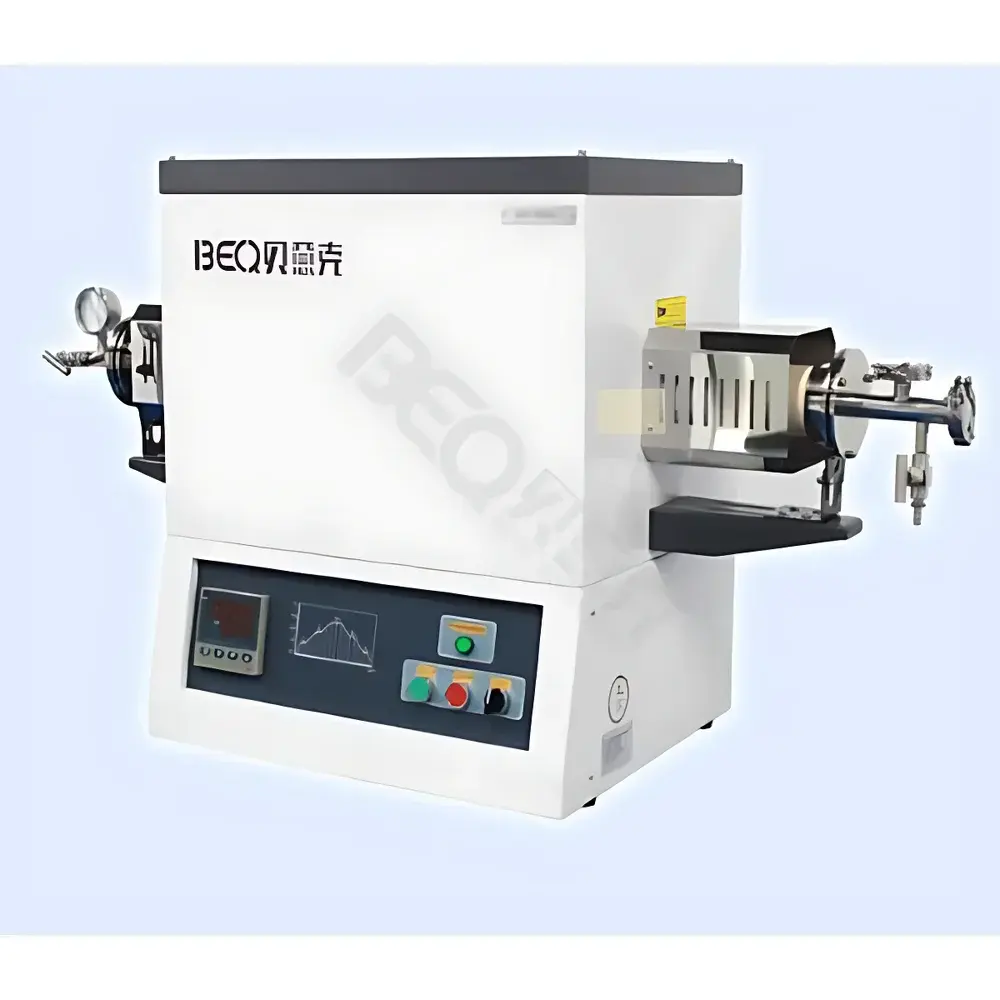
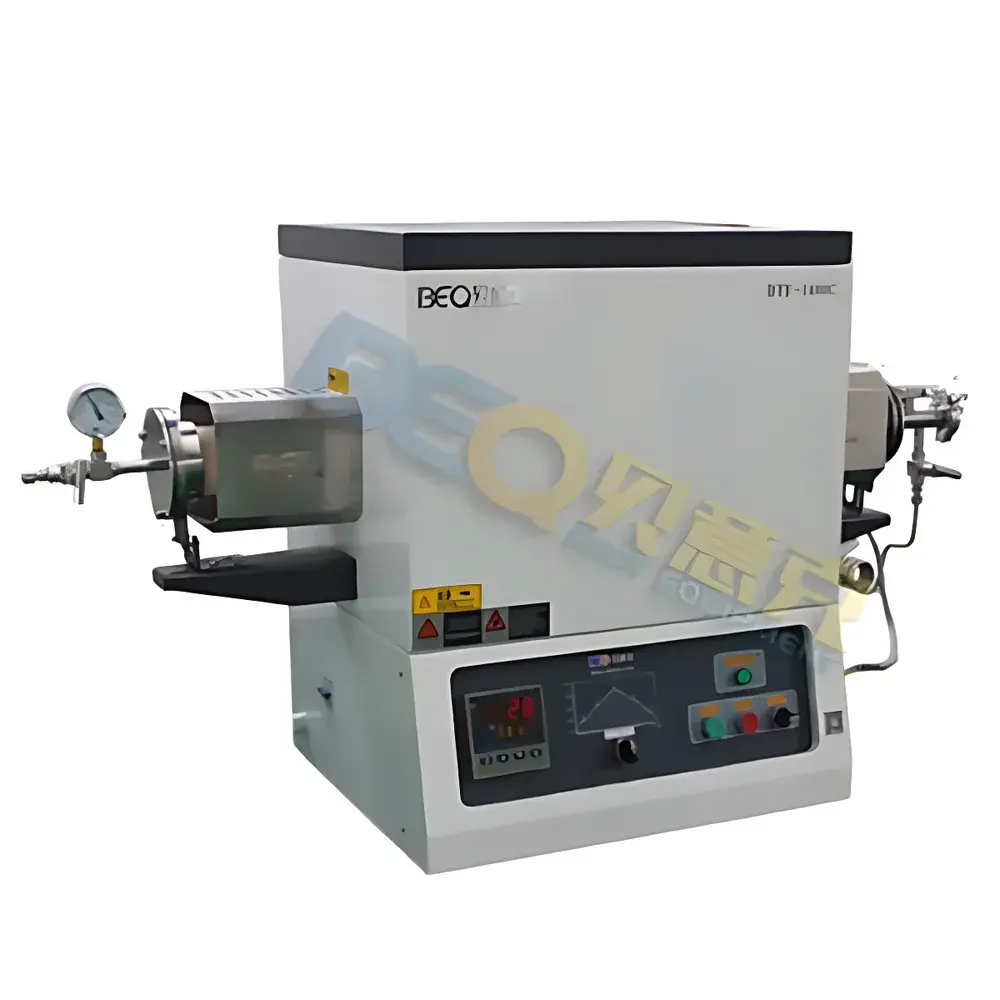
BEQ BTF-1400C High-Temperature Vacuum Tube Furnace
| Brand | BEQ |
|---|---|
| Origin | Anhui, China |
| Model | BTF-1400C |
| Maximum Temperature | 1400 °C |
| Temperature Control Accuracy | ±1 °C |
| Rated Power | 5 kW |
| Heating Rate | ≤10 °C/min below 1200 °C |
| Heating Element | Silicon Carbide (SiC) Rods |
| Tube Dimensions | Φ60 mm × 1000 mm or Φ80 mm × 1000 mm |
| Furnace Chamber Material | High-Purity Alumina (Al₂O₃) with US-Imported High-Temperature Alumina Coating |
| Cooling System | Dual-layer shell with forced-air cooling |
| Safety Features | Over-temperature and thermocouple failure alarm |
Overview
The BEQ BTF-1400C is a high-precision vacuum-compatible tube furnace engineered for controlled thermal processing under inert, reducing, or low-pressure atmospheres. It operates on the principle of resistive heating via silicon carbide (SiC) rod elements, which provide stable, repeatable heat generation up to 1400 °C. The furnace features a long uniform temperature zone—achieved through dense, symmetrically arranged SiC heating elements—and is optimized for applications requiring precise thermal profiles, such as sintering of advanced ceramics, annealing of thin-film substrates, crystal growth precursor treatment, and solid-state synthesis under vacuum or gas-purged conditions. Its dual-layer stainless steel shell, integrated forced-air cooling system, and high-purity alumina (99.7% Al₂O₃) tube chamber ensure structural integrity, thermal stability, and extended service life—even during prolonged operation near maximum temperature.
Key Features
- Ultra-stable temperature control with ±1 °C accuracy across the central 300 mm zone, verified per ASTM E220 calibration standards
- Two standard quartz or high-purity alumina tube options: Φ60 mm × 1000 mm and Φ80 mm × 1000 mm—both compatible with standard KF or CF vacuum flanges
- High-efficiency heating architecture using U-shaped SiC rods mounted in grooved ceramic holders for optimal thermal distribution and minimal hot-spot formation
- Dual-shell design with interstitial air gap and axial fan-assisted convection cooling, enabling rapid cooldown and reduced external surface temperature (<60 °C at 1400 °C operation)
- Integrated safety circuitry including independent over-temperature cutoff (setpoint +15 °C), real-time thermocouple continuity monitoring, and automatic power shutdown upon sensor fault
- Front-loading configuration with adjustable support stands and reinforced flange mounts to minimize mechanical stress on the tube during repeated thermal cycling
Sample Compatibility & Compliance
The BTF-1400C accommodates a wide range of sample geometries—including powders, pellets, wafers, fibers, and crucibles—within its high-purity alumina chamber. The interior coating, sourced from a US-based refractory materials supplier, enhances infrared emissivity and mitigates contamination from volatile alkali species during high-temperature reactions. The furnace meets mechanical and electrical requirements outlined in IEC 61000-6-3 (EMC emission limits) and IEC 61000-6-2 (immunity). While not certified for Class I Div 1 hazardous locations, it is routinely deployed in ISO/IEC 17025-accredited laboratories for method development aligned with ASTM C1171 (sintering shrinkage), ISO 11507 (UV resistance testing preconditioning), and USP (thermal sterilization validation support). Vacuum compatibility extends to ≤10⁻³ mbar when paired with a two-stage rotary vane pump and appropriate sealing hardware.
Software & Data Management
The furnace is equipped with a programmable 30-segment PID controller featuring RS485 Modbus RTU interface for integration into centralized lab automation systems. Optional PC software enables remote ramp-soak programming, real-time temperature logging (1 Hz sampling), and CSV export compliant with 21 CFR Part 11 requirements—including electronic signature fields, audit trail activation, and user-level access controls. All temperature setpoints, actual readings, alarm events, and power status are timestamped and stored locally for ≥30 days, supporting GLP/GMP documentation workflows. Data integrity is preserved via non-volatile memory backup and cyclic redundancy check (CRC) validation on all communication packets.
Applications
- Sintering of oxide and non-oxide ceramics (e.g., Al₂O₃, SiC, ZrO₂) under vacuum or Ar/H₂ atmospheres
- Thermal annealing of CVD-grown graphene, transition metal dichalcogenides (TMDs), and perovskite thin films
- Controlled pyrolysis of polymer-derived ceramics and carbon precursors
- Heat treatment of battery electrode materials (e.g., LiFePO₄, NMC cathodes) prior to electrochemical testing
- Pre-oxidation of refractory metals (Mo, Nb, Ta) and diffusion barrier layer formation
- Calibration reference source for high-temperature blackbody radiance studies (NIST-traceable thermocouples recommended)
FAQ
What vacuum level can the BTF-1400C achieve with standard accessories?
With a compatible two-stage rotary vane pump and Viton O-rings, the system typically reaches 1–5 × 10⁻³ mbar. For higher vacuum performance (≤10⁻⁵ mbar), a turbomolecular pump and metal (CF) flange upgrade are required.
Is the furnace compatible with hydrogen gas atmospheres?
Yes—when operated with proper ventilation, leak-checked fittings, and optional H₂-compatible pressure relief valves, the BTF-1400C supports reducing atmospheres up to 1 bar partial pressure of H₂, per ISO 22866 guidelines for hydrogen safety in thermal equipment.
Can the temperature uniformity be validated per AMS2750E?
While the furnace itself is not an AMS2750E-certified “furnace class,” its ±1 °C stability and documented 300 mm uniform zone enable users to perform SAT (System Accuracy Tests) and TUS (Temperature Uniformity Surveys) in accordance with AMS2750E Section 3.2.1 using calibrated multi-point thermocouples.
What maintenance is required for the SiC heating elements?
SiC rods exhibit gradual resistance increase over time. Annual verification of element resistance (±5% deviation from nominal) and visual inspection for cracking or warping is recommended. Replacement intervals average 2,500–4,000 hours at 1350 °C continuous operation.
Does the controller support custom alarm logic or digital I/O triggers?
Yes—the Modbus-enabled controller supports configurable digital outputs for external interlocks (e.g., vacuum pump enable, exhaust damper actuation) and user-defined alarm thresholds beyond default over-temperature detection.



