
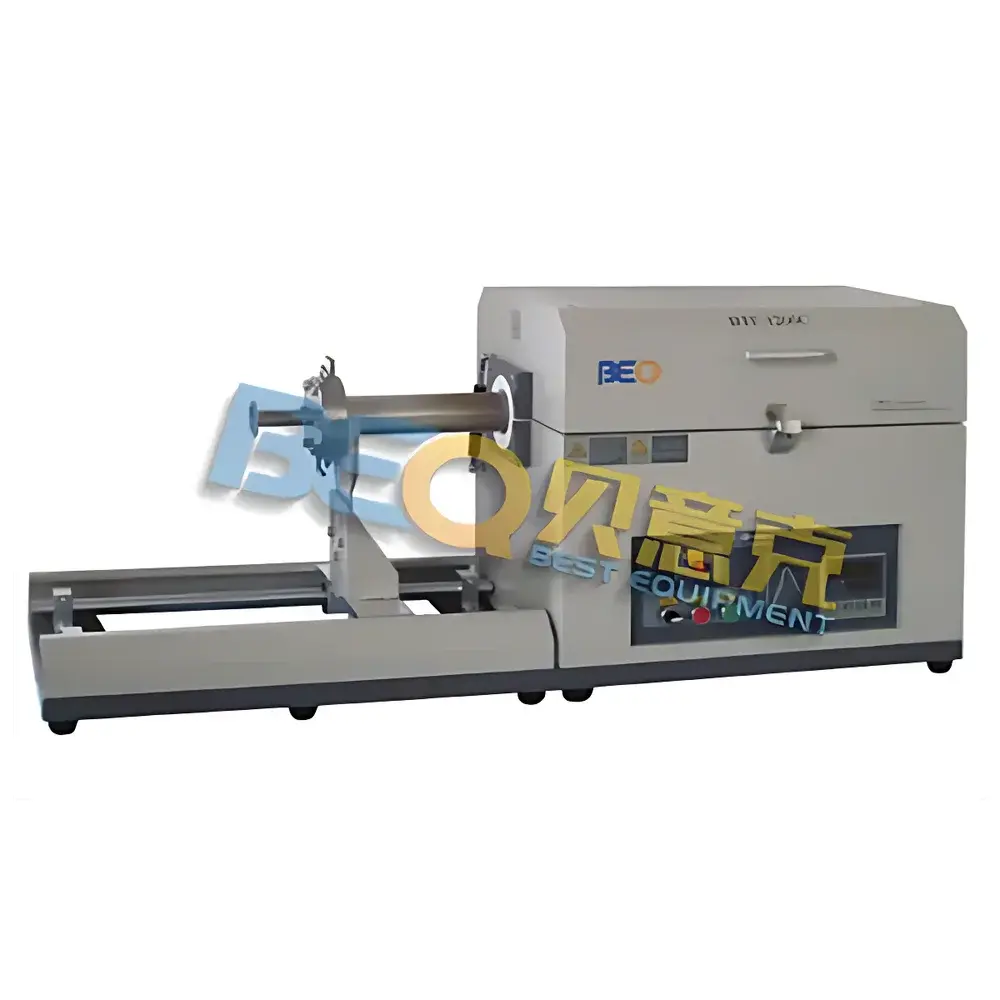
BEQ BTF-1200C-SLD High-Temperature & High-Pressure Horizontal Tube Furnace
| Brand | BEQ |
|---|---|
| Origin | Anhui, China |
| Model | BTF-1200C-SLD |
| Max Temperature | 1200 °C (quartz tube), 1100 °C (alloy steel pressure tube) |
| Temperature Control Accuracy | ±1 °C |
| Max Power | 3 kW |
| Heating Rate | up to 50 °C/s (during rapid insertion), 30 °C/s (100–1000 °C under standard ramp) |
| Heating Element | Imported Kanthal A1 resistance wire |
| Control System | Fuzzy PID with auto-tuning + 30-segment programmable controller |
| Configuration | Horizontal sliding rail design for rapid thermal cycling |
Overview
The BEQ BTF-1200C-SLD is a horizontally oriented, high-temperature and high-pressure tube furnace engineered for advanced materials processing under controlled atmospheric and thermal conditions. It operates on resistive heating principles using Kanthal A1 alloy resistance wire, delivering stable and uniform axial temperature profiles within the hot zone. Unlike conventional muffle furnaces, this system integrates a precision-engineered sliding rail mechanism that enables dynamic thermal management—allowing either rapid insertion of pre-heated samples into a stabilized hot zone or immediate extraction of the entire tube assembly for accelerated cooling. This architecture supports time-resolved thermal protocols essential in solid-state synthesis, thin-film processing, and kinetic studies where thermal inertia must be minimized. The furnace accommodates interchangeable reaction tubes—including fused quartz (rated to 1200 °C), high-strength alloy steel (rated to 1100 °C at elevated pressure), and refractory ceramic variants such as mullite—enabling adaptation across vacuum annealing, pressurized sintering, rapid thermal processing (RTP), and chemical vapor deposition (CVD) applications.
Key Features
- Horizontal sliding rail system enabling sub-second mechanical displacement of the tube relative to the heated zone—critical for achieving >50 °C/s effective heating rates during sample insertion
- Dual-rated tube compatibility: quartz tubing supports inert/vacuum processes up to 1200 °C; alloy steel tubing permits pressurized operation up to 1100 °C with compatible sealing hardware
- Fuzzy logic PID temperature controller with auto-tuning capability ensures robust setpoint tracking and minimal overshoot across wide operating ranges
- 30-segment programmable temperature profile memory, supporting complex multi-step ramps, holds, and cooling sequences with independent rate control per segment
- High-purity Kanthal A1 heating elements provide long-term stability, oxidation resistance, and consistent watt density distribution along the 300 mm effective hot zone
- Front-panel digital interface with real-time temperature display, program status monitoring, and manual override functionality
Sample Compatibility & Compliance
The BTF-1200C-SLD is designed for use with standard OD 60–100 mm cylindrical reaction tubes and accepts custom-length configurations up to 1200 mm. Its modular tube-mounting flange supports standardized VCR, CF, or ISO-K vacuum fittings, facilitating integration into existing gas-handling or vacuum manifolds. When operated with quartz tubing under inert or reducing atmospheres, the system complies with ASTM E1113 for thermal uniformity verification in horizontal tube furnaces. For high-pressure applications, users must implement externally rated pressure vessels, rupture discs, and leak-tested seals conforming to ASME BPVC Section VIII requirements. The furnace’s electrical architecture meets IEC 61000-6-3 (EMC emission limits) and IEC 61000-6-2 (immunity standards), and its thermal insulation conforms to ISO 23993 for laboratory furnace surface temperature safety thresholds.
Software & Data Management
While the base unit features standalone front-panel control, optional RS485/Modbus RTU communication enables integration with LabVIEW, MATLAB, or SCADA platforms for remote operation and data logging. All temperature profiles, ramp rates, hold durations, and real-time thermocouple readings (Type K, calibrated to NIST-traceable standards) are timestamped and exportable in CSV format. The controller maintains an internal audit trail of executed programs and manual interventions—supporting GLP-compliant documentation workflows. When deployed in regulated environments, the system can be validated per IQ/OQ protocols aligned with FDA 21 CFR Part 11 requirements through third-party software extensions offering electronic signatures and user-access tiering.
Applications
- Rapid thermal annealing (RTA) of semiconductor wafers and transparent conductive oxides (TCOs)
- High-pressure solid-state sintering of ceramics, intermetallics, and battery electrode composites
- Vacuum degassing and recrystallization of metal powders and precursor films
- Atmospheric-controlled CVD growth of 2D materials (e.g., MoS₂, h-BN) and carbon nanotubes
- In-situ electrical transport characterization via integrated feedthroughs for four-point probe or impedance spectroscopy
- Kinetic studies of phase transformations, oxidation, and decomposition reactions requiring precise ΔT/Δt resolution
FAQ
What tube materials are supported, and what are their pressure/temperature limits?
Quartz tubes support continuous operation up to 1200 °C under vacuum or inert gas, but are not rated for pressure service. Alloy steel tubes (e.g., Inconel 600 or 310S) are required for pressurized applications and maintain structural integrity up to 1100 °C at ≤10 bar, depending on wall thickness and end-cap design.
Can the furnace be used under vacuum?
Yes—the standard flange configuration supports high-vacuum operation (<10⁻³ mbar) when paired with appropriate vacuum-rated tubing, O-rings (e.g., Viton or Kalrez), and pumping systems. Optional water-cooled flanges are available for extended vacuum duty.
Is the 50 °C/s heating rate achievable across the full temperature range?
No—the 50 °C/s rate reflects transient thermal response during rapid mechanical insertion of a room-temperature tube into a pre-equilibrated 1000–1200 °C zone. Sustained ramp rates are governed by power delivery and thermal mass, with 30 °C/s specified between 100–1000 °C under standard conditions.
Does the controller support data logging without external software?
The embedded controller records program execution history and fault events internally but does not store continuous temperature vs. time streams. Real-time logging requires external acquisition via Modbus or analog output signals.
What calibration standards apply to the temperature measurement system?
The furnace uses Type K thermocouples traceable to NIST Standard Reference Materials (SRMs). Users are advised to perform periodic verification using a calibrated secondary standard thermometer per ISO/IEC 17025 guidelines.



