
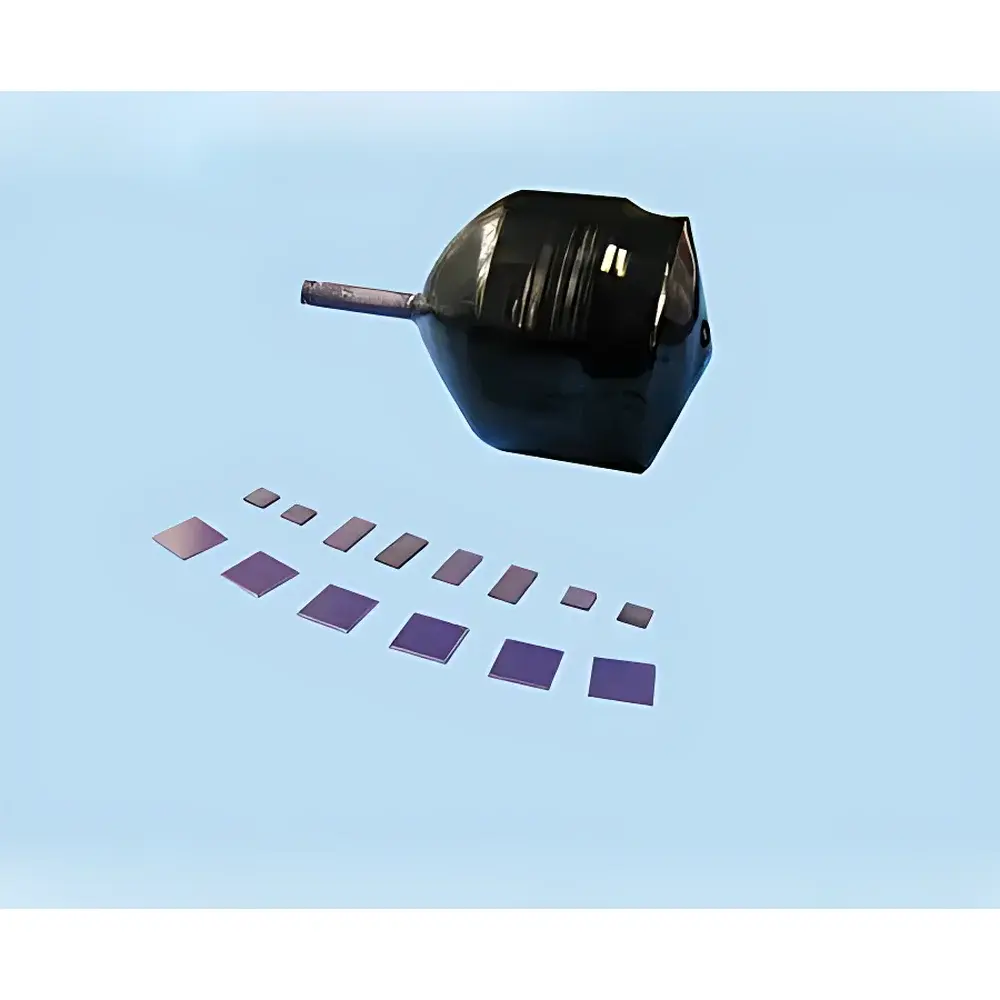
NdCaAlO4 Single Crystal Substrate
| Brand | Hefei Kejing |
|---|---|
| Origin | Anhui, China |
| Manufacturer Type | Distributor |
| Origin Category | Domestic |
| Model | NdCaAlO4 |
| Pricing | Upon Request |
| Crystal Structure | Tetragonal |
| Lattice Constants | a = 3.685 Å, c = 12.12 Å |
| Growth Method | Czochralski (Cz) |
| Melting Point | 1850 °C |
| Density | 5.56 g/cm³ |
| Mohs Hardness | ~6.5 |
| Thermal Expansion Coefficient | 12 × 10⁻⁶ /°C |
| Dielectric Constant (εᵣ) | 19.5 |
| Standard Dimensions | 10 × 10 × 0.5 mm, 5 × 5 × 0.5 mm |
| Orientation | <001>, Tolerance ±0.5° |
| Surface Finish | Single- or Double-Polished |
| Surface Roughness (Ra) | < 0.5 nm |
| Packaging | Class 1000 Cleanroom + Class 100 Clean Bag or Individual Wafer Cassette |
Overview
NdCaAlO4 (Neodymium Calcium Aluminum Oxide) is a high-quality single-crystal substrate engineered for advanced thin-film epitaxy and surface-sensitive electrochemical characterization. Its tetragonal crystal structure (space group I4/mmm) provides a well-matched lattice interface for the growth of complex oxide heterostructures—particularly those involving rare-earth manganites, cobaltites, and multiferroic perovskites. As a substrate material for Quartz Crystal Microbalance (QCM) sensor development and fundamental interfacial studies in electrochemical systems, NdCaAlO4 offers superior thermal stability, low dielectric loss, and mechanical rigidity under vacuum and controlled-atmosphere deposition conditions. Unlike conventional substrates such as SiO2 or quartz, NdCaAlO4 enables precise control over strain relaxation pathways and interfacial charge transfer due to its anisotropic lattice parameters (a = 3.685 Å, c = 12.12 Å) and moderate dielectric constant (εr ≈ 19.5).
Key Features
- High-purity single-crystal wafers grown via the Czochralski method, ensuring structural homogeneity and minimal defect density
- Precise orientation with angular tolerance ≤ ±0.5°, validated by high-resolution X-ray diffraction (HR-XRD)
- Ultra-smooth surface finish: Ra < 0.5 nm (measured by atomic force microscopy), suitable for monolayer-level film nucleation
- Thermal expansion coefficient (12 × 10−6/°C) compatible with common functional oxides, minimizing interfacial cracking during thermal cycling
- Chemically inert in non-reducing environments; stable under O2, Ar, and forming gas atmospheres up to 800 °C
- Available in standard dimensions (5 × 5 × 0.5 mm and 10 × 10 × 0.5 mm) with optional custom cutting, chamfering, and backside lapping
Sample Compatibility & Compliance
NdCaAlO4 substrates are routinely employed in ultra-high-vacuum (UHV) sputtering, pulsed laser deposition (PLD), and molecular beam epitaxy (MBE) systems for the fabrication of QCM-active layers and electrochemical sensing interfaces. Their compatibility extends to industry-standard wafer handling protocols—including robotic cassette loading and SEM/AFM stage mounting—without risk of chipping or delamination. All substrates are processed in ISO Class 5 (100-level) cleanrooms and packaged in certified static-dissipative, particle-free containers. While not certified to ISO 9001 or ASTM F797 for medical device use, the material meets ASTM F1529 requirements for crystalline oxide substrates used in research-grade thin-film metrology. Documentation includes batch-specific XRD rocking curve data and surface profilometry reports upon request.
Software & Data Management
As a passive substrate material, NdCaAlO4 does not incorporate embedded firmware or digital interfaces. However, it integrates seamlessly into automated QCM-D (Quartz Crystal Microbalance with Dissipation monitoring) platforms from companies including Biolin Scientific (Q-Sense), Malvern Panalytical (E4), and Sartorius (Octet). When used in conjunction with time-resolved electrochemical impedance spectroscopy (EIS) or cyclic voltammetry setups, substrate consistency ensures reproducible baseline frequency shifts (Δf) and dissipation (ΔD) responses across multiple experimental runs. Traceability is maintained through unique lot numbering, with full manufacturing records—including growth log files, annealing history, and post-polish inspection reports—available for GLP-compliant laboratories conducting method validation or regulatory submissions.
Applications
- Epitaxial growth template for La0.7Sr0.3MnO3 (LSMO), Nd0.5Sr0.5MnO3, and other colossal magnetoresistive (CMR) films
- Dielectric layer in solid-state electrochemical cells requiring low leakage current and high breakdown voltage
- Reference substrate for calibrating X-ray reflectivity (XRR) and grazing-incidence small-angle scattering (GISAXS) instruments
- Platform for studying ion adsorption/desorption kinetics at oxide–electrolyte interfaces using QCM-based sensors
- Alternative to SrTiO3 or LSAT for strain-engineered heterostructures where reduced lattice mismatch (<2.5% vs. YBCO) is critical
FAQ
Is NdCaAlO4 compatible with reactive sputtering in oxygen plasma?
Yes—its high melting point (1850 °C) and oxidation resistance allow stable operation under O2-rich sputter atmospheres up to 500 °C substrate temperature.
Can these substrates be bonded to silicon carriers for flip-chip integration?
They are compatible with Au–Au thermocompression bonding and low-temperature glass frit bonding when surfaces are chemically activated via O2 plasma treatment.
Do you provide EDS or XPS surface contamination analysis reports?
Standard substrates include ambient-air XPS survey scans (C 1s, O 1s, Al 2p, Ca 2p, Nd 3d); full quantitative EDS mapping is available as a value-added service.
What is the maximum recommended annealing temperature in air before surface degradation occurs?
Annealing up to 900 °C in air for ≤2 hours preserves surface stoichiometry and roughness; prolonged exposure above this threshold may induce Ca segregation.
Are there restrictions on international shipping due to export control regulations?
NdCaAlO4 substrates fall outside EAR99 and ITAR classifications; no license is required for export to EU, Canada, Japan, or Australia.





