
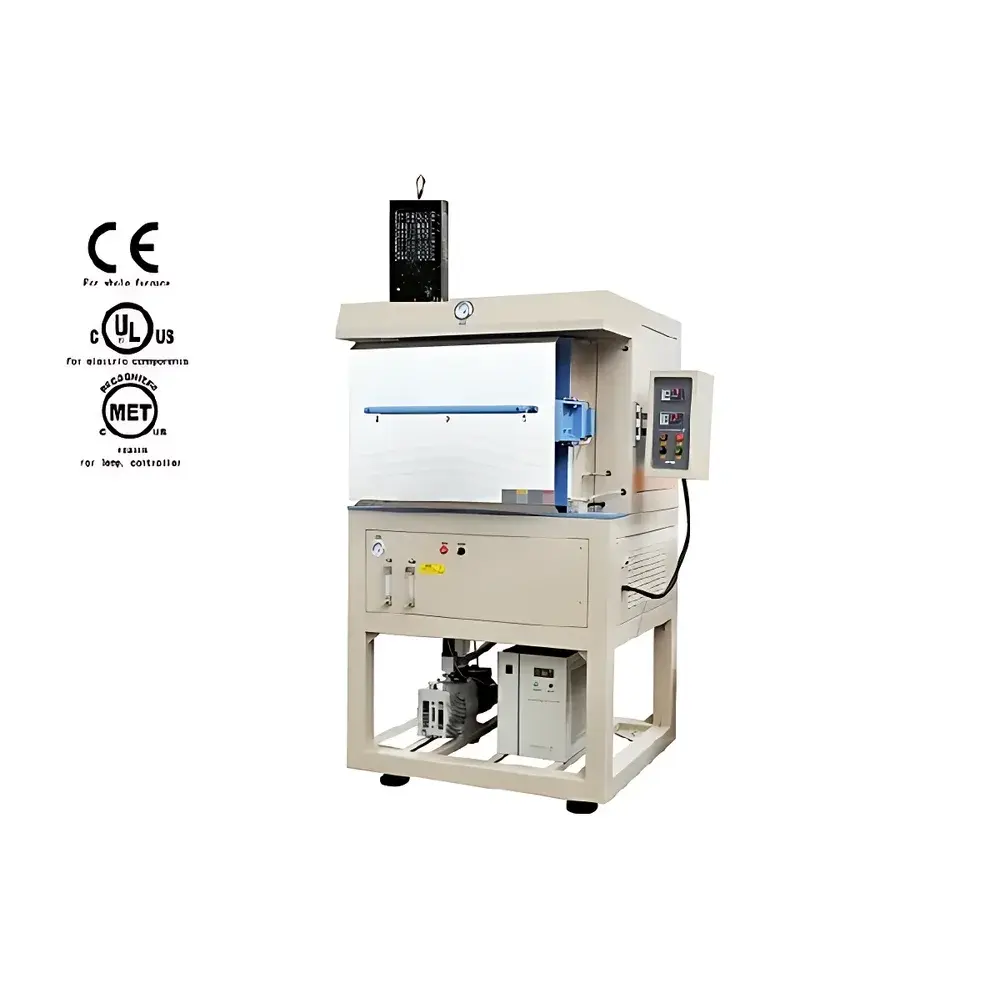
KSL-1200X-H2 Hydrogen-Atmosphere Box Furnace (1200°C, CE & TÜV/UL Certified)
| Brand | Hefei Kejing |
|---|---|
| Origin | Anhui, China |
| Model | KSL-1200X-H2 |
| Chamber Dimensions | 400 × 400 × 400 mm (64 L) |
| Max Operating Temperature | 1200°C (≤1 h), Continuous Use: 1100°C |
| Temperature Uniformity | ±5°C within 250 mm cube |
| Heating Elements | Kanthal® Fe-Cr-Al alloy (1350°C grade) |
| Heating Configuration | 5-sided (left, right, front, back, bottom) |
| Insulation | High-purity alumina fiber + high-temp alumina coating |
| Power Rating | 10 kW, 208–240 V AC, 50/60 Hz, Single-phase |
| Cooling System | Dual air/water cooling |
| Pressure Range | +1 MPa (gauge) / –0.1 MPa (vacuum) |
| Gas Control | Dual rotameters, stainless steel shut-off valves, integrated H₂ auto-ignition & flame-out safety cutoff |
| Vacuum Pump | Two-stage rotary vane pump (via corrugated hose) |
| Safety Certifications | CE, TÜV/UL 61010 compliant |
| Net Weight | 300 kg |
| External Dimensions | 2050 × 1280 × 1200 mm (H×W×L) |
Overview
The KSL-1200X-H2 is a rigorously engineered hydrogen-atmosphere box furnace designed for controlled thermal processing under reducing, inert, or oxidizing atmospheres—primarily targeting applications requiring strict gas-phase chemistry management at elevated temperatures. Its core operational principle relies on resistive heating via high-stability Kanthal® Fe-Cr-Al heating elements, arranged in a five-sided configuration to minimize axial and radial thermal gradients. This architecture ensures reproducible temperature distribution across the 64 L working chamber (400 × 400 × 400 mm), critical for uniform phase transformations, sintering, annealing, and reduction reactions in functional materials. The furnace meets IEC 61010-1 safety requirements and carries CE marking alongside TÜV- and UL-recognized certification for electrical components operating above 24 V, affirming compliance with international laboratory equipment safety standards. Structural integrity is reinforced by a double-walled steel housing with integrated forced-air and water-cooling circuits, enabling sustained operation while maintaining external surface temperatures below 45°C under full load.
Key Features
- Five-sided heating layout (left, right, front, back, and floor) delivers superior temperature uniformity (±5°C within a 250 mm cubic zone), outperforming conventional three-wall configurations.
- High-purity alumina fiber insulation with ceramic-based high-emissivity coating enhances thermal efficiency and extends refractory service life beyond 5,000 operational hours at 1100°C.
- Dual-stage vacuum capability (–0.1 MPa) paired with precision mass flow control via two calibrated glass rotameters enables accurate atmosphere composition tuning and purge sequencing.
- Integrated hydrogen safety system includes automatic ignition of exhaust H₂ at the top flue, real-time flame monitoring, and fail-safe solenoid valve closure within <1 second upon flame extinction.
- Robust pressure management: maintains stable internal overpressure up to +1 MPa or vacuum down to –0.1 MPa; mechanical pressure gauge mounted on top for direct visual verification.
- Water-cooled door seal with vacuum-tight gasket prevents thermal degradation of elastomeric components during repeated H₂ cycling, supporting long-term leak integrity.
Sample Compatibility & Compliance
The KSL-1200X-H2 accommodates samples up to 35 kg and supports diverse material classes—including rare-earth phosphors, Ti-6Al-4V preforms, Ni-based superalloy precursors, and metal oxide cathode precursors—requiring strictly controlled reducing atmospheres. Its design conforms to key regulatory expectations for lab-scale thermal processing: pressure containment follows ASME BPVC Section VIII Div. 1 guidelines for low-pressure vessels; gas-handling components meet ISO 8573-1 Class 2 purity requirements for compressed gases; and all electrical interlocks satisfy EN 60204-1 machinery safety directives. For GLP/GMP-aligned workflows, optional RS485 interface enables integration with validated data acquisition systems supporting 21 CFR Part 11-compliant audit trails when used with third-party compliant software.
Software & Data Management
A programmable PID controller (30-segment ramp-soak profile capability) resides in the left-side control panel, featuring dual K-type thermocouples for redundant measurement and control. Optional PC-based temperature logging and remote operation are supported via RS485 Modbus RTU protocol. While the base unit does not include bundled software, it is compatible with industry-standard SCADA platforms (e.g., LabVIEW, WinCC) and validated thermal process recorders meeting ASTM E2251–23 requirements for furnace qualification. Users requiring FDA-submission-ready data sets may implement third-party compliant software with electronic signature, user access controls, and immutable event logging—fully traceable to individual furnace runs.
Applications
This furnace serves specialized roles in advanced materials synthesis and processing: reduction of Y₂O₃:Eu³⁺ phosphor precursors under 5% H₂/Ar; stress-relief annealing of additively manufactured titanium components; carbothermal synthesis of SiC nanowires; post-deposition annealing of CVD-grown transition metal dichalcogenides; and solid-state reaction studies of Li-rich layered oxides for battery cathodes. Its compatibility with rapid gas switching also supports cyclic redox testing protocols relevant to catalyst durability evaluation per ISO 11902. When retrofitted with quartz viewing ports and precursor delivery lines, the chamber may be adapted for atmospheric-pressure CVD experiments involving silane, ammonia, or metalorganic precursors.
FAQ
What safety certifications apply to the KSL-1200X-H2?
It holds CE marking and complies with TÜV/UL 61010-1 for electrical safety; all components rated >24 V carry UL or CSA recognition.
Can this furnace operate continuously at 1200°C?
No—1200°C is rated for short-duration cycles (≤1 hour); continuous operation is limited to 1100°C to ensure heating element longevity and thermal stability.
Is inert gas purging mandatory before introducing H₂?
Yes—strict N₂ or Ar purge sequences are required to reduce O₂ concentration below 100 ppm prior to H₂ admission, mitigating explosion risk per NFPA 55 guidelines.
What is the maximum allowable internal pressure during H₂ operation?
The chamber is rated for 0.01–0.02 MPa (gauge) during active H₂ flow; exceeding 0.05 MPa voids warranty and violates safe operating limits.
Does the furnace support automated vacuum-to-atmosphere cycling?
Yes—integrated vacuum pump, pressure relief valve, and gas inlet valves allow programmable evacuation/refill sequences when coordinated via external PLC or optional software.



