
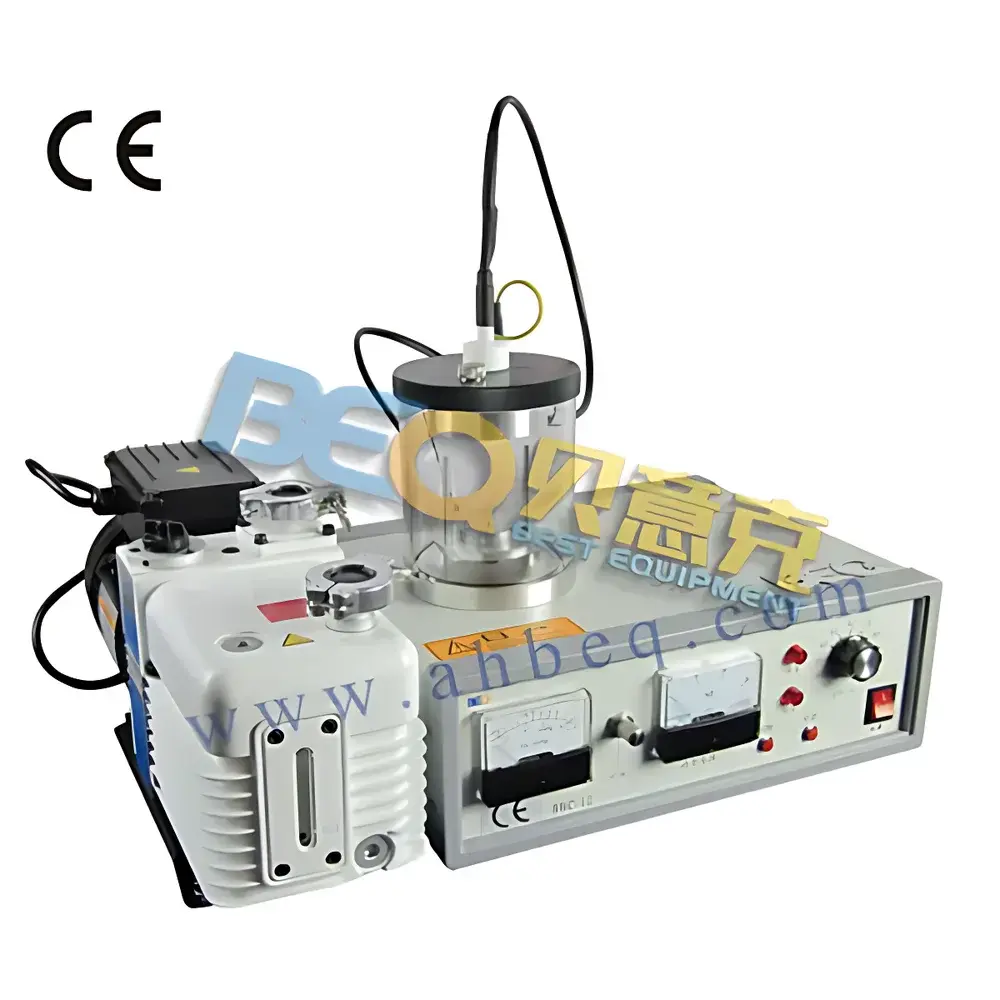
BEQ Miniature Ion Sputter Coater
| Brand | BEQ |
|---|---|
| Origin | Anhui, China |
| Manufacturer Type | Authorized Distributor |
| Target Market | Domestic (China) |
| Target Applications | SEM Sample Preparation |
| Sputtering Target Diameter | 58 mm |
| Sample Stage Diameter | 40 mm (accommodates up to six standard sample cups) |
| Chamber Dimensions | Ø100 mm × 130 mm (height) |
| Vacuum System | Direct-coupled two-stage rotary vane pump (RVD-2), pumping speed: 2 L/s, ultimate pressure: 5 × 10⁻² Pa |
| Vacuum Gauge | Pirani gauge |
| Process Gas Options | Air or high-purity argon (dedicated Ar inlet with fine-flow micro-regulation valve) |
| Operating Pressure Range | Adjustable from ~1–20 Pa via precision bleed valve |
| Safety Interlock | Automatic cutoff at 20 Pa chamber pressure |
Overview
The BEQ Miniature Ion Sputter Coater is a compact, benchtop sputter deposition system engineered for routine conductive coating of non-conductive specimens prior to scanning electron microscopy (SEM) analysis. It operates on the principle of DC magnetron sputtering: under controlled low-pressure inert gas (typically argon) environment, a plasma discharge is generated between a metallic target (e.g., Au, Pt, Cr, or Pd) and the grounded sample stage. Energetic argon ions bombard the target surface, ejecting atoms that subsequently condense as a uniform, nanoscale conductive film onto the specimen. This process mitigates charging artifacts, improves secondary electron yield, and enhances signal-to-noise ratio during high-resolution SEM imaging—particularly critical for biological tissues, polymers, ceramics, and geological samples. Designed for laboratories with space constraints and moderate throughput requirements, the coater delivers reproducible sub-10 nm gold coatings with minimal thermal load and negligible substrate damage.
Key Features
- Compact borosilicate glass vacuum chamber (Ø100 mm × 130 mm height) with front-loading hinged lid and O-ring sealed viewport for real-time process monitoring.
- High-efficiency DC magnetron sputtering source with standardized 58 mm diameter target mounting—compatible with commercially available Au, Pt, Au/Pd, and Cr targets.
- Rotatable, electrically isolated sample stage (Ø40 mm) accommodating up to six standard 10 mm-diameter sample stubs or cup holders simultaneously—enabling batch processing without manual repositioning.
- Dedicated high-purity argon gas inlet with integrated precision micro-flow control valve, enabling stable pressure regulation between 1 and 20 Pa for optimized sputter rate and film morphology.
- Integrated Pirani vacuum gauge with digital readout and automatic safety interlock: power supply deactivates if chamber pressure exceeds 20 Pa, preventing arcing and ensuring operator safety.
- Robust two-stage rotary vane vacuum pump (RVD-2 type) delivering 2 L/s pumping speed and <5 × 10⁻² Pa base pressure—sufficient for rapid pump-down (<90 s to operational range) and long-term stability.
Sample Compatibility & Compliance
The coater supports a broad spectrum of non-conductive and semi-conductive specimens, including freeze-fractured biological sections, insulating polymer films, oxide-based catalysts, mineral thin sections, and porous ceramic substrates. All internal components—including chamber walls, stage, and shield—utilize electropolished stainless steel or inert glass surfaces to minimize contamination and facilitate cleaning. The system conforms to general laboratory safety standards (IEC 61010-1) and supports GLP-compliant operation through manual logbook documentation of process parameters (time, pressure, current). While not certified for GMP or FDA 21 CFR Part 11 compliance out-of-the-box, its repeatable sputtering protocol aligns with ASTM E1558–22 (Standard Guide for Sputter Coating Nonconductive Specimens for SEM) and ISO/IEC 17025 traceability frameworks when operated within validated parameter ranges.
Software & Data Management
This model operates via an analog front-panel interface with manually adjustable DC power output (0–40 mA), timer (0–300 s), and gas flow regulator. No embedded firmware or digital control software is included; however, all operational parameters are directly observable and recordable in laboratory notebooks. For integration into automated workflows, external TTL-triggered timers or programmable logic controllers (PLCs) may be interfaced via the unit’s dry-contact output port (optional accessory). Process logs—including sputter duration, observed chamber pressure, and target material—are recommended for audit trails in regulated environments.
Applications
- Routine gold coating of SEM specimens for high-resolution topographic imaging and energy-dispersive X-ray spectroscopy (EDS) analysis.
- Preparation of TEM grid support films using carbon or chromium targets.
- Thin-film deposition for electrical contact formation on MEMS devices during failure analysis.
- Surface modification of hydrophobic polymers to enable subsequent metal-assisted etching or lithography steps.
- Teaching laboratories: demonstration of plasma physics fundamentals, thin-film growth kinetics, and vacuum technology principles.
FAQ
What target materials are compatible with this sputter coater?
Standard 58 mm diameter targets—including Au, Pt, Au/Pd (80/20), Cr, C, and Ni—are mechanically and electrically compatible. Target thickness should be ≥1.5 mm for stable sputtering life.
Can I use nitrogen or oxygen as the sputtering gas?
No. Reactive gases such as N₂ or O₂ are not supported; only inert gases (Ar, optionally air for basic training use) are permitted to avoid oxidation of the cathode assembly and uncontrolled plasma instability.
Is the sample stage cooled during sputtering?
No active cooling is provided. However, the low-duty-cycle DC operation (typical 30–90 s per run) and thermally isolated stage design limit sample temperature rise to <15 °C above ambient—suitable for most heat-sensitive biological specimens.
How often does the vacuum pump oil require replacement?
Under normal usage (≤5 cycles/day), pump oil should be replaced every 500 operating hours or semiannually, whichever occurs first. Use only ISO VG 100 rotary vane pump oil.
Does the system include a film thickness monitor?
No. Thickness estimation is based on empirical calibration curves (time vs. nominal thickness for Au at fixed pressure/current). Quartz crystal microbalances (QCM) are available as optional add-ons but require chamber modification.



