
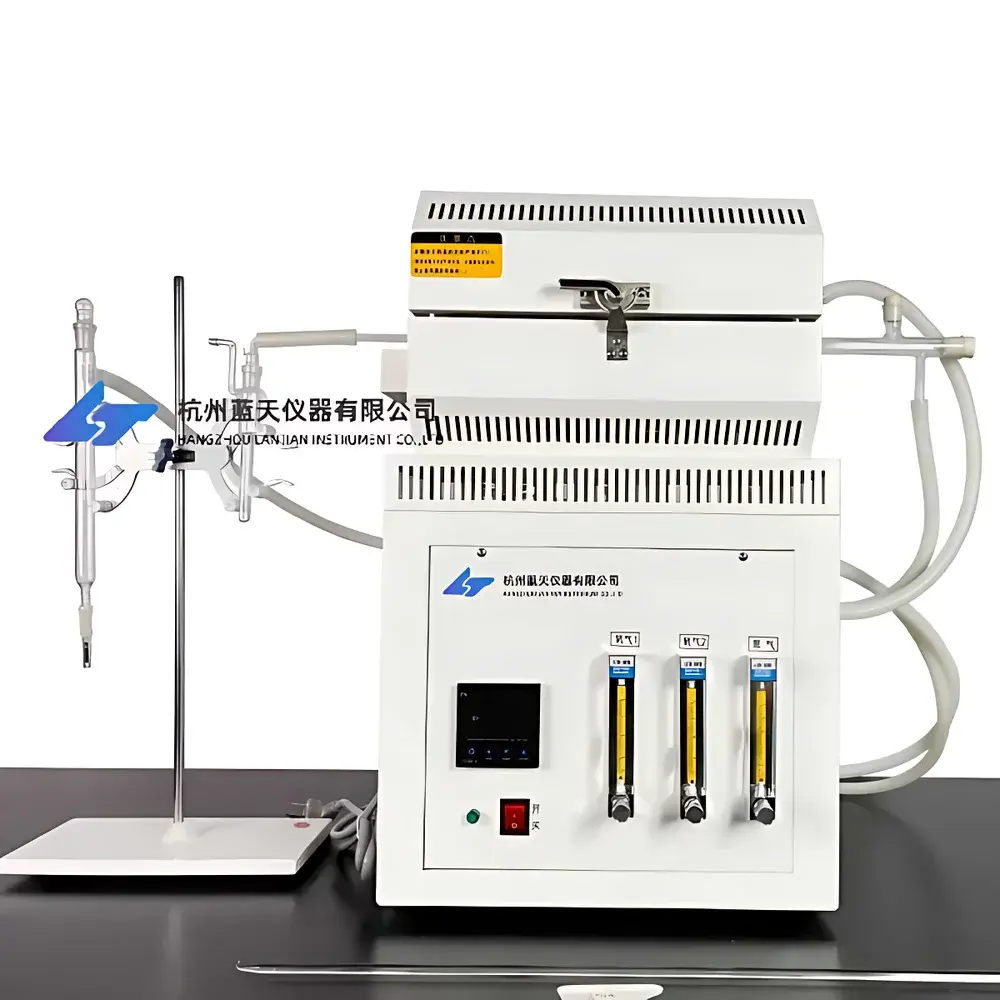
LANTIAN AOX- Organic Halogen Combustion Furnace
| Brand | LANTIAN |
|---|---|
| Origin | Zhejiang, China |
| Manufacturer Type | Direct Manufacturer |
| Model | AOX- Organic Halogen Combustion Furnace |
| Compliance | HJ/T 83–2001, ISO 9562:1989, GB/T 15959–1995, GB 8978–1996, GB 3544–2008 |
| Sample Throughput | Up to 24 samples per batch (standard configuration) |
| Combustion Temperature Range | Ambient to 1100 °C (programmable, ±2 °C stability) |
| Gas Supply | Dual-gas system (N₂ for adsorption, O₂ for combustion) |
| Tube Material | High-purity quartz combustion tube (OD 15 mm, length 600 mm) |
| Integrated Scrubbing System | Five-stage acid/alkali wash bottles + dual absorption traps |
Overview
The LANTIAN AOX- Organic Halogen Combustion Furnace is a purpose-built thermal oxidation system engineered for the quantitative determination of Adsorbable Organic Halogens (AOX) in environmental matrices. It operates on the principle of adsorptive enrichment followed by high-temperature catalytic combustion (900–1100 °C), converting organically bound chlorine, bromine, and iodine into inorganic halide ions (Cl⁻, Br⁻, I⁻), which are subsequently trapped in aqueous absorbent solutions for downstream quantification—typically via ion chromatography (IC) or microcoulometric titration. Designed in strict accordance with HJ/T 83–2001 (China’s EPA standard for AOX in water), ISO 9562:1989, and GB/T 15959–1995, the furnace delivers trace-level halogen recovery with high reproducibility and minimal memory effect. Its robust architecture supports routine compliance testing across wastewater treatment plants, environmental monitoring labs, pulp & paper facilities, and regulatory quality control units.
Key Features
- Integrated, space-efficient design with built-in multi-stage scrubbing system (5 wash bottles + 2 absorption traps) to remove SO₂, NOₓ, CO₂, and acidic gases prior to halide capture.
- Programmable temperature controller with PID regulation and real-time monitoring (±2 °C accuracy over full 100–1100 °C range).
- Quartz combustion tube (OD 15 mm, 600 mm length) resistant to thermal shock and halogen corrosion; includes dual-zone heating profile capability.
- Dual-gas manifold with independent N₂ (adsorption phase) and O₂ (combustion phase) flow control; all gas lines pre-configured with calibrated stainless-steel regulators and pressure gauges.
- Modular sample handling: Includes 2 ceramic sample boats, 1 quartz push rod, 2 silicone rubber end caps, and standardized 15 mm OD silicone tubing kit (1.27 m total, pre-cut to specification).
- No external vacuum pump required—uses positive-pressure N₂ purging during adsorption and controlled O₂ flow during combustion.
Sample Compatibility & Compliance
The AOX- Combustion Furnace accommodates liquid, solid, and semi-solid environmental samples per standardized protocols: drinking water, surface water, groundwater, municipal and industrial wastewater (including saline effluents), sludge, sediments, and spent fats/oils. Sample preparation follows HJ/T 83–2001 methodology—adsorption onto activated carbon (user-supplied, 500 g minimum), followed by acidification and thermal desorption. All hardware interfaces—including adsorption column mounting fixtures, gas line routing, and absorption train geometry—conform to dimensional and functional requirements outlined in ISO 9562 and GB/T 15959. The system is compatible with GLP-compliant workflows and supports full audit trails when paired with validated IC or microcoulometric instrumentation meeting USP <643>, ASTM D5908, and EPA Method 1650 requirements.
Software & Data Management
While the AOX- furnace itself is hardware-controlled (no embedded microprocessor), its operational parameters are fully documentable within laboratory information management systems (LIMS) via manual log entry or external data acquisition modules. Temperature profiles, gas flow rates (N₂: 50–200 mL/min; O₂: 100–300 mL/min), and combustion duration (typically 10–15 min) are recorded per sample batch to satisfy ISO/IEC 17025 documentation requirements. When integrated with compliant ion chromatographs (e.g., Thermo Scientific Dionex or Metrohm 940 Series), the complete AOX workflow supports 21 CFR Part 11–aligned electronic signatures, audit trail generation, and raw data archiving—ensuring readiness for regulatory inspections under CNAS, CMA, or EU ILAC frameworks.
Applications
- Routine AOX monitoring in municipal wastewater treatment plants for discharge compliance (GB 8978–1996, GB 3544–2008).
- Process validation in chlorinated pulp bleaching operations where organochlorine byproducts must be quantified.
- Soil and sediment screening at contaminated sites under China’s “Soil Environmental Quality Risk Control Standard” (GB 15618–2018) Annex B.
- Validation of activated carbon filtration efficiency in potable water treatment facilities.
- Research-grade halogen speciation studies requiring precise thermal release kinetics and low blank performance (<0.5 µg Cl⁻ equivalent).
FAQ
What analytical instruments are required to complete the AOX measurement?
Ion chromatography (IC) or microcoulometric titrator is mandatory for final halide quantification. The furnace provides only the combustion and trapping step.
Is the system compatible with EPA Method 1650?
Yes—when operated per HJ/T 83–2001 and coupled with IC detection, the method equivalence to EPA 1650 is established through interlaboratory validation data published in Chinese Environmental Monitoring (Vol. 39, No. 4, 2023).
Can the furnace handle high-salinity samples such as seawater or brine?
Yes—its quartz tube and scrubber configuration tolerate chloride loads up to 10,000 mg/L; however, pre-dilution or matrix-matched calibration is recommended for optimal accuracy.
What maintenance is required for long-term reliability?
Quarterly inspection of quartz tube integrity, replacement of silicone tubing every 6 months, and annual recalibration of gas flow meters using certified mass flow calibrators.
Does the system support automated sample loading?
No—it is manually loaded; however, the standardized sample boat geometry allows integration with third-party autosamplers upon custom mechanical adaptation.







