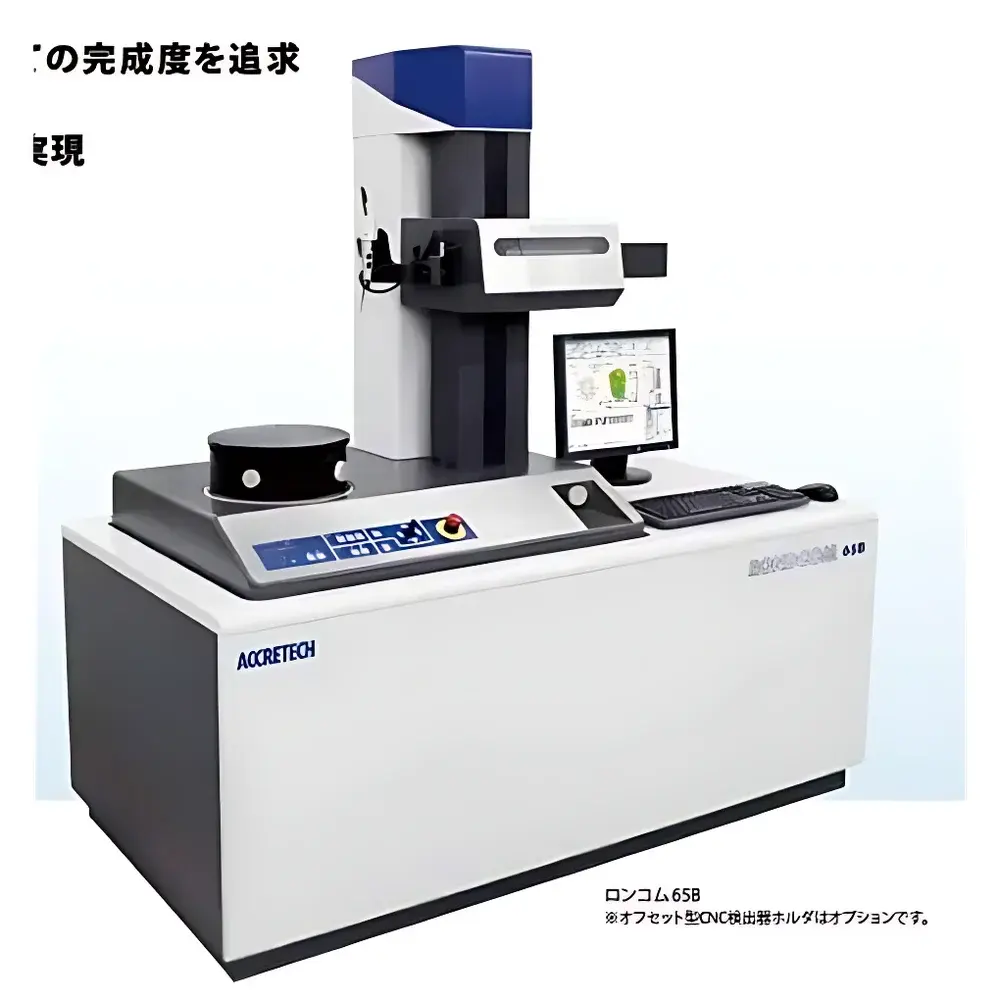
Accretech RONDCOM 65B High-Precision Roundness and Cylindricity Measuring Instrument
| Brand | Accretech (ACCRETECH) |
|---|---|
| Origin | Switzerland |
| Model | RONDCOM 65B |
| Measurement Capabilities | Roundness, Cylindricity, Straightness (axial & radial), Parallelism, Perpendicularity, Coaxiality, Concentricity, Taper, Diameter, Radial Runout, Total Radial Runout, Generatrix Straightness of Cylinders, Face Straightness, Face Runout, Flatness, Wall Thickness Variation, Angular Deviation, Small Arc Segments, Piston Profile |
| Spindle Accuracy | (0.01 + 4H/10,000) µm (H = height from table in mm) |
| Bearing Type | Air-bearing spindle |
| Max. External Diameter | 420 mm |
| Rotation Speed | 2–10 rpm (up to 20 rpm during positioning) |
Overview
The Accretech RONDCOM 65B is a high-precision, air-bearing roundness and cylindricity measuring instrument engineered for metrology laboratories and advanced quality control environments requiring traceable, sub-micron geometric form evaluation. Based on the principle of precision rotational axis metrology, the system employs a highly stable air-spindle architecture to establish a reference rotation axis with exceptional radial and axial fidelity—enabling measurement of form deviations against ideal geometric constructs (e.g., perfect circle, cylinder, plane, or line). Its mechanical design integrates a massive granite base and column structure to minimize thermal drift and dynamic deflection, ensuring long-term repeatability and resistance to environmental perturbations. Compliant with JIS B 7451:1997 for roundness evaluation methodology and uncertainty modeling, the RONDCOM 65B delivers certified measurement capability for ISO/IEC 17025-accredited calibration labs and industries governed by ASME Y14.5, ISO 1101, and ISO 5436-1 standards.
Key Features
- Air-bearing main spindle with radial accuracy of (0.01 + 4H/10,000) µm per JIS B 7451:1997, where H is the vertical distance from the turntable surface to the measurement point.
- Granite structural frame providing high rigidity, low thermal expansion, and vibration damping essential for nanoscale form metrology.
- Motorized Z-axis (500 mm travel) and R-axis (220 mm radial travel) with programmable speeds (0.6–6 mm/s), enabling precise probe positioning across complex geometries.
- Adjustable turntable with ±5 mm centering range and ±1° tilt capability, supporting automatic centering and leveling functions for asymmetric or off-center workpieces.
- Stylus force continuously adjustable from 30–100 mN, optimized for delicate surfaces (e.g., bearing races, optical lenses, precision gears) without plastic deformation.
- Digital filtering options including Gaussian, 2RC, Spline, and ISO 13565-3 compliant “009” filter, with configurable cutoff wavelengths (0.025–8 mm for Z-axis; 15–1500 undulations/revolution for θ-axis).
- Multi-algorithm form evaluation: MZC (Minimum Zone Center), LSC (Least Squares Center), MIC (Maximum Inscribed Circle), MCC (Minimum Circumscribed Circle), and N.C. (No Correction), supporting full GD&T-compliant reporting.
Sample Compatibility & Compliance
The RONDCOM 65B accommodates cylindrical, disc-shaped, and stepped components up to φ420 mm OD, 780 mm height, and 150 mm maximum bore depth. Workpiece mass capacity is 60 kg. Its modular probe configuration—including standard φ1.6 mm × 53 mm sapphire-tipped styli and optional inkjet-type non-contact sensor mounts—supports both tactile and hybrid measurement strategies. All measurement data and system logs are structured to support GLP/GMP audit trails. Software-generated reports include full traceability metadata (operator ID, timestamp, environmental conditions, calibration certificate IDs), satisfying FDA 21 CFR Part 11 requirements when deployed with validated electronic signature modules. The instrument meets CE marking requirements and conforms to IEC 61000-6-2 (immunity) and IEC 61000-6-3 (emission) electromagnetic compatibility standards.
Software & Data Management
Equipped with Accretech’s proprietary RONDCOM-PC software suite, the system supports full CNC programming, real-time waveform visualization, and multi-layer shape analysis. Raw profile data is stored in ASCII-compatible binary format with embedded metadata headers for interoperability with third-party statistical process control (SPC) platforms such as Minitab, JMP, and Q-DAS. Advanced post-processing includes cross-sectional profile comparison against CAD nominal geometry, amplitude distribution histograms, power spectral density (PSD) analysis, load curve generation, and contour mapping (wireframe, grayscale, and contour-line representations). All software operations—including parameter modification, report export, and filter selection—are logged with time-stamped, user-attributed entries to fulfill ALCOA+ data integrity principles.
Applications
The RONDCOM 65B serves critical dimensional verification tasks across aerospace (turbine blade root profiles, landing gear bushings), automotive (crankshaft journals, fuel injector nozzles, piston rings), medical device manufacturing (orthopedic implant tapers, syringe barrels), and precision optics (lens mount concentricity, collimator housing cylindricity). It is routinely deployed in Tier-1 supplier QA labs serving OEMs including Honda, Hitachi, General Motors, and Apple, where compliance with PPAP Level 3 submission requirements mandates documented uncertainty budgets and measurement system analysis (MSA) per AIAG MSA-4 guidelines. Its ability to quantify taper, generatrix straightness, and face runout makes it indispensable for evaluating rotary sealing interfaces and hydrodynamic bearing surfaces.
FAQ
What standards does the RONDCOM 65B comply with for roundness evaluation?
It adheres to JIS B 7451:1997 for spindle error separation and uncertainty modeling, and supports evaluation per ISO 12181-1 (roundness) and ISO 12180-1 (cylindricity).
Can the system perform automated GD&T-compliant reporting?
Yes—software includes built-in ASME Y14.5 and ISO 1101 symbol mapping, with customizable report templates exportable to PDF, CSV, and XML.
Is air supply conditioning required for stable operation?
Yes—a clean, dry, oil-free compressed air source at 0.4 MPa (4 bar) is mandatory; integrated filtration and pressure regulation are recommended per ISO 8573-1 Class 2:2:2.
What is the typical measurement uncertainty for diameter assessment on a φ100 mm steel gauge ring?
Under controlled lab conditions (20 ± 0.5 °C, vibration-isolated floor), expanded uncertainty (k=2) is ≤0.35 µm for diameter, validated per ISO/IEC 17025 internal procedures.
Does the system support integration into factory-wide MES or QMS platforms?
Via OPC UA and TCP/IP-based API, raw data and pass/fail status can be streamed directly to Siemens Opcenter, PTC ThingWorx, or custom SQL databases using ODBC-compliant drivers.