
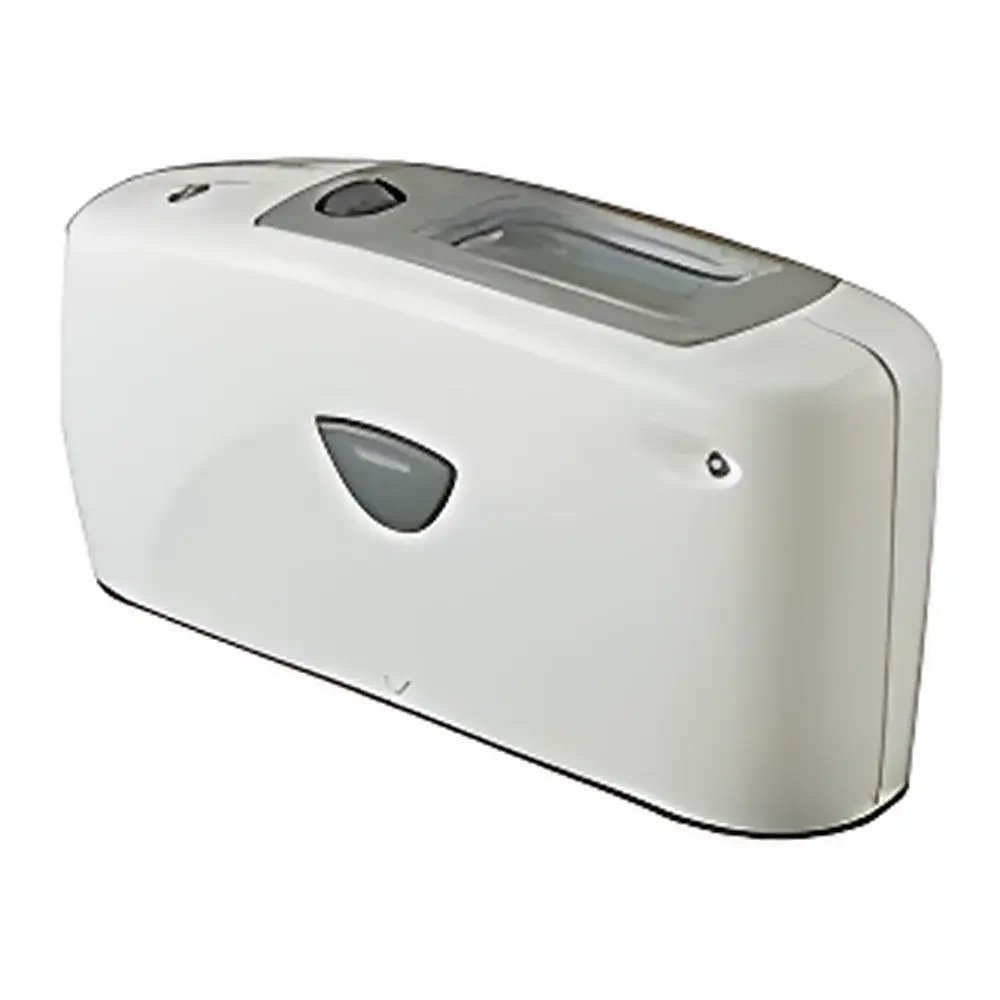
Konica Minolta Multi Gloss 268 Portable Tri-Angle Gloss Meter
| Brand | Konica Minolta |
|---|---|
| Origin | Japan |
| Model | Multi Gloss 268 |
| Measurement Angles | 20°, 60°, 85° |
| Measurement Spot Size | 20°: 10 × 10 mm |
| 60° | 9 × 15 mm |
| 85° | 5 × 38 mm |
| Standards Compliance | ISO 2813, ISO 7668, ASTM D523, ASTM D2457, DIN 67530, JIS Z 8741, BS 3900, BS 6161-12 |
| Measurement Range | 20°: 0.0–2000 GU |
| 60° | 0.0–1000 GU |
| 85° | 0.0–160 GU |
| Resolution | 0.1 GU (0.0–99.9 GU), 1 GU (100–2000 GU) |
| Repeatability | ±0.2 GU (0.0–99.9 GU), ±0.2% of reading (100–2000 GU) |
| Instrument Error | ±0.5 GU (0.0–99.9 GU), ±0.5% of reading (100–2000 GU) |
| Data Storage | 999 measurements with timestamp |
| Standard Memory | 50 reference standards |
| Measurement Speed | 0.5 s per reading |
| Power Source | 1.5 V AA (R6) alkaline batteries (approx. 10,000 measurements) |
| Auto Power-Off | Adjustable 10–99 s |
| Operating Environment | 15–40 °C, ≤85% RH (non-condensing at ≤35 °C) |
| Storage Conditions | −10–60 °C, ≤85% RH (non-condensing at ≤35 °C) |
| Dimensions | 155 × 73 × 48 mm |
| Weight | 400 g |
| Interface | RS-232C |
| Supported Languages | English, Spanish, German, French, Italian, Japanese |
| Software | GlossLink data exchange software |
Overview
The Konica Minolta Multi Gloss 268 is a handheld tri-angle gloss meter engineered for high-precision, traceable surface gloss evaluation across industrial quality control and R&D environments. It operates on the principle of specular reflectance measurement—quantifying the ratio of reflected light intensity at a defined geometry to that from a polished black glass standard (defined as 100 GU at 60°). By supporting three standardized incident angles—20° (optimized for high-gloss surfaces ≥70 GU), 60° (universal reference angle per ISO 2813 and ASTM D523), and 85° (designed for low-gloss and matte finishes ≤10 GU)—the instrument enables consistent, multi-angle characterization of surface optical response. Its compact form factor (155 × 73 × 48 mm, 400 g), battery-powered operation, and sub-second measurement cycle (0.5 s) make it suitable for in-line inspection, field audits, and laboratory benchtop use without sacrificing metrological rigor.
Key Features
- Tri-angle measurement capability (20°, 60°, 85°) with dedicated spot sizes optimized for each geometry—ensuring accurate sampling of heterogeneous or textured surfaces.
- Compliance with international standards including ISO 2813, ISO 7668, ASTM D523, ASTM D2457, DIN 67530, JIS Z 8741, BS 3900, and BS 6161-12—facilitating cross-laboratory comparability and regulatory acceptance.
- High-resolution display and dual-button interface enabling rapid access to calibration, measurement, statistical analysis (mean, SD, min/max), and gloss difference (ΔGU) calculation—no menu navigation required.
- Onboard memory storing up to 999 timestamped measurements with automatic date/time stamping—supporting GLP-compliant recordkeeping and batch traceability.
- Integrated reference memory for up to 50 user-defined standards—enabling rapid pass/fail assessment against internal specifications or customer tolerances.
- RS-232C serial interface and bundled GlossLink software for bidirectional data transfer, report generation, and integration into LIMS or MES platforms.
- Robust mechanical design with IP54-rated ingress protection (dust- and splash-resistant), calibrated using NIST-traceable high-gloss ceramic tiles included in the standard kit.
Sample Compatibility & Compliance
The Multi Gloss 268 accommodates flat, curved, and moderately textured surfaces—including painted automotive body panels, injection-molded plastic housings, coated metal substrates, ceramic glazes, and laminated composites. Its variable aperture sizes (10 × 10 mm at 20°, 9 × 15 mm at 60°, 5 × 38 mm at 85°) minimize edge effects and ensure representative sampling across diverse geometries. The instrument meets the physical and procedural requirements for routine testing under ISO/IEC 17025-accredited laboratories and supports audit readiness for FDA-regulated manufacturing (e.g., medical device coatings) and IATF 16949 automotive processes. All factory calibrations are documented with certificate of conformance referencing JIS Z 8741 Annex B and ASTM E1347 methodology.
Software & Data Management
GlossLink software provides secure, structured data handling compliant with 21 CFR Part 11 requirements—including electronic signatures, audit trails, and user-access controls. Raw measurement logs export in CSV and Excel-compatible formats, preserving metadata (operator ID, sample ID, time/date, angle, GU value, deviation from standard). Trend analysis tools enable SPC charting (X-bar/R charts), capability indices (Cp/Cpk), and deviation heatmaps across production lots. Firmware updates and language pack installations are performed via RS-232C connection, ensuring long-term maintainability without hardware modification.
Applications
- Automotive OEMs and Tier-1 suppliers: Monitoring paint gloss consistency across body-in-white, clear coat, and trim components per OEM-specific standards (e.g., GMW14872, Ford WSS-M2P147-A2).
- Plastics processors: Verifying surface finish stability during extrusion, thermoforming, and injection molding—correlating gloss shifts with melt temperature, mold release agent concentration, or pigment dispersion.
- Ceramic and tile manufacturers: Quantifying glaze uniformity and firing consistency in sanitaryware, tableware, and architectural ceramics per ISO 10545-14.
- Coatings R&D labs: Screening formulation variables (resin type, solvent blend, flattening agent loading) using multi-angle gloss profiles to predict visual appearance under varied illumination conditions.
- Quality assurance in aerospace composites: Assessing gel coat integrity and post-cure surface reflectivity on carbon fiber-reinforced polymer (CFRP) panels prior to final assembly.
FAQ
Does the Multi Gloss 268 require annual recalibration?
Yes—Konica Minolta recommends annual traceable recalibration using certified reference standards. In-house verification with the supplied high-gloss TRI tile should be performed before each shift.
Can the instrument measure curved surfaces?
It can measure convex surfaces with radii ≥50 mm and concave surfaces with radii ≥100 mm, provided the measurement spot remains fully within the illuminated area and no shadowing occurs.
Is USB connectivity supported natively?
No—USB communication requires the optional USB-to-RS-232 adapter (sold separately); the built-in interface is RS-232C only.
How is measurement repeatability verified?
Repeatability is validated per ISO 2813 Annex A: ten consecutive readings on a stable, homogeneous reference tile under controlled temperature (23 ± 2 °C) and humidity (50 ± 5% RH).
Are calibration certificates provided with the instrument?
A factory calibration certificate (traceable to NMIJ/AIST, Japan) is included; accredited calibration certificates (ISO/IEC 17025) are available upon request at time of purchase.






