
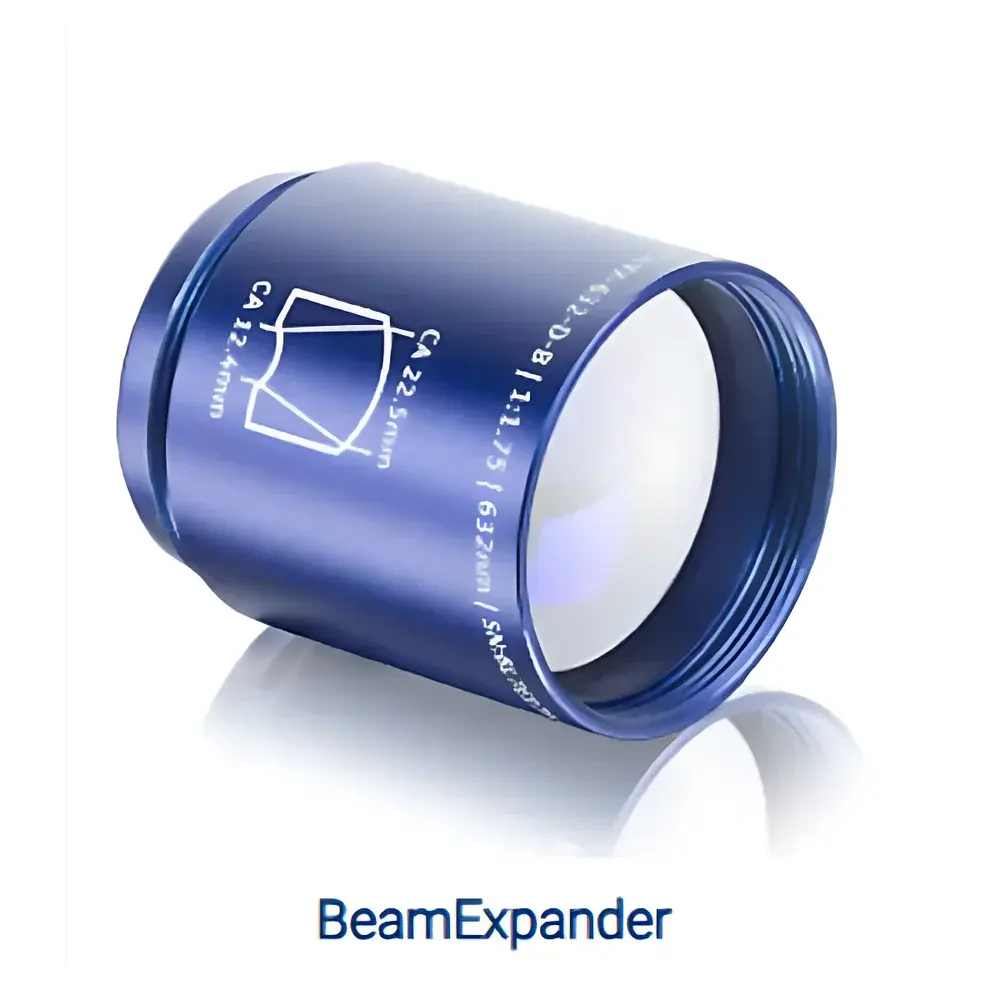
asphericon BAM25-200-B-632 Diffraction-Limited Aspheric Beam Expander
| Brand | asphericon |
|---|---|
| Origin | Germany |
| Model | BAM25-200-B-632 |
| Design Wavelength | 632 nm |
| Expansion Ratio | 2.0× |
| Input Aperture | 10.6 mm |
| Output Aperture | 22.5 mm |
| Thread | M28×0.75 |
| Length | 34.8 mm |
| Coating Type | Broadband AR (600–1050 nm, R<1.0% max, R<0.4% avg at 0° AOI) |
| Laser Damage Threshold | 12 J/cm² @ 100 Hz, 6 ns, 532 nm |
| Surface Irregularity (RMSi) | <0.5 µm |
| Compliance | RoHS |
Overview
The asphericon BAM25-200-B-632 is a monolithic, diffraction-limited beam expander engineered for high-precision laser applications requiring minimal wavefront distortion and maximal transmission stability. Unlike conventional Keplerian or Galilean telescopes composed of multiple spherical elements, this device employs a single custom-aspheric lens pair—designed using rigorous non-paraxial ray tracing—to eliminate spherical aberration, coma, and field curvature across its full operating bandwidth. Its optical architecture leverages the inherent advantages of aspheric surfaces to achieve near-theoretical diffraction-limited performance (Strehl ratio >0.95) at 632 nm, making it ideal for interferometry, holography, ultrafast pulse shaping, and high-resolution lithography alignment systems. Manufactured in Germany under ISO 9001-certified cleanroom conditions, each unit undergoes individual interferometric verification with full ZYGO-compatible test reports and an original asphericon Certificate of Conformance.
Key Features
- Monolithic design with zero internal air gaps—eliminates ghost reflections and thermal drift-induced misalignment
- Diffraction-limited performance verified per ISO 10110-5; RMS wavefront error < λ/14 @ 632 nm (typ.)
- Optimized broadband anti-reflection coating (Type B) delivering <0.4% average reflectance from 600–1050 nm at normal incidence
- Mechanically robust M28×0.75 threaded housing compatible with standard optomechanical mounts (e.g., Thorlabs SM2, Newport KM100)
- Laser damage threshold certified to 12 J/cm² (100 Hz, 6 ns, 532 nm), enabling safe integration into Q-switched and mode-locked Nd:YAG systems
- Surface irregularity controlled to RMSi < 0.5 µm over full clear aperture—critical for maintaining beam quality in M²-sensitive applications
- Scalable modular architecture: up to five BAM units may be cascaded without intermediate re-collimation, supporting total expansion ratios up to 32× with <0.3 mrad pointing deviation
Sample Compatibility & Compliance
The BAM25-200-B-632 is qualified for use with continuous-wave (CW) and pulsed lasers operating at 632 nm—including HeNe, diode-pumped solid-state (DPSS), and frequency-doubled sources. Its fused silica and S-LAH64 substrate materials ensure low thermal lensing and negligible birefringence under moderate power loading (<5 W CW). All optical surfaces meet ISO 10110-7 scratch-dig specification 20–10, and mechanical housing conforms to DIN 40050-9 (IP54 equivalent) for dust resistance. The product complies with EU RoHS Directive 2011/65/EU and carries CE marking for optical safety (EN 60825-1:2014). While not classified as medical or IVD equipment, its metrological traceability supports GLP-compliant calibration workflows when used in metrology-grade laser alignment setups.
Software & Data Management
Each unit ships with a digital twin package including Zemax (.zmx), CodeV (.seq), and STEP (.stp) files for integration into optical design and mechanical CAD environments. Interferometric test data is provided in ASCII-encoded .txt format compatible with MATLAB, Python (NumPy), and commercial analysis tools (e.g., 4D Technology’s DFTFringe). No proprietary software is required for operation or validation. For laboratories subject to FDA 21 CFR Part 11 or ISO/IEC 17025 requirements, asphericon provides optional audit-ready documentation packages—including raw interferogram exports, calibration uncertainty budgets (k=2), and operator sign-off logs—upon request.
Applications
- Precision interferometric alignment in semiconductor mask inspection and EUV source development
- Beam conditioning for Ti:sapphire amplifier chains and optical parametric chirped-pulse amplification (OPCPA) systems
- High-fidelity illumination in confocal microscopy and structured light projection metrology
- Low-noise excitation path expansion in Raman spectroscopy and cavity ring-down absorption systems
- Stable collimation of single-mode fiber outputs for free-space quantum optics experiments (e.g., Bell state generation, homodyne detection)
- Calibration reference in laser beam profiling systems compliant with ISO 11146-1/-2
FAQ
Is the BAM25-200-B-632 suitable for ultrashort pulses (e.g., <100 fs)?
Yes—its monolithic design eliminates group delay dispersion (GDD) contributions from air-glass interfaces. Measured GDD is <±5 fs² across 600–650 nm, enabling direct use with Ti:sapphire oscillators without prism or chirped mirror compensation.
Can I cascade multiple BAM expanders without realignment?
Yes—the integrated kinematic thread interface maintains coaxial alignment within ±2.5 µm centering tolerance per stage. Total pointing stability remains within ±0.3 mrad after stacking five units.
Does asphericon provide NIST-traceable calibration certificates?
Standard delivery includes interferometric certification against a calibrated Zygo Verifire™ system. NIST-traceable calibration (via PTB-accredited lab) is available as a value-added service with documented measurement uncertainty.
What is the maximum input beam diameter supported at 632 nm?
The specified maximum input aperture is 10.6 mm. Exceeding this risks vignetting and degradation of diffraction-limited performance; users requiring larger inputs should consider the BAM25-150-B-632 variant (14.7 mm input).
Are custom coatings available for this model?
Yes—custom V-coatings (e.g., R<0.25% @ 632 nm) or dual-band AR options can be quoted separately. Lead time increases by 4–6 weeks, and minimum order quantity applies.




