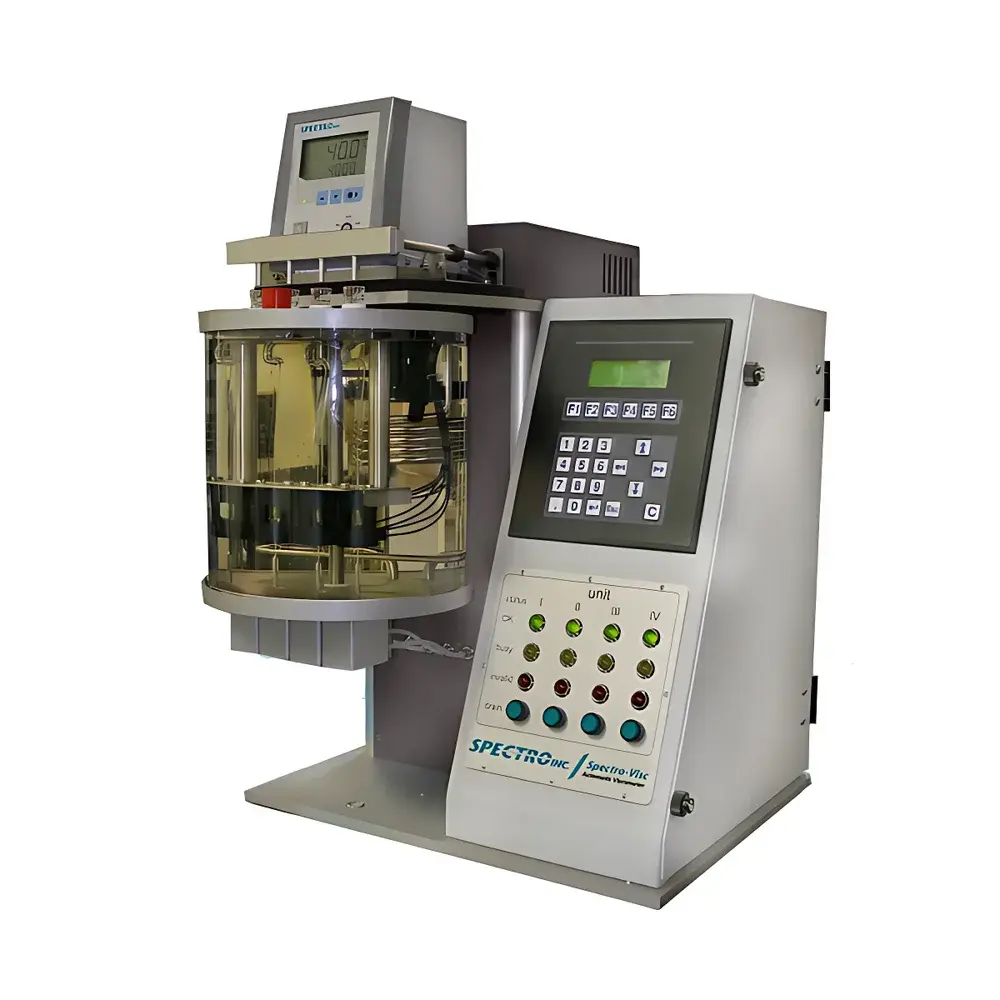
Spectro Scientific SpectroVisc 300 Series Kinematic Viscosity Analyzer
| Brand | Spectro Scientific |
|---|---|
| Origin | USA |
| Model | SpectroVisc 300 (Single-Bath, 4-Capillary) / SpectroVisc 310 (Dual-Bath, 8-Capillary) |
| Compliance | ASTM D445, ASTM D7279, ASTM D446, ISO 3104, IP 71 |
| Throughput | Up to 60 samples/hour |
| Sample Volume | 0.2–0.6 mL per test |
| Solvent Consumption | 2–3 mL per sample |
| Capillary Type | Patented S-type (Houillon) viscometer tubes |
| Temperature Control | Precision thermostatic bath with recirculating heater |
| Dimensions (SpectroVisc 300) | 48 × 44 × 62 cm |
| Weight (SpectroVisc 300) | 33 kg |
| Dimensions (SpectroVisc 310) | 48 × 70 × 62 cm |
| Weight (SpectroVisc 310) | 62 kg |
| Operation Modes | Kinematic viscosity measurement mode or capillary calibration mode |
| Cleaning | Automated solvent rinse and hot-air drying |
| Optional Features | Dual-solvent cleaning, dual-measurement capability, PC-based data acquisition and audit trail |
Overview
The Spectro Scientific SpectroVisc 300 Series is a benchtop semi-automated kinematic viscosity analyzer engineered for high-reproducibility measurement of new and in-service lubricants, hydraulic fluids, transformer oils, and other petroleum-based industrial fluids. It operates on the principle of gravity-driven capillary flow through calibrated S-type (Houillon) viscometer tubes—standardized geometry capillaries defined in ASTM D445 and ISO 3104. As the sample flows under controlled thermal conditions (typically at 40 °C and/or 100 °C), optical sensors precisely detect the transit time between two marked points along the capillary. Kinematic viscosity (ν, in mm²/s or cSt) is calculated using the equation ν = C × t, where C is the certified capillary constant (determined via calibration with reference standards) and t is the measured efflux time. The system’s robust architecture integrates a precision thermostatic bath with independent temperature control, low-drift circulation, and real-time thermal monitoring to ensure compliance with the ±0.02 °C temperature tolerance specified in ASTM D445. Designed for routine laboratory environments—including ISO/IEC 17025-accredited oil analysis labs—the SpectroVisc 300 Series delivers traceable, auditable results aligned with global regulatory expectations for condition monitoring and predictive maintenance programs.
Key Features
- Patented S-type (Houillon) capillary design ensures laminar flow and minimizes wall effects, supporting accurate determination across a broad kinematic viscosity range (0.2–1000 mm²/s).
- Single-bath SpectroVisc 300 configuration supports simultaneous operation of four independent capillaries; dual-bath SpectroVisc 310 expands capacity to eight capillaries with independent temperature zones—enabling concurrent testing at multiple standard temperatures (e.g., 40 °C and 100 °C).
- Automated workflow includes optical flow detection, programmable rinse cycles (single- or dual-solvent), hot-air drying, and capillary status monitoring via front-panel LEDs.
- Minimal consumables: only 0.2–0.6 mL sample volume and 2–3 mL solvent per test—reducing operational cost and hazardous waste generation.
- Flexible operation: standalone mode via integrated LCD interface with intuitive menu navigation, or networked PC mode with full data logging, statistical reporting, and configurable user permissions.
- Comprehensive parameter control: users define number of replicate measurements, capillary constants, rinse duration, drying time, and temperature setpoints—all stored with timestamped metadata.
Sample Compatibility & Compliance
The SpectroVisc 300 Series is validated for use with mineral oils, synthetic lubricants, greases (after dilution), diesel fuels, jet fuels, and insulating liquids. Its measurement methodology conforms to the fundamental requirements of ASTM D445 (Standard Test Method for Kinematic Viscosity of Transparent and Opaque Liquids), ASTM D7279 (Standard Practice for Determining Kinematic Viscosity of Petroleum Products by Automated Glass Capillary Viscometers), ASTM D446 (Specifications for Glass Capillary Kinematic Viscometers), ISO 3104 (Petroleum products — Transparent and opaque liquids — Determination of kinematic viscosity), and IP 71 (Determination of kinematic viscosity of petroleum products). All systems undergo factory calibration using NIST-traceable viscosity standards and include documentation suitable for GLP/GMP environments. When configured with PC-based software, the system supports 21 CFR Part 11-compliant electronic records—including audit trails, electronic signatures, and role-based access control—making it suitable for regulated laboratories subject to FDA or EMA oversight.
Software & Data Management
The optional SpectroVisc Control Software provides a secure, Windows-based platform for instrument control, data acquisition, and post-processing. It enables automated report generation (PDF/CSV), statistical analysis (mean, SD, CV%, trend charts), and integration with LIMS via ODBC or CSV export. Each measurement record contains full contextual metadata: operator ID, sample ID, date/time stamp, bath temperature, efflux times, calculated viscosity, capillary ID, and cleaning cycle logs. Audit trail functionality captures all user actions—including parameter edits, calibration updates, and data deletions—with immutable timestamps and operator attribution. Software validation packages—including IQ/OQ documentation—are available upon request to support laboratory accreditation and regulatory audits.
Applications
- Routine quality control of new lubricants and base oils prior to distribution.
- In-service oil analysis for turbine, compressor, gear, and hydraulic systems—detecting viscosity increase (oxidation, soot loading) or decrease (fuel dilution, shear degradation).
- Transformer oil monitoring per IEEE C57.106 and IEC 60429 standards to assess aging and contamination impact on dielectric performance.
- Research and development of formulated lubricants, including additive package evaluation and shear stability assessment.
- Third-party testing laboratories performing accredited viscosity testing under ISO/IEC 17025 scope.
FAQ
What standards does the SpectroVisc 300 Series comply with?
ASTM D445, ASTM D7279, ASTM D446, ISO 3104, and IP 71—covering kinematic viscosity measurement of transparent and opaque petroleum products.
Can the instrument perform both 40 °C and 100 °C measurements simultaneously?
Yes—only the SpectroVisc 310 dual-bath model supports concurrent testing at two independent temperatures; the SpectroVisc 300 requires sequential measurement at different setpoints.
Is capillary calibration required before each test?
No—capillaries are factory-calibrated with certified constants; users may perform periodic verification using reference oils per ASTM D445 Annex A1.
Does the system support 21 CFR Part 11 compliance?
Yes—when operated with the validated SpectroVisc Control Software and appropriate IT infrastructure, including electronic signatures and audit trail configuration.
How is solvent waste minimized during operation?
Through precise metering of 2–3 mL solvent per test and optional dual-solvent cleaning, which allows reuse of primary rinse solvent for preliminary flushes.