
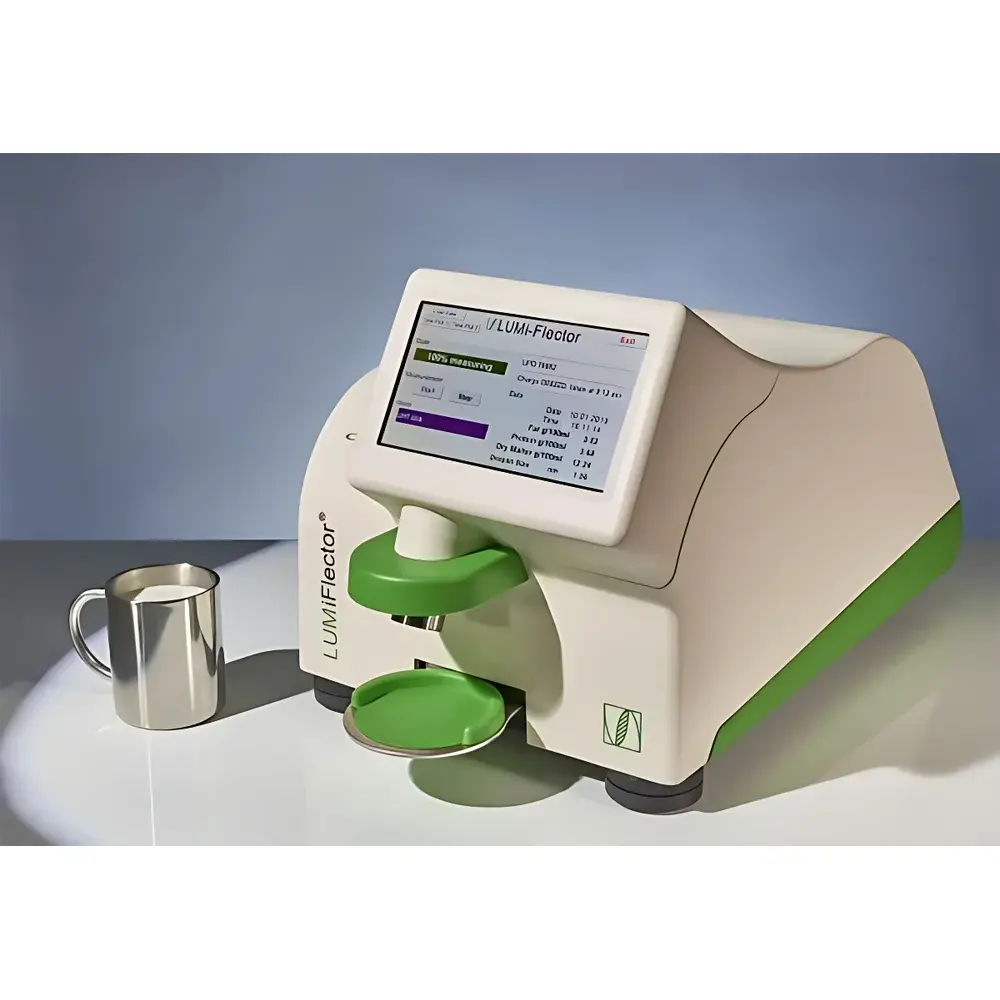
LUM LUMiFlector Multi-Reflection Spectroscopy Analyzer
| Brand | LUM |
|---|---|
| Origin | Germany |
| Model | LUMiFlector |
| Beam Configuration | Single-beam |
| Detector Type | CCD (Charge-Coupled Device) |
| Wavelength Range | 290 nm – 1650 nm |
| Wavelength Accuracy | > ±20 nm |
| Stray Light | < 0.01% T |
| Automation Level | Automatic Wavelength Scanning |
| Sample Interface | Non-contact, optical surface |
| Measurement Time | ~20 s per analysis |
| Calibration | User-definable or factory-customized for specific product matrices |
| Product Parameter Output | Up to 4 simultaneous quantitative parameters per measurement |
| Preloaded Methods | Up to 8 product-specific analysis profiles |
Overview
The LUM LUMiFlector is a benchtop multi-reflection spectroscopy (MRS®) analyzer engineered for rapid, non-invasive quantification of compositional and structural parameters in liquid and semi-liquid dispersions. Unlike conventional UV-Vis spectrophotometers that rely on single-path absorbance or transmittance, the LUMiFlector implements patented MRS Technology®—a spatially resolved reflectance measurement principle utilizing multiple internal reflections within a precisely defined optical cavity. This enables high-sensitivity detection of scattering, absorption, and refractive index gradients across the ultraviolet–visible–near-infrared (UV-Vis-NIR) spectrum (290–1650 nm), without sample dilution, chemical reagents, or physical contact between sensor and product. Designed for both laboratory validation and production-line integration, the instrument delivers reproducible, traceable measurements compliant with industrial quality assurance frameworks including ISO/IEC 17025 and FDA-aligned process analytical technology (PAT) principles.
Key Features
- Non-contact, reagent-free analysis: Eliminates consumables, hazardous waste, and operator exposure risks—fully aligned with green chemistry and sustainable manufacturing goals.
- Single-beam CCD-based optical architecture: Ensures stability and low drift over extended operation; optimized for routine use in QA/QC labs and controlled production environments.
- Multi-parameter output per acquisition: Simultaneously reports up to four independent quantitative metrics (e.g., fat content, protein concentration, total solids, droplet size distribution proxy) from one 20-second measurement.
- User-customizable calibration: Supports transferable method development—calibrations may be generated in-house using reference standards or commissioned from LUM’s application laboratory for matrix-specific validation (e.g., infant formula, whey protein isolate, soy beverage).
- Compact footprint and modular mounting: Dimensions permit integration beside filling lines, in laminar flow hoods, or on standard lab benches; IP-rated housing options available for hygienic environments.
- Intuitive touchscreen interface with guided workflow: No programming expertise required; built-in method library supports rapid switching between eight preloaded product profiles.
Sample Compatibility & Compliance
The LUMiFlector is validated for heterogeneous systems where optical heterogeneity correlates with functional composition—including emulsions (e.g., milk, cream, plant-based beverages), suspensions (e.g., yeast cultures, starch slurries, pharmaceutical oral suspensions), and semi-viscous matrices (e.g., nutritional gels, sauces, feed pastes). It complies with ICH Q5A (viral clearance monitoring support), USP Analytical Instrument Qualification (AIQ), and supports 21 CFR Part 11-compliant data integrity when deployed with optional audit-trail-enabled software modules. All calibrations are documented per GLP/GMP requirements, with full traceability to NIST-traceable reference materials where applicable.
Software & Data Management
Instrument control and data evaluation are managed via LUM’s proprietary SpectraView™ software, which provides real-time spectral visualization, batch reporting, trend analysis, and SPC charting. Raw spectra and derived parameter logs are stored in vendor-neutral .csv and .xml formats. Optional integration with LIMS (e.g., LabWare, Thermo Fisher SampleManager) and MES platforms (e.g., Siemens Opcenter, Rockwell FactoryTalk) is supported through OPC UA and RESTful API interfaces. Software validation packages—including IQ/OQ documentation, change control records, and electronic signature workflows—are available upon request for regulated environments.
Applications
- Milk standardization and dairy stream monitoring (fat/protein ratio verification)
- Enteral nutrition formulation QC (macronutrient consistency, homogeneity assessment)
- Feed premix uniformity testing (vitamin/mineral dispersion stability)
- Bioprocess intermediate checks (yeast/bacterial suspension density, cell viability proxies)
- Starch gelatinization endpoint detection in food processing
- Emulsion stability screening during R&D (phase separation kinetics, droplet coalescence indicators)
- Regulatory release testing for OTC liquid medications and nutraceuticals
FAQ
Does the LUMiFlector require daily recalibration?
No—factory-calibrated instruments maintain stability for ≥6 months under normal operating conditions; quarterly performance verification using certified reference standards is recommended.
Can it measure particle size directly?
It does not provide absolute particle size distributions like DLS or laser diffraction; however, its MRS signal correlates strongly with effective droplet/particle population shifts and is widely used for relative stability ranking and specification conformance.
Is cleaning validated for GMP environments?
Yes—the optical window is accessible, chemically resistant (316L stainless steel + fused silica), and cleanable with water, mild detergent, or 70% ethanol; cleaning procedures are included in the IQ/OQ protocol.
What spectral resolution does the CCD detector provide?
Spectral sampling interval is 1.2 nm across the 290–1650 nm range; resolution is governed by optical cavity geometry and MRS signal deconvolution—not monochromator slit width.
How is method transfer performed between instruments?
Calibration models are exportable as encrypted .lumf files; cross-instrument reproducibility is maintained within ±1.5% RSD for matched product batches when using identical optical alignment and temperature stabilization protocols.
Related Products




