
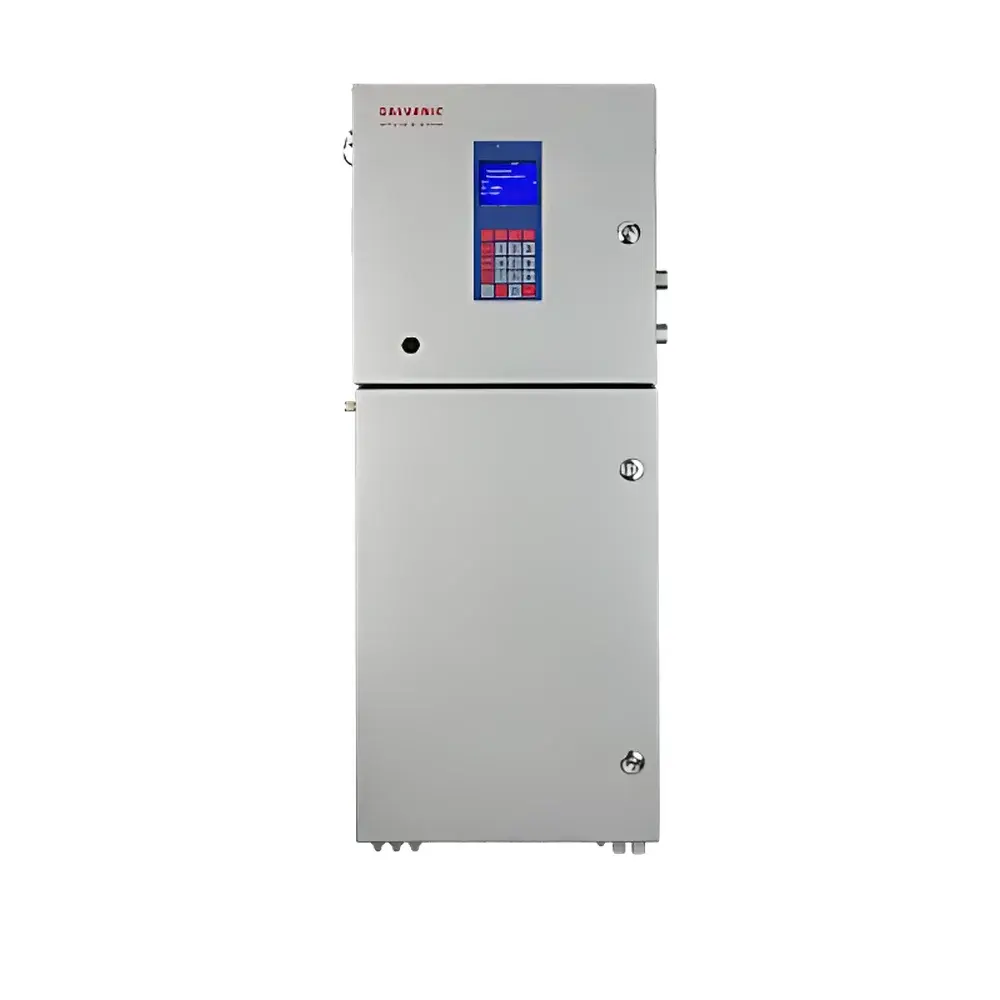
Galvanic Accuseries LPA Online Hydrogen Peroxide Analyzer
| Brand | Galvanic |
|---|---|
| Origin | USA |
| Manufacturer Type | Authorized Distributor |
| Product Category | Imported Instrument |
| Model | Accuseries LPA Online Analyzer |
| Instrument Type | Online Multi-Ion Analyzer |
| Measurement Range | 0–500 mg/L |
| Detection Limit | 1 ppm |
| Response Time | 10 min |
| Accuracy | ±1% of reading |
| Operating Temperature Range | −20 °C to +60 °C |
| Measurement Principle | Potentiometric Titration |
| Communication Interfaces | 4–20 mA, Modbus TCP/IP, RS232, RS485, USB, GUI PC Direct Connection |
| Relay Outputs | Yes |
| Sample Streams | Up to 6 modular flow paths |
| Enclosure Rating | IP65 (corrosion-resistant, H₂S/Cl₂ tolerant, moisture-proof) |
| Automation Level | Fully Automated (auto-calibration, auto-cleaning, reagent replenishment, 24/7 unattended operation) |
Overview
The Galvanic Accuseries LPA Online Hydrogen Peroxide Analyzer is an industrial-grade, potentiometric titration-based system engineered for continuous, real-time quantification of hydrogen peroxide (H₂O₂) in complex aqueous matrices. Designed specifically for demanding process environments—including pesticide manufacturing effluents, metallurgical rinse waters, electroplating baths, and specialty chemical process streams—the analyzer delivers stable, trace-level detection with high reproducibility and minimal operator intervention. Its core architecture separates electronic control units from wet chemistry modules, enabling robust operation in corrosive, humid, or chemically aggressive settings where conventional analyzers suffer drift or premature failure. The system operates across two calibrated ranges (0–50 mg/L and 0–500 mg/L), supporting both low-concentration monitoring and high-dose process control applications under ISO/IEC 17025-aligned measurement conditions.
Key Features
- Modular flow-path design supports up to six independent sample streams—ideal for multi-point monitoring in distributed treatment systems or parallel process lines.
- Full automation cycle: automatic standardization, electrode conditioning, reagent delivery, endpoint detection, waste evacuation, and system rinsing—all executed without manual input.
- Corrosion-resistant fluidic architecture with chemically inert wetted materials (e.g., PTFE, PVDF, borosilicate glass) ensures long-term stability in H₂S-, Cl₂-, and oxidant-rich environments.
- Dual-range potentiometric titration method provides selectable sensitivity: low-range mode (0–50 mg/L) optimized for environmental compliance monitoring; high-range mode (0–500 mg/L) suited for process optimization in disinfection or oxidation steps.
- IP65-rated enclosure with sealed electronics compartment and isolated power supply minimizes risk of moisture ingress and electrical interference.
- Embedded diagnostics engine continuously monitors reagent levels, electrode response slope, sample flow integrity, and calibration validity—triggering configurable relay alarms or DCS/PLC notifications upon deviation.
Sample Compatibility & Compliance
The Accuseries LPA accommodates samples with suspended solids ≤50 mg/L and turbidity ≤200 NTU when used with optional inline filtration. It meets ASTM D1253-22 (Standard Test Method for Residual Chlorine in Water) and EPA Method 335.4 (for H₂O₂ quantification via redox titration) in principle, though final validation must be performed per site-specific matrix interferences. The analyzer’s firmware supports audit-trail logging compliant with FDA 21 CFR Part 11 requirements when integrated with validated SCADA or MES platforms. All calibration records, maintenance logs, and alarm events are time-stamped and exportable in CSV or XML format for GLP/GMP documentation workflows.
Software & Data Management
A web-accessible embedded interface (HTTPS-enabled) provides remote configuration, real-time trend visualization, and historical data review via standard browsers. Data output includes analog (4–20 mA), digital (Modbus TCP/IP, RS485), and direct USB export options. The system stores ≥30 days of compressed operational history onboard and supports scheduled FTP push to centralized data lakes. Optional integration with PI System™, Ignition SCADA, or DeltaV DCS enables automated alarm forwarding, batch reporting, and predictive maintenance scheduling based on electrode drift trends and reagent consumption rates.
Applications
- Continuous monitoring of residual H₂O₂ in wastewater pretreatment prior to biological treatment stages—ensuring non-inhibitory concentrations for activated sludge viability.
- Real-time dosing feedback control in semiconductor wafer cleaning processes where precise oxidant concentration directly impacts etch uniformity.
- Quality assurance in pharmaceutical water-for-injection (WFI) systems, verifying complete peroxide removal after ozone/H₂O₂ sterilization cycles.
- Process safety oversight in pulp bleaching lines, preventing explosive peroxide accumulation during alkaline peroxide mechanical pulping (APMP).
- Regulatory reporting support for facilities subject to local discharge permits requiring sub-ppm H₂O₂ verification at outfall points.
FAQ
What measurement principle does the Accuseries LPA use?
It employs potentiometric titration with a platinum indicator electrode and Ag/AgCl reference electrode, detecting the inflection point of redox potential during stoichiometric reaction with standardized ceric sulfate or potassium permanganate titrant.
Can the analyzer operate in hazardous area classifications?
The base unit is rated for Class I, Division 2 (CID2) environments when installed with appropriate conduit seals and intrinsically safe barriers; ATEX Zone 2 certification requires optional field-installable explosion-proof housing.
Is third-party validation support available for regulatory submissions?
Yes—Galvanic provides IQ/OQ documentation templates and participates in joint site-specific PQ protocols aligned with ISO/IEC 17025 and USP guidelines.
How frequently must the titrant solution be replaced?
Under typical operating conditions (one stream, 10-min cycle), reagent cartridges last 30–45 days; usage scales linearly with number of active channels and analysis frequency.
Does the system support remote firmware updates?
Firmware upgrades are delivered via secure HTTPS download and require manual initiation with checksum verification—no automatic over-the-air updates are enabled by default for process integrity assurance.







