
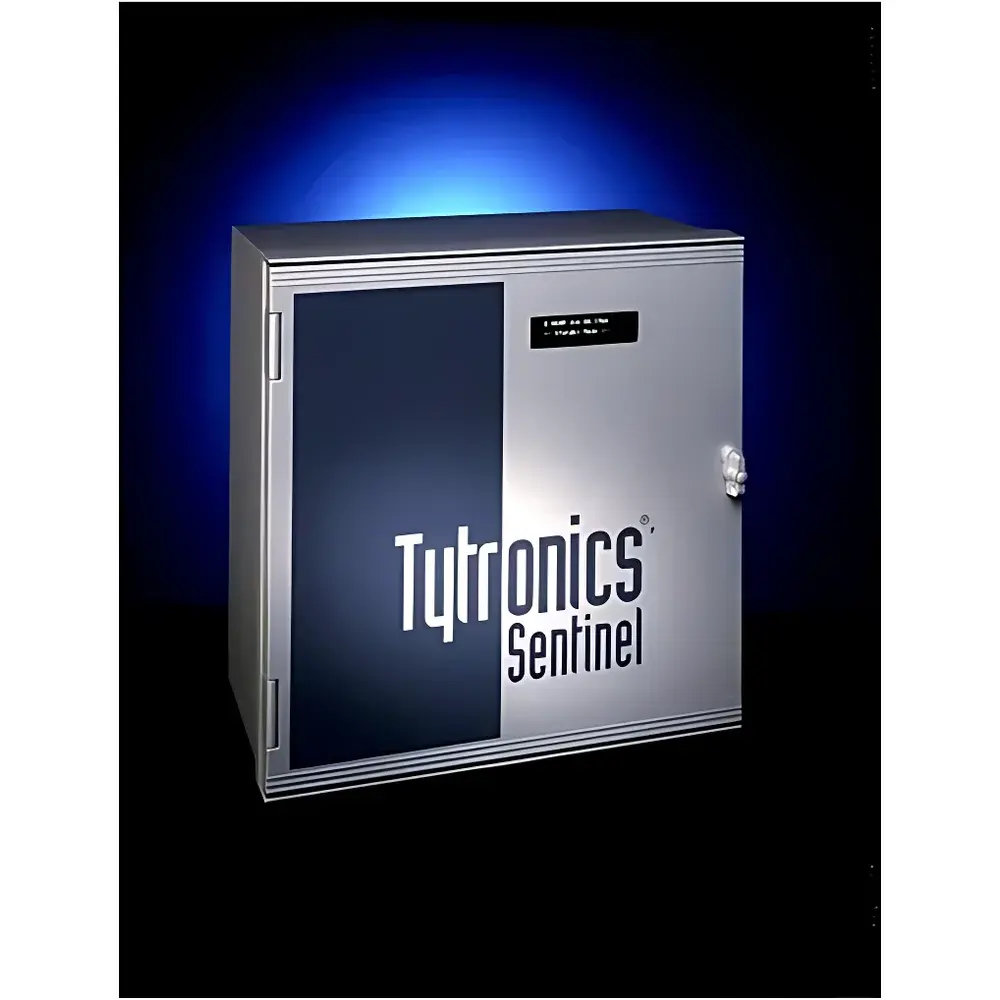
Tytronics Sentinel Sodium Ion Online Monitor
| Origin | USA |
|---|---|
| Manufacturer Type | Authorized Distributor |
| Origin Category | Imported |
| Model | Sentinel Sodium Ion Online Monitor |
| Price Range | USD 28,000 – 70,000 |
| Instrument Type | Online Water Quality Analyzer |
| Measurement Principle | Ion-Selective Electrode (ISE) with Single Standard Addition (SSA/SKA) Method |
| Range | High Range 0–200 ppm, Low Range 0–200 ppb |
| Accuracy | ±2% of reading or full scale |
| Resolution | 0.001 ppm/ppb |
| Repeatability | ±2% of reading or full scale |
| Sample Volume | 19 mL |
| Reagent Consumption | 2 mL per analysis |
| Sample Flow Rate | 50–900 mL/min |
| Sample Inlet | 1/4" compression fitting |
| Sample Temperature | 5–70 °C |
| Suspended Solids | ≤2% w/w, max particle size 0.05" (1.27 mm) |
| Sample Pressure | 0–50 psig |
| Waste Outlet | 3/4" NPT male, open drain |
| Alarm Outputs | User-programmable digital outputs |
| Analog Output | 4–20 mA, fully configurable |
| Power Supply | 100–240 VAC, 50/60 Hz |
| Enclosure Rating | NEMA 4X (IP65) |
| Mounting | Wall-mounted (hardware included) |
| Dimensions (W×H×D) | 387 × 406 × 210 mm |
| Weight | ~36 kg (fully assembled) |
Overview
The Tytronics Sentinel Sodium Ion Online Monitor is a robust, laboratory-grade continuous monitoring system engineered for real-time quantification of sodium ion concentration in aqueous streams using potentiometric ion-selective electrode (ISE) technology. Designed for deployment in demanding industrial and municipal water environments—including power plant boiler feedwater, cooling circuits, drinking water distribution systems, wastewater effluents, and chemical process streams—the instrument implements the Single Standard Addition (SKA) method to compensate for electrode drift, junction potential variability, and matrix-induced interference. Unlike conventional ISE-based analyzers that rely solely on calibration slope verification, the Sentinel performs in-situ standard addition during each measurement cycle, enabling trace-level accuracy (down to 0.001 ppb resolution) without manual recalibration or operator intervention. Its flow-through cell architecture, coupled with a large-bore sample pathway and patented low-shear aspiration system, ensures stable operation even with turbid, particulate-laden, or low-conductivity samples—eliminating clogging risks and minimizing maintenance frequency.
Key Features
- Patented high-flow, low-clog sample introduction system with 1/4″ compression inlet and integrated particulate tolerance (≤1.27 mm particles at ≤2% solids)
- True SKA-based quantification: automatic injection of known Na⁺ standard prior to each analysis to correct for electrode drift and liquid-junction potential shifts
- Triple-mode calibration support: single-point, two-point, and multi-point calibration with programmable schedules
- Full automation: auto-zero, auto-calibrate, auto-clean, reagent fill, and waste purge—all governed by user-defined logic sequences
- No memory effect: dedicated fluidic path design and optimized rinse cycles ensure complete carryover elimination between samples
- Matrix-insensitive detection: performance unaffected by sample turbidity, color, pH fluctuation (buffered reagent delivery minimizes pH perturbation), or variable flow dynamics
- NEMA 4X (IP65)-rated enclosure suitable for outdoor or wet industrial environments; wall-mount configuration with pre-drilled mounting hardware
- Configurable 4–20 mA analog output with linear or logarithmic scaling, plus relay-based alarm outputs for out-of-spec conditions (e.g., low reagent level, no flow, sensor fault)
Sample Compatibility & Compliance
The Sentinel accepts raw, unfiltered water samples across a broad physicochemical spectrum: from ultrapure boiler feedwater (conductivity <0.1 µS/cm) to secondary-treated wastewater (TSS up to 200 mg/L). It operates reliably within 5–70 °C and withstands transient pressures up to 50 psig. The system complies with core regulatory frameworks governing automated water quality instrumentation, including ASTM D4192 (Standard Practice for On-Line Monitoring of Ionic Species in Water), ISO 10523 (Water Quality — Determination of pH), and supports audit-ready data integrity per FDA 21 CFR Part 11 when integrated with compliant SCADA or LIMS platforms. All firmware logs—including calibration events, SKA response curves, sensor diagnostics, and alarm triggers—are time-stamped and immutable, facilitating GLP/GMP-aligned validation and routine QA/QC review.
Software & Data Management
Local HMI features a 7-inch capacitive touchscreen with intuitive menu navigation, multilingual UI (English, Spanish, Chinese), and embedded configuration wizard for rapid method setup. Up to ten independent analytical methods—including differential SKA protocols for high- and low-range modes—can be stored and scheduled. Data export options include Modbus TCP/RTU, OPC UA, and ASCII over RS-485 or Ethernet. Internal non-volatile memory retains ≥30 days of second-by-second measurement records, diagnostic snapshots, and event logs. Remote access is enabled via secure HTTPS interface with role-based authentication (admin/operator/viewer tiers), supporting remote troubleshooting, firmware updates, and historical trend analysis without onsite visits.
Applications
- Power generation: Continuous monitoring of sodium breakthrough in mixed-bed demineralizers and condensate polishing units to prevent turbine corrosion
- Municipal utilities: Early detection of saline intrusion in groundwater sources or distribution network cross-contamination events
- Pharmaceutical manufacturing: Verification of sodium residuals in purified water (PW) and water for injection (WFI) loops per USP
- Chemical processing: Control of sodium carryover in caustic regeneration streams or brine purification circuits
- Food & beverage: Verification of sodium content in process rinse waters and final product contact streams
- Environmental compliance: Real-time reporting for NPDES discharge permits requiring sodium-specific limits
FAQ
How does the Single Standard Addition (SKA) technique improve long-term stability compared to conventional ISE calibration?
SKA introduces a precise volume of standardized Na⁺ solution directly into the measurement cell prior to each sample analysis. By measuring the resulting potential shift and applying the Nicolsky-Eisenman equation, the system calculates absolute concentration while inherently correcting for electrode slope degradation, reference junction drift, and activity coefficient variations—eliminating reliance on fixed calibration curves.
Can the Sentinel operate without daily manual maintenance?
Yes. With scheduled auto-cleaning cycles, reagent replenishment alerts, and self-diagnostics (including flow verification, electrode impedance monitoring, and leak detection), the unit supports unattended operation for ≥30 days under typical municipal water conditions.
Is the 4–20 mA output compatible with legacy DCS systems?
Yes. The analog output is isolated, fully configurable for zero/span mapping, and supports both linear and log-scale encoding—ensuring seamless integration with Emerson DeltaV, Honeywell Experion, Siemens Desigo, and other major industrial control platforms.
What validation documentation is provided for regulated industries?
Each unit ships with Factory Acceptance Test (FAT) report, IQ/OQ protocol templates aligned with ASTM D3370 and ISO/IEC 17025, and electronic calibration certificates traceable to NIST SRMs. Optional 3Q validation support (IQ/OQ/PQ) is available through certified field service engineers.
Does the system meet cybersecurity requirements for OT networks?
Yes. Firmware includes TLS 1.2 encryption, disabled default credentials, configurable firewall rules, and periodic security patch updates—designed to align with ISA/IEC 62443-3-3 Level 2 requirements for industrial cyber resilience.







