
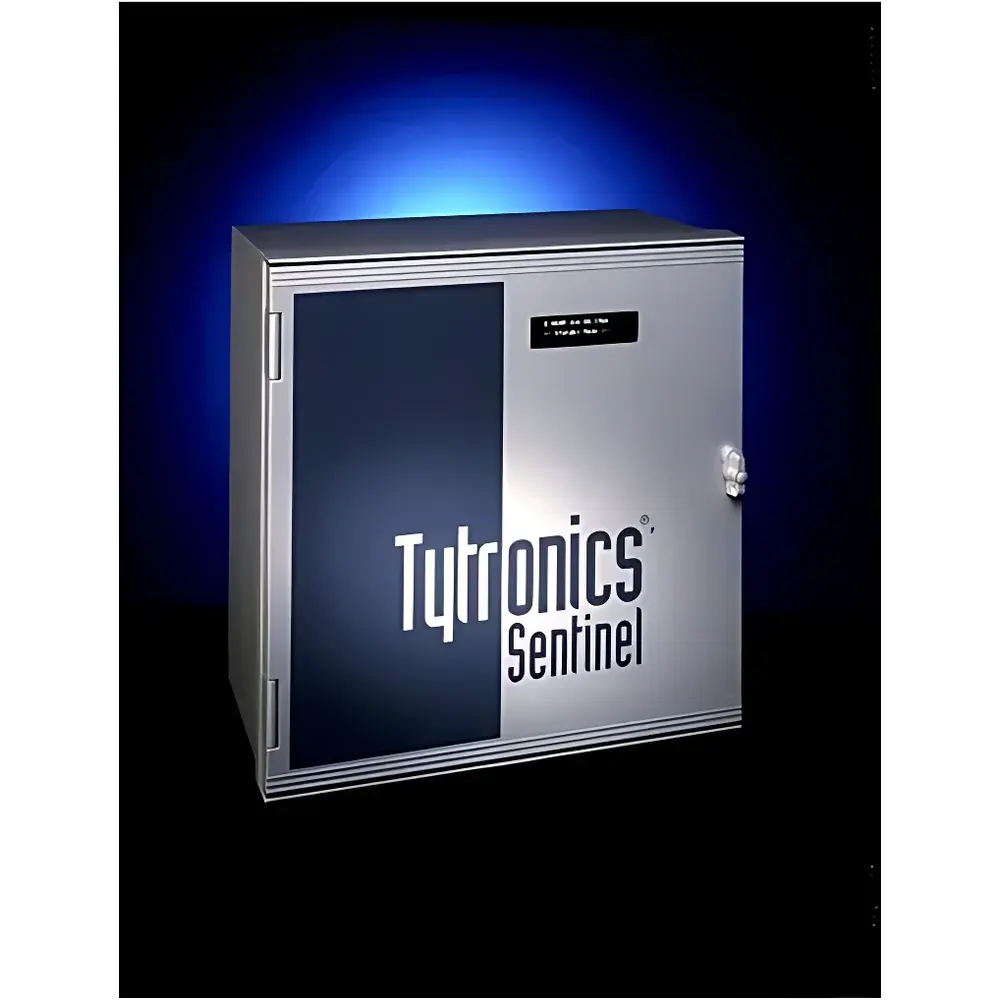
Tytronics Sentinel Titrator for Online OH⁻ Concentration Analysis in Sodium Hypochlorite Solutions
| Origin | USA |
|---|---|
| Manufacturer Type | Authorized Distributor |
| Origin Category | Imported |
| Model | OH⁻ in NaOCl Solution |
| Price | Upon Request |
Overview
The Tytronics® Sentinel Titrator is an industrial-grade, fully automated online titration analyzer engineered for continuous, real-time quantification of hydroxide ion (OH⁻) concentration in sodium hypochlorite (NaOCl) solutions. It operates on a validated two-step potentiometric titration principle: first, stoichiometric neutralization of residual free chlorine interference using standardized sodium thiosulfate (1 equivalent per OCl⁻), followed by precise acid–base titration with 0.3125-normal hydrochloric acid against a high-stability pH electrode. This dual-chemistry protocol eliminates oxidative interference from hypochlorite—an inherent challenge in conventional pH-based alkalinity measurement—and delivers chemically selective, matrix-resistant OH⁻ determination. Designed for integration into chlorination control loops in municipal water treatment, wastewater disinfection, and industrial bleach manufacturing, the Sentinel ensures compliance with process-critical monitoring requirements where reagent stability, endpoint reproducibility, and long-term drift resistance are non-negotiable.
Key Features
- Potentiometric endpoint detection using a rugged, temperature-compensated pH electrode with automatic drift correction and self-diagnostic calibration validation.
- Modular reagent delivery architecture: maintenance-free piston pumps for precise acid reagent dosing; peristaltic pumps for carrier, wash, and quench solutions—each independently programmable for volume, timing, and sequence.
- Patented volumetric sampling system with 1/4″ OD sample tubing and integrated coil-loop manifold, minimizing clogging risk and ensuring representative sub-sampling (5–30 mL range) even in turbid or suspended-solid-laden streams (up to 2% w/w, particles ≤1.27 mm).
- Triple-tier password protection (operator, technician, administrator) aligned with NIST SP 800-53 access control requirements; all method changes, calibrations, and alarm acknowledgments logged with timestamp and user ID.
- Onboard diagnostics including flow rate verification, reagent level monitoring, electrode impedance check, and real-time endpoint slope analysis—enabling predictive maintenance and GLP-compliant audit trails.
- Programmable cleaning cycles (pre- and post-analysis), zero-point auto-correction, and adaptive endpoint algorithms (fixed, inflection, and derivative modes) to accommodate variable sample matrices and aging reagent kinetics.
Sample Compatibility & Compliance
The Sentinel is validated for direct analysis of undiluted sodium hypochlorite solutions across a 0–50% w/w OH⁻ range (as NaOH equivalent), with typical repeatability of ±2% of reading or full scale—whichever is greater—under field-representative conditions (5–70°C, 0–345 kPa sample pressure, 50–900 mL/min flow). It accommodates samples containing up to 2% suspended solids and meets IP65 enclosure rating for wet industrial environments. All wetted materials—including PFA-lined reaction cell, EPDM gaskets, and 316 stainless steel fittings—are compatible with oxidizing, caustic, and low-pH media. The system supports traceability per ISO/IEC 17025 and data integrity frameworks aligned with FDA 21 CFR Part 11 when connected to compliant SCADA or LIMS platforms via RS232/RS485.
Software & Data Management
Embedded firmware enables full method configuration without external PC: users define titrant addition profiles, rinse durations, electrode stabilization windows, and multi-point calibration curves (high/low range switching supported). Analytical results—including raw mV vs. volume curves, calculated OH⁻ concentration, endpoint volume, and slope metrics—are stored locally in non-volatile memory (108 analyses + 25 calibrations, retained ≥5 years without power). Analog 4–20 mA output (fully scalable and linearized) interfaces directly with DCS systems; digital outputs support ASCII-formatted printouts and remote command execution (e.g., initiate calibration, force sample, reset alarm). Audit logs record all parameter modifications, calibration events, and fault conditions with immutable timestamps—essential for GMP process validation and regulatory review.
Applications
- Real-time optimization of NaOCl dosing in drinking water pre-chlorination and post-disinfection stages.
- Quality assurance of commercial bleach concentration during bulk production and tank farm transfer.
- Monitoring OH⁻ carryover in membrane filtration backwash streams to prevent irreversible fouling.
- Control of caustic scrubber solutions in flue gas desulfurization (FGD) systems where NaOCl is co-injected.
- Supporting ASTM D1209 (colorimetric) and ASTM D4192 (titrimetric) method equivalency studies in third-party labs.
FAQ
What interference does the thiosulfate pretreatment eliminate?
Thiosulfate stoichiometrically reduces residual hypochlorite (OCl⁻) to chloride (Cl⁻), preventing oxidation of the pH electrode surface and erroneous alkalinity readings caused by redox potential shifts.
Can the instrument be reconfigured for other analytes?
Yes—the Sentinel’s open method architecture supports user-defined titration protocols for acids, carbonates, cyanides, hardness, and peroxide, provided compatible electrodes and reagents are installed.
Is offline calibration required before deployment?
No—field calibration uses certified standard NaOH solutions; the system performs automatic electrode slope verification and offset adjustment prior to each analysis cycle.
How is data integrity ensured during power interruption?
All critical parameters and recent results are written to EEPROM with write-protection logic; power-loss recovery resumes from last stable state without data corruption.
What maintenance intervals are recommended?
Electrode replacement every 6–12 months depending on sample aggressiveness; pump tubing inspection every 3 months; quarterly verification of reagent concentration and flow accuracy using gravimetric checks.





