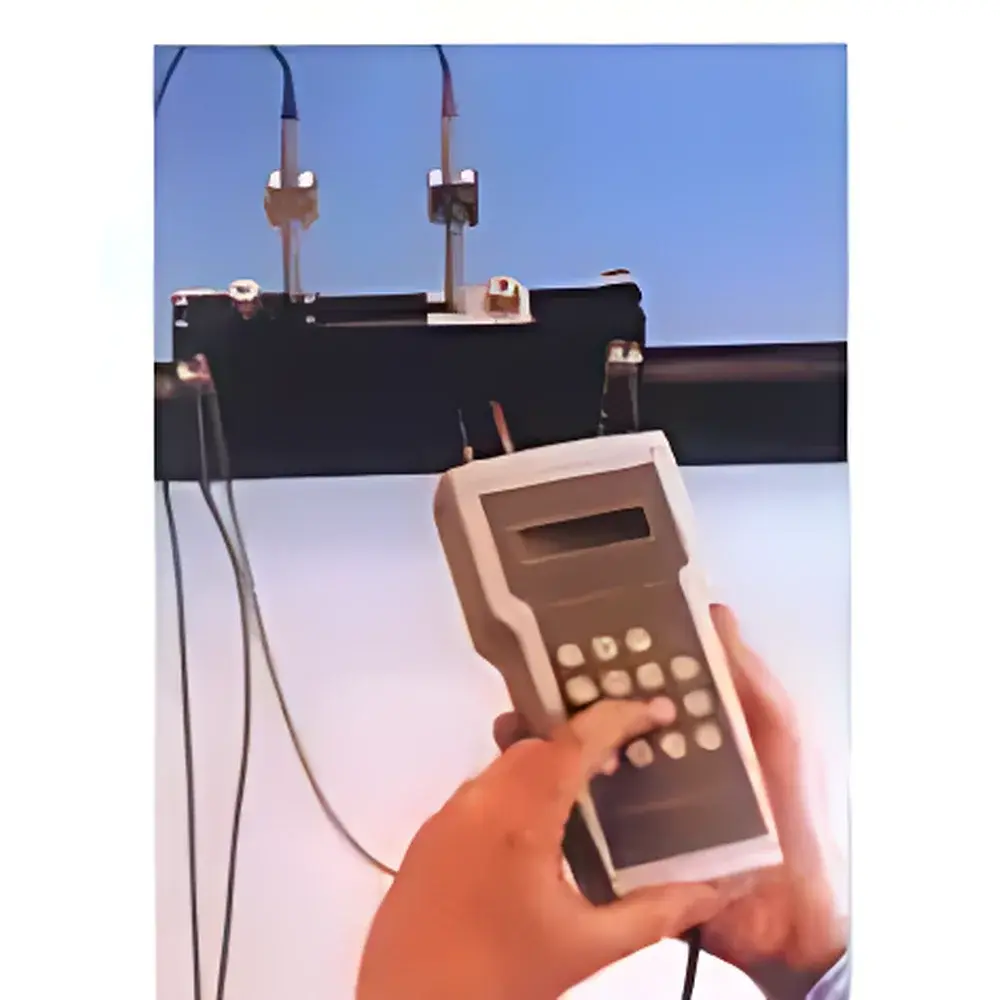
Micronics PF204plus/PF216plus Portable Clamp-on Ultrasonic Flowmeter
| Origin | UK |
|---|---|
| Manufacturer Type | Authorized Distributor |
| Origin Category | Imported |
| Model | PF204plus / PF216plus |
| Pricing | Available Upon Request |
| Accuracy | ±0.5–2% of reading (ID 13–75 mm, flow velocity >0.2 m/s) |
| Pipe ID Range | PF204plus: 13–115 mm |
| PF216plus | 50–1000 mm |
| Sensor Operating Temperature | –20 °C to +135 °C (Groups A & B) |
| Output | Optically isolated 0/4–20 mA |
| pulse output | 1 pulse/sec, max 5 V |
| Velocity Range | 0.1–20 m/s |
| Display | 64 × 240 pixel graphical LCD |
| Power | Rechargeable battery (20 h typical runtime) or 110/240 VAC ±10% via external PSU |
| Certifications | CE compliant |
| Enclosure | Polypropylene carrying case with custom-cut foam insert |
Overview
The Micronics PF204plus and PF216plus are true portable, clamp-on ultrasonic flowmeters engineered for non-invasive, high-reliability liquid flow measurement in pressurized pipelines. Based on the time-of-flight (TOF) principle, these instruments measure the differential transit time of ultrasonic pulses traveling upstream and downstream between two externally mounted transducers. This time difference is directly proportional to the average axial velocity of the fluid, enabling precise volumetric flow calculation when combined with known pipe internal geometry. Designed for field deployment across diverse industrial infrastructure, the PF series eliminates process interruption—no cutting, welding, tapping, or system shutdown is required for installation. Its ruggedized housing, low-power architecture, and dual power options (rechargeable battery or AC adapter) support extended operation in remote or hazardous environments while maintaining metrological integrity under varying thermal and mechanical loads.
Key Features
- Non-intrusive clamp-on measurement: zero process penetration, no pressure drop, no risk of leakage or contamination
- True portability: integrated rechargeable battery (20 h typical endurance), lightweight polypropylene transit case with protective foam insert, and ergonomic handheld interface
- Dual-model scalability: PF204plus optimized for small-bore applications (13–115 mm ID); PF216plus extends range to large-diameter piping (50–1000 mm ID)
- Wide fluid compatibility: validated for water, glycol solutions, hydraulic oils, diesel, fuel oils, chemical solvents, and HVAC heat-transfer media
- High-temperature sensor capability: Group A and B transducers rated from –20 °C to +135 °C, suitable for steam condensate, hot oil, and industrial cooling loops
- Industrial-grade I/O: optically isolated 4–20 mA analog output with HART-compatible signal conditioning; configurable pulse output (1 pulse/sec, 5 V max) for integration with SCADA, DCS, or data loggers
- Compliance-ready design: CE-marked per Directive 2014/30/EU (EMC) and 2014/35/EU (LVD); supports audit trails for GLP/GMP-aligned verification workflows
Sample Compatibility & Compliance
The PF204plus/PF216plus is validated for single-phase, homogeneous liquids with minimum acoustic impedance contrast and stable sound speed profiles. It is not intended for slurries, highly aerated fluids, or multiphase flows where ultrasonic signal attenuation or scattering exceeds transducer sensitivity thresholds. Compatible media include potable water, river water, chilled/hot water, softened water, aqueous glycol mixtures (up to 60% v/v), mineral oils, ISO VG 32–68 hydraulic fluids, diesel fuel (EN 590), kerosene, and select organic solvents with sound speed >1000 m/s and attenuation <5 dB/m at 1 MHz. All configurations comply with EN 61326-1:2013 for electromagnetic immunity in industrial environments and meet essential requirements of the EU Measuring Instruments Directive (MID) Annex MI-001 for portable flow verification tools used in energy auditing and system commissioning.
Software & Data Management
Configuration and real-time monitoring are performed via the built-in 64 × 240 pixel graphical display and 16-key membrane keypad—no external PC or proprietary software required for basic operation. Device parameters—including pipe material, wall thickness, fluid type, transducer spacing, and flow unit selection—are stored in non-volatile memory with timestamped change logging. Optional firmware upgrades (via USB-to-serial adapter) enable enhanced diagnostics, including signal quality index (SQI) reporting, echo amplitude tracking, and automatic gain control history. While the instrument does not embed FDA 21 CFR Part 11-compliant electronic signatures, its configuration logs and measurement records can be exported manually for inclusion in validated QA/QC documentation packages supporting ISO/IEC 17025 or ASTM D3242-22 compliance frameworks.
Applications
- Field verification of installed flowmeters (e.g., magnetic, turbine, or vortex meters) per ISO 5167 or API RP 14E protocols
- Energy efficiency audits in HVAC chillers, boiler feedwater systems, and district heating networks
- Pump performance testing and NPSH validation without process isolation
- Leak detection and quantification via mass balance analysis across parallel branches
- Filtration system integrity checks through differential flow rate profiling
- Cooling tower make-up and blowdown rate monitoring
- Fire protection system flow certification per NFPA 25 requirements
- Commissioning support for pharmaceutical water-for-injection (WFI) and purified water (PW) distribution loops (non-sterile verification only)
- On-site calibration of custody transfer meters prior to formal metrological certification
FAQ
Can the PF204plus/PF216plus measure gas or steam flow?
No. These instruments are strictly designed for single-phase liquid flow measurement. Gaseous media exhibit excessive ultrasonic attenuation and insufficient acoustic coupling for reliable TOF detection.
Is sensor mounting adhesive required for long-term installations?
No. The standard clamp-on transducers use adjustable stainless-steel straps with elastomeric couplant pads. Permanent bonding is neither recommended nor necessary for industrial field use.
What is the minimum required straight pipe length upstream/downstream?
For optimal accuracy, ≥10D upstream and ≥5D downstream are recommended. However, the instrument includes correction algorithms that mitigate partial profile distortion in constrained layouts.
Does the device support Modbus RTU or Profibus communication?
No. Communication is limited to analog 4–20 mA and TTL-level pulse outputs. Integration with industrial networks requires external protocol converters.
Can measurements be performed on lined or insulated pipes?
Yes—provided the liner material is acoustically transparent (e.g., epoxy, rubber, or plastic liners ≤3 mm thick) and insulation is removed locally at transducer mounting points to ensure direct metal contact.