
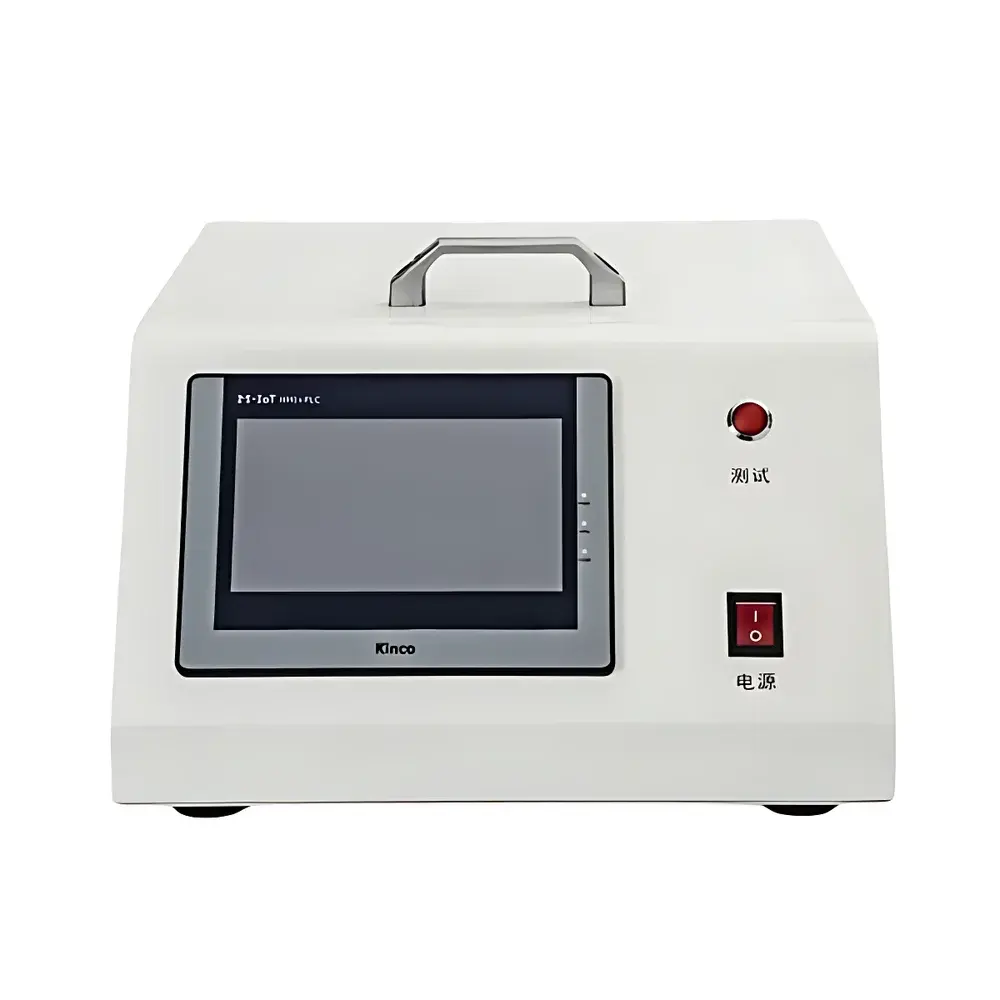
Aerospace ZST-212 Surface & Volume Resistivity Tester for Plastic Films
| Brand | Aerospace |
|---|---|
| Origin | Beijing, China |
| Model | ZST-212 |
| Resistance Range | 1×10⁴ Ω to 1×10¹⁸ Ω |
| Current Range | 2×10⁻⁴ A to 1×10⁻¹⁶ A |
| Test Voltages | DC 10 V / 50 V / 100 V / 250 V / 500 V / 1000 V (±10%) |
| Accuracy | ±1% (up to 10¹⁰ Ω), ±5% + 2 digits (10¹¹–10¹³ Ω), ±10–15% + 5 digits (>10¹⁴ Ω) |
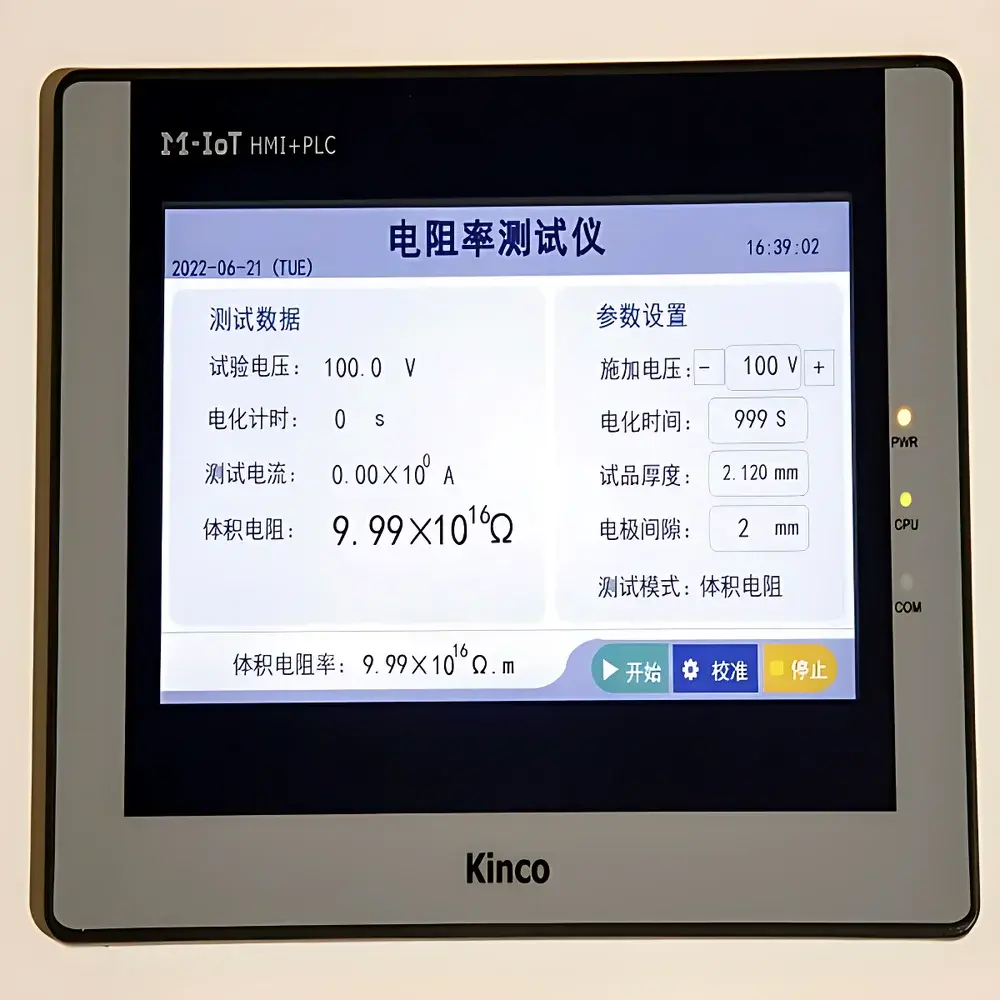
| Display | Full-digit LCD, simultaneous resistance and current readout |
| Dimensions | 300 mm × 280 mm × 150 mm |
| Weight | ~3.0 kg |
| Power | AC 220 V, 50 Hz, ~10 W |
| Operating Environment | –10 °C to 50 °C, RH < 90% |
Overview
The Aerospace ZST-212 Surface & Volume Resistivity Tester is a precision electrometric instrument engineered for high-impedance characterization of insulating and antistatic polymeric films and sheet materials. It operates on the fundamental principle of Ohm’s Law (R = V/I), employing dual-sensing architecture to measure both applied DC test voltage and resulting current simultaneously—eliminating nonlinearity inherent in conventional fixed-voltage high-resistance meters. Unlike analog galvanometer-based systems, the ZST-212 utilizes high-stability operational amplifiers, low-leakage guarding circuitry, and 24-bit A/D conversion to deliver direct digital readouts of resistance (Ω) and current (A) across 10 decades—from 10⁴ Ω to 10¹⁸ Ω and 2×10⁻⁴ A down to 1×10⁻¹⁶ A (0.1 fA). This architecture ensures measurement integrity independent of source voltage drift or electrode polarization effects, making it suitable for compliance-driven applications in R&D labs, quality control environments, and certification testing facilities where traceable, reproducible resistivity data are required per ISO 62, ASTM D257, and GB/T 1410–2006.
Key Features
- Simultaneous digital display of resistance value and leakage current—no manual scaling or coefficient multiplication required
- Six programmable DC test voltages (10 V, 50 V, 100 V, 250 V, 500 V, 1000 V) with ±10% tolerance, selectable via front-panel interface
- Guarded three-electrode configuration compliant with ASTM D257 Annex A2 and IEC 60093 for unambiguous surface vs. volume resistivity separation
- Integrated high-impedance input stage (<1 fA input bias current) and electrometer-grade shielding to minimize environmental noise coupling
- Real-time overcurrent detection (threshold configurable at 1 µA) with automatic test termination and audible/visual alert
- Dual grounding system: separate safety ground for chassis and dedicated low-impedance guard ground for measurement electrodes (ground resistance ≤4 Ω)
- Front-panel HV interlock: power cutoff and residual charge dissipation (<1 V within 100 ms) upon chamber door opening
Sample Compatibility & Compliance
The ZST-212 supports standardized electrode fixtures for plastic films per GB/T 1410–2006 (equivalent to IEC 60093) and ASTM D257–99, including concentric ring electrodes for surface resistivity and guarded electrode assemblies for volume resistivity. It accommodates specimens up to 100 mm × 100 mm with thicknesses from 25 µm to 3 mm. The instrument meets electromagnetic compatibility requirements per CISPR 11 Group 1 Class B and is designed for operation in controlled laboratory environments (ambient temperature –10 °C to 50 °C, RH < 90%, background EMI < 30 dBµV). Its measurement methodology supports GLP-compliant documentation when paired with optional audit-trail-enabled software (see Software & Data Management). Calibration traceability is maintained using certified reference resistors (10 kΩ, 1 GΩ, 1 TΩ) accredited to CNAS (ISO/IEC 17025), and microcurrent linearity is verified using calibrated alpha-particle sources (e.g., ²⁴¹Am) generating stable 1 pA-level currents.
Software & Data Management
While the ZST-212 operates as a standalone benchtop instrument, optional PC connectivity via RS-232 enables integration into automated test workflows. The companion software (v3.2+) provides time-stamped data logging, customizable test protocols, and export to CSV or XML formats compatible with LIMS platforms. All measurement sessions include embedded metadata: operator ID, timestamp, test voltage, electrode configuration, ambient temperature/humidity (when external sensors are connected), and pass/fail flags against user-defined limits. Audit trails record parameter changes, calibration events, and user logins—supporting FDA 21 CFR Part 11 compliance when deployed with role-based access control (administrator, engineer, operator tiers) and electronic signature functionality. Raw current and voltage waveforms can be captured at 10 Hz sampling for transient analysis during dielectric absorption or space-charge-limited conduction studies.
Applications
- Volume resistivity validation of high-performance polymer insulation (e.g., XLPE cable sheathing, requiring >1×10¹⁶ Ω·m per GB/T 31838.2)
- Surface resistivity mapping of antistatic packaging films (e.g., PET/PE laminates) for semiconductor handling environments (ESD S20.20)
- Accelerated aging studies of encapsulants under 85 °C/85 % RH per JEDEC JESD22-A101, tracking insulation resistance decay in epoxy mold compounds
- Charge transport analysis in nanocomposites (e.g., CNT/polyimide blends), resolving carrier mobility and trap density via ultra-low-current (<1 fA) I–V sweeps
- Dark current quantification in optoelectronic substrates and battery separator films (e.g., ceramic-coated PE separators for Li-ion cells), supporting failure mode analysis in high-energy-density storage systems
- Quality assurance of conductive flooring tiles and ESD footwear per ANSI/ESD STM97.1 and EN 61340-4-1
FAQ
What standards does the ZST-212 comply with for surface and volume resistivity measurements?
It conforms to ASTM D257–99 (Reapproved 2020), IEC 60093, ISO 62, and GB/T 1410–2006—including mandatory use of three-electrode configurations for unambiguous separation of surface and bulk conduction pathways.
Can the ZST-212 measure both surface and volume resistivity on the same sample?
Yes—by reconfiguring the electrode assembly per ASTM D257 Annex A2, users can switch between guarded two-terminal (volume) and concentric ring (surface) modes without recalibration.
Is the instrument suitable for elevated temperature or humidity testing?
The base unit operates up to 50 °C ambient; for thermal stress testing, it must be integrated with an externally controlled environmental chamber. Humidity exposure requires optional guarded cabling and desiccant-sealed electrode housings to prevent surface leakage artifacts.
How is measurement uncertainty validated?
Uncertainty budgets are established per GUM (JCGM 100:2008) using certified reference resistors, voltage standard calibrators, and low-current verification sources. Full uncertainty reports accompany each factory calibration certificate.
Does the ZST-212 support automated pass/fail evaluation against specification limits?
Yes—threshold-based judgment logic is configurable in the optional software suite, with real-time visual alerts and auto-generated compliance reports aligned with ISO/IEC 17025 reporting requirements.



