
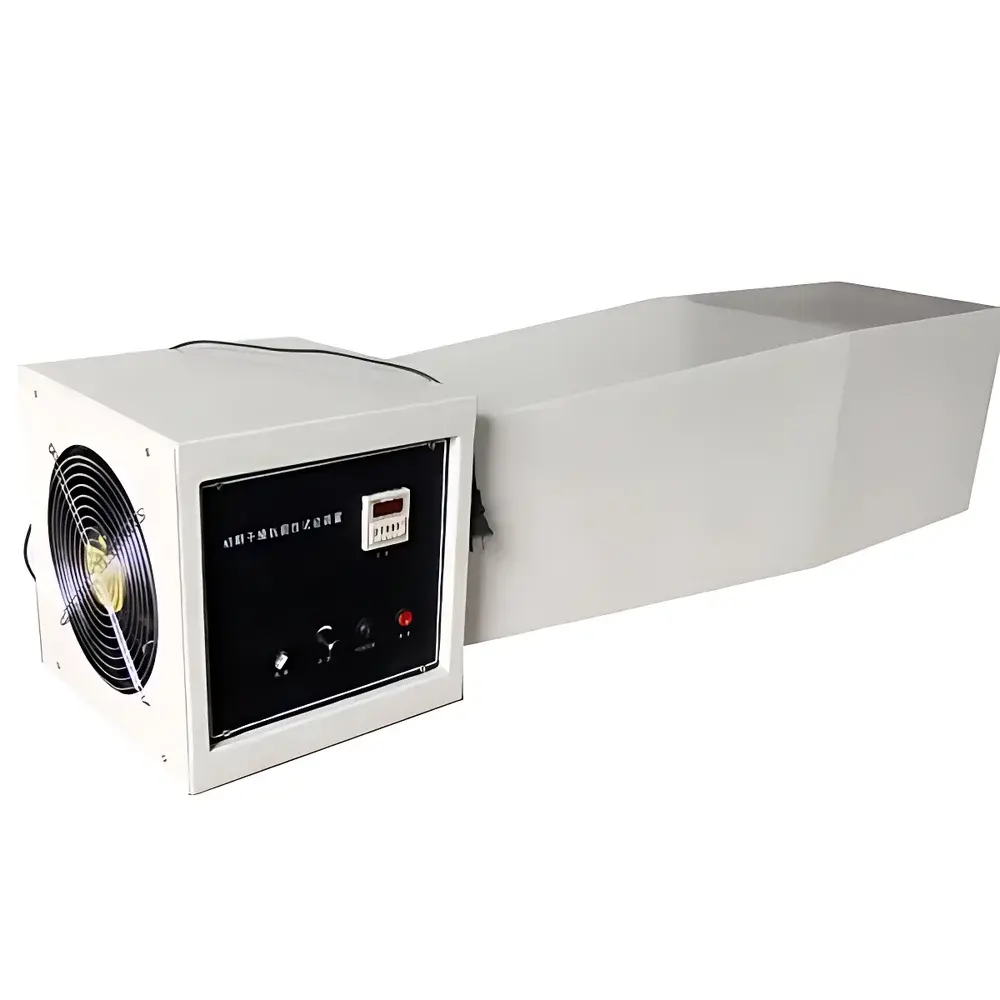
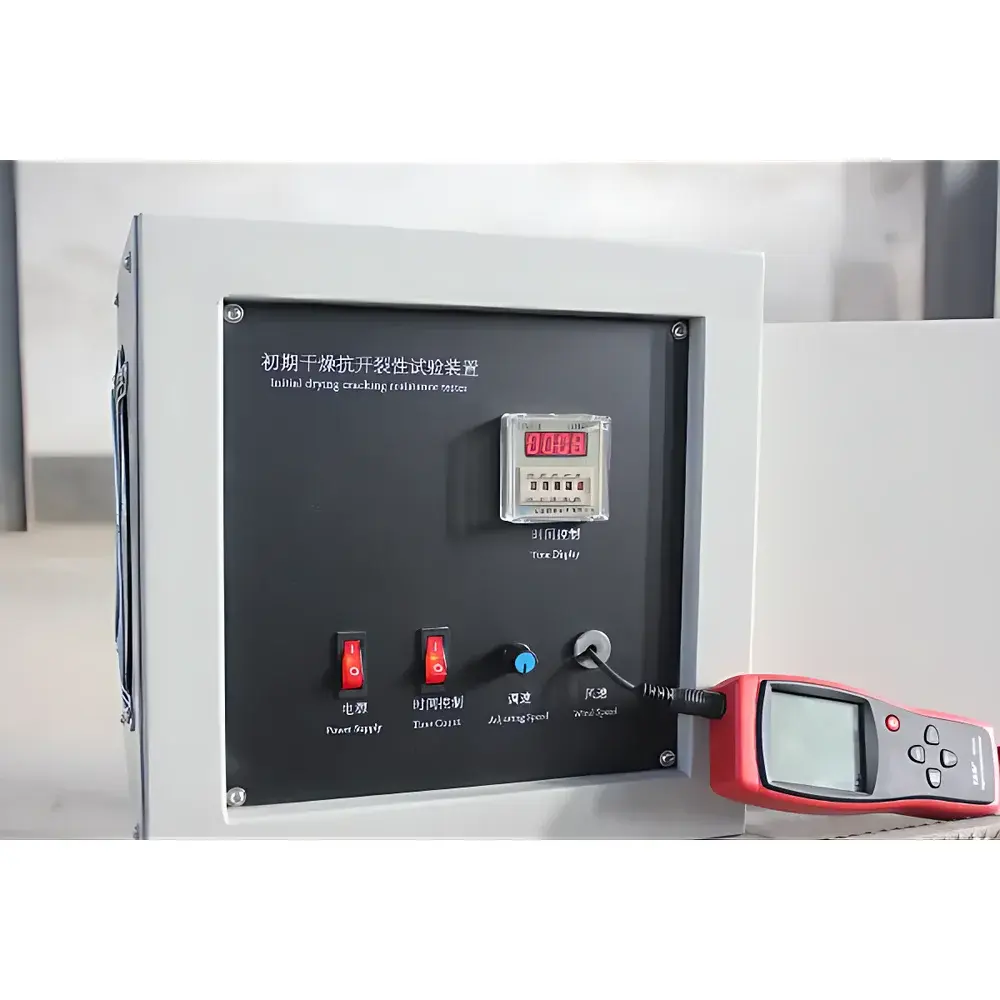
CRTA-2 Initial Drying Crack Resistance Tester
| Brand | Aerospace Zongheng |
|---|---|
| Origin | Beijing, China |
| Manufacturer Type | Authorized Distributor |
| Country of Origin | China |
| Model | CRTA-2 |
| Price Range | USD 1,400 – 2,800 |
| Airflow Configuration | Axial Fan with Conical Inlet Duct |
| Wind Speed Control | 3.0 ± 0.3 m/s |
| Operating Voltage | 200–240 V, 50 Hz |
| Environmental Test Conditions | 23 ± 2 °C, 50 ± 5 % RH |
| Compliant Standards | GB 9779–2015, JG/T 24–2000 |
Overview
The CRTA-2 Initial Drying Crack Resistance Tester is an engineered laboratory instrument designed for standardized evaluation of early-stage film integrity in architectural coatings and interior/exterior putties under controlled airflow conditions. It operates on the principle of accelerated convective drying—simulating real-world environmental exposure during the critical first minutes after application—where surface tension gradients, solvent evaporation kinetics, and substrate interaction jointly govern crack initiation. Developed in strict accordance with GB 9779–2015 “Textured Architectural Coatings” and referenced in JG/T 24–2000 “Synthetic Resin Emulsion Sand-Grain Finish Coatings”, the CRTA-2 replicates the standardized wind tunnel environment required for quantitative assessment of crack formation propensity prior to full cure. Its core architecture integrates a precision axial fan system, calibrated conical inlet duct (optimized for laminar flow profile and minimal turbulence), and thermohygrometrically stabilized test chamber—ensuring reproducible boundary conditions essential for inter-laboratory comparability.
Key Features
- Stable airflow generation via high-efficiency axial fan with adjustable throttle valve, delivering consistent wind velocity of 3.0 ± 0.3 m/s at the specimen plane—verified per ISO 5801:2017 air velocity calibration protocols.
- Conical inlet duct geometry engineered to minimize flow separation and ensure uniform velocity distribution across the 200 mm × 300 mm test zone, complying with the geometric specifications outlined in GB 9779–2015 Annex B.
- Digital timer with programmable duration (0–60 min, 1-sec resolution) and automatic shutdown function, eliminating operator-dependent endpoint variability.
- Modular specimen holder accommodating standard coated panels (e.g., glass, asbestos-free fiber cement board, or specified primed substrates) at fixed 0° orientation relative to airflow direction.
- Integrated ambient monitoring: real-time display of chamber temperature (±0.5 °C accuracy) and relative humidity (±3 % RH accuracy), logged alongside test metadata.
- Robust stainless-steel and powder-coated steel construction, rated for continuous operation in ISO Class 8 (Class 100,000) laboratory environments.
Sample Compatibility & Compliance
The CRTA-2 supports standardized test specimens prepared per GB 9779–2015 Section 5.3: films applied at specified wet film thickness (e.g., 1.0–1.5 mm for textured coatings) using drawdown bars or applicator combs onto conditioned substrates. Compatible material classes include acrylic, silicone-acrylic, styrene-acrylic, and silicate-based architectural coatings; polymer-modified dry-mix putties; and mineral-based plasters. All operational parameters—including airflow velocity tolerance, thermal/hygrometric control limits, and timing resolution—are traceable to national metrological standards maintained by CNAS-accredited calibration laboratories. The system satisfies method validation requirements under GLP (Good Laboratory Practice) frameworks and provides documented evidence suitable for regulatory submissions referencing GB, JG, and ISO 21371:2021 “Coatings — Determination of resistance to cracking during drying” (under development, cited for alignment).
Software & Data Management
While the CRTA-2 operates as a stand-alone electromechanical tester, its digital timer module supports RS-232 serial output (optional adapter) for time-stamped event logging into external LIMS or Excel-based QA databases. Test records include start/stop timestamps, set duration, actual elapsed time, chamber T/RH readings at initiation and termination, and operator ID field (manually entered). Audit trails comply with basic 21 CFR Part 11 principles when paired with validated electronic record systems—supporting retrospective review, deviation investigation, and batch release documentation in GMP-aligned coating manufacturing facilities.
Applications
- Quality control screening of incoming raw materials (e.g., rheology modifiers, film-forming agents) for crack-inhibiting efficacy.
- Formulation development support: comparative evaluation of binder-to-filler ratios, coalescing agent selection, and thickener types under identical drying stress profiles.
- Batch-to-batch consistency verification for production lots of exterior texture coatings prior to dispatch.
- Technical service response: root-cause analysis of field-reported cracking incidents via controlled replication of suspected drying conditions.
- Educational use in university materials science labs for teaching coating failure mechanisms linked to evaporative stress and viscoelastic relaxation.
FAQ
Does the CRTA-2 meet international standards beyond Chinese national standards?
Yes—the airflow specification (3.0 ± 0.3 m/s) aligns with the drying stress condition referenced in ISO 21371 draft clauses and ASTM D5237 (Standard Practice for Evaluating Cracking Resistance of Latex Paints), enabling cross-standard correlation studies.
Can the device be calibrated externally, and is calibration certificate included?
Third-party calibration is supported using NIST-traceable anemometers and thermohygrometers; a factory calibration report (including wind speed, temperature, and RH verification data) is supplied with each unit.
Is the test panel orientation adjustable?
No—the CRTA-2 fixes the specimen at 0° incidence to airflow per GB 9779–2015; angular variation is outside scope and not supported by design.
What maintenance is required for long-term accuracy?
Annual inspection of fan bearing integrity, duct seal integrity, and sensor drift verification is recommended; no consumables are required beyond routine cleaning of the inlet cone and test chamber surfaces.
Is the unit compatible with fume hood integration?
Yes—the CRTA-2 operates silently (<55 dB(A)) and generates no hazardous emissions; it may be installed inside ventilated enclosures without performance degradation.




