
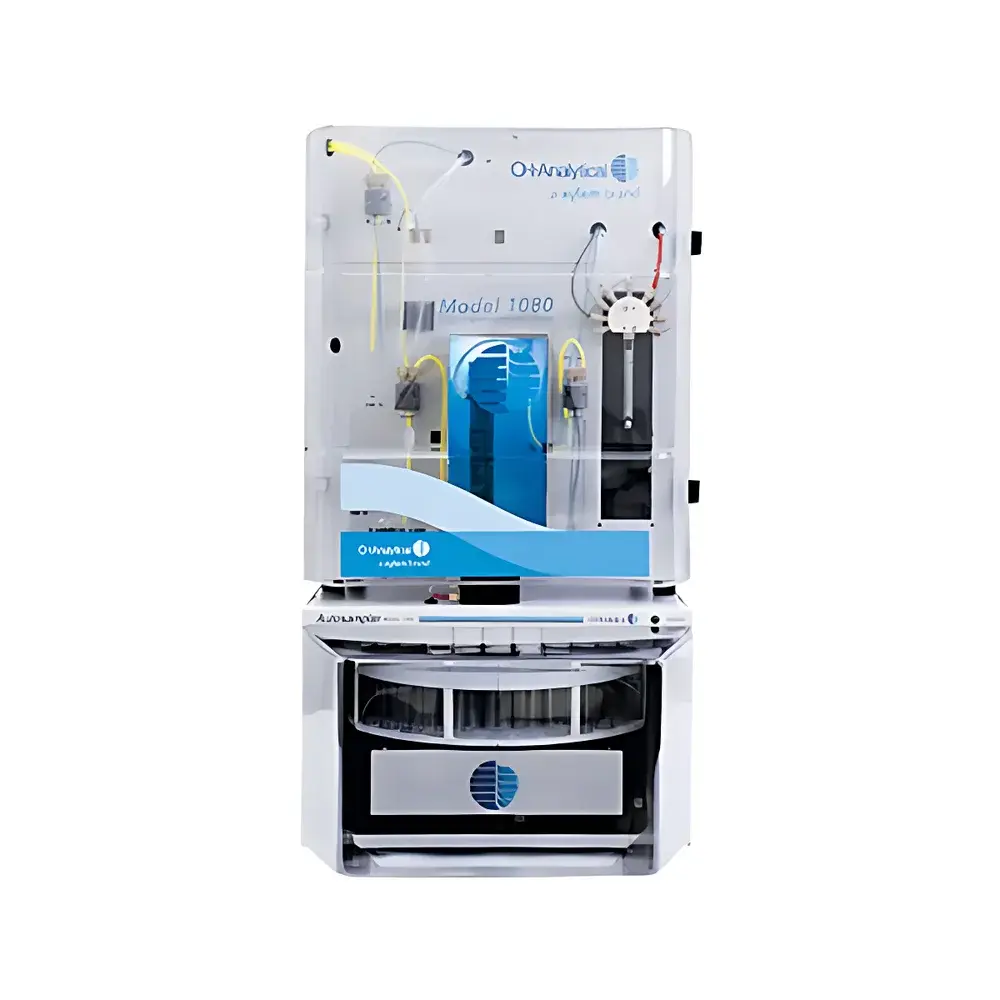
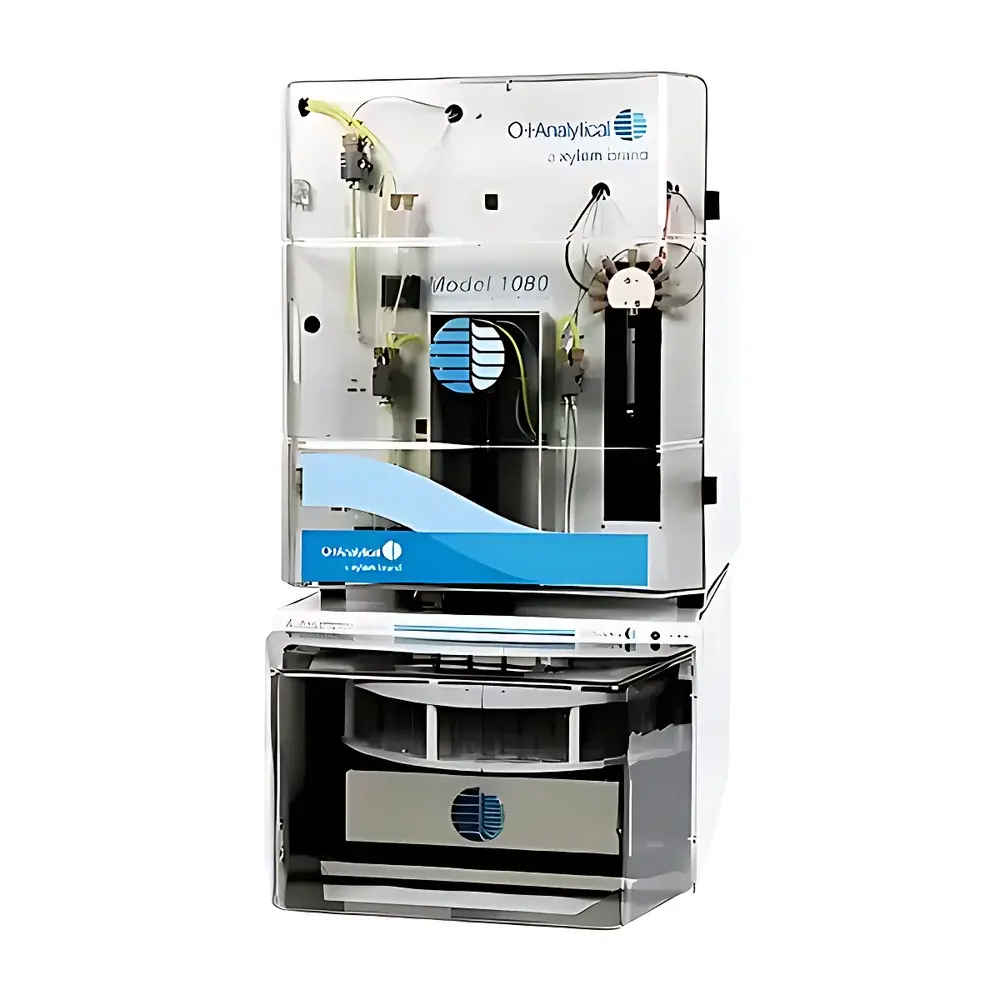
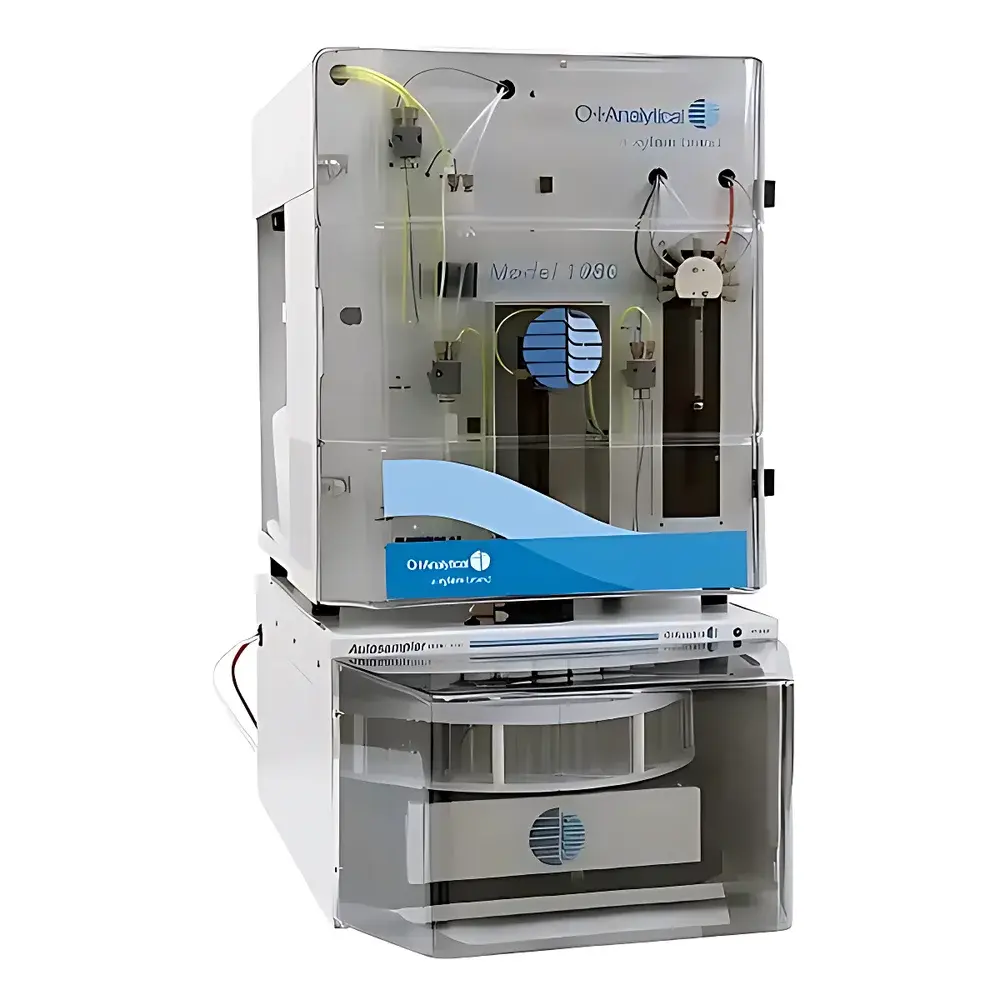
OI Analytical TOC 1080 Total Organic Carbon Analyzer
| Brand | OI Analytical |
|---|---|
| Origin | USA |
| Model | 1080 |
| Oxidation Method | High-Temperature Catalytic Combustion (680–950 °C) |
| Detector | Solid-State Non-Dispersive Infrared (SSNDIR) |
| Detection Range | TC: 50 ppb–2000 ppm |
| Precision | RSD < 3% |
| Sample Injection Volume | 50 µL–2 mL (adjustable in 10 µL increments) |
| Compliance | ASTM D7573, USP <643>, EPA Methods 415.3 & 9060A, ISO 8245 |
Overview
The OI Analytical TOC 1080 Total Organic Carbon Analyzer is a high-performance, regulatory-compliant instrument engineered for precise quantification of total organic carbon in aqueous matrices. It employs high-temperature catalytic combustion oxidation—operating at 680 °C standard (up to 950 °C optional for TNb analysis)—to fully mineralize organic compounds into CO2. This CO2 is then measured via a solid-state non-dispersive infrared (SSNDIR) detector, featuring narrow-band infrared optics and solid-state electronics to maximize selectivity and minimize interference from water vapor or inorganic gases. Designed for continuous operation in demanding environmental and industrial laboratories, the TOC 1080 delivers robust performance across drinking water, wastewater, surface water, seawater, and high-salinity process streams—without requiring dilution or method adjustment.
Key Features
- Patented combustion tube protective sleeve design prevents salt deposition on the Pt catalyst, extending catalyst service life by up to 3× and ensuring stable oxidation efficiency over extended run times.
- Intelligent sliding sample introduction mechanism increases O-ring seal lifetime from 30 days to 15 months, reducing maintenance frequency and improving system uptime.
- Pulsed timed injection technology enables sequential sample preparation during prior reaction cycles, supporting faster throughput and improved accuracy for low-volume injections (e.g., 50–200 µL).
- Stop-flow/bypass injection mode converts larger liquid sample volumes (up to 2 mL) into vapor-phase CO2 prior to NDIR detection—enhancing sensitivity for trace-level TOC without compromising linearity.
- Integrated desiccation system includes a permeation dryer and visual humidity indicator to eliminate water vapor interference, preserving SSNDIR detector integrity and long-term calibration stability.
- Sample isolation ring architecture ensures reagents and samples remain physically separated from the syringe pump body—preventing carryover, corrosion, and cross-contamination.
Sample Compatibility & Compliance
The TOC 1080 accommodates a broad range of sample types—including high-conductivity, high-chloride, and saline matrices—without signal suppression or catalyst deactivation. Its wide dynamic range (50 ppb–2000 ppm TC) supports both ultra-trace monitoring and concentrated effluent analysis. The analyzer meets or exceeds requirements for multiple international standards: ASTM D7573 (combustion-based TOC), USP (pharmaceutical water testing), EPA Methods 415.3 and 9060A (drinking and wastewater), and ISO 8245 (water quality—determination of TOC). Instrument design incorporates hardware- and software-level safeguards aligned with GLP/GMP data integrity expectations, including audit-trail-enabled operation logs and user-access controls.
Software & Data Management
Control and data acquisition are managed through OI’s intuitive, Windows-based TOC Navigator™ software. The interface provides real-time chromatogram visualization, automated method sequencing, and customizable report templates compliant with 21 CFR Part 11 requirements—including electronic signatures, secure user authentication, and immutable audit trails. All calibration curves, QC checks, and system suitability tests are stored with full metadata (operator ID, timestamp, instrument state). Raw data files are exportable in CSV and XML formats for LIMS integration or third-party statistical analysis.
Applications
The TOC 1080 is routinely deployed in municipal water treatment facilities for compliance monitoring under the Safe Drinking Water Act; in pharmaceutical manufacturing for Purified Water (PW) and Water for Injection (WFI) qualification per USP ; in power generation for boiler feedwater purity assurance; and in petrochemical and semiconductor industries where ultra-low TOC levels (<100 ppb) must be verified. Its ability to handle undiluted seawater, brine, and wastewater sludge filtrates makes it suitable for environmental field labs and regulatory agencies conducting ambient water quality surveys.
FAQ
What oxidation methods does the TOC 1080 support?
The instrument uses high-temperature catalytic combustion only—no UV/persulfate option is available. Combustion temperature is programmable from 680 °C to 950 °C in 1 °C increments.
Can the TOC 1080 measure total nitrogen (TNb)?
Yes—when equipped with the optional TNb module, the furnace temperature can be elevated to 720 °C or higher to achieve complete nitrogen conversion, enabling simultaneous TC/TNb analysis.
Is the SSNDIR detector susceptible to moisture interference?
No—the integrated permeation dryer and colorimetric humidity indicator actively remove water vapor prior to detection, ensuring long-term detector stability and eliminating the need for frequent recalibration.
How is sample carryover minimized during high-throughput operation?
The patented sample isolation ring prevents contact between aggressive reagents and the syringe pump internals, while the stop-flow injection technique eliminates liquid-phase residue in the combustion path.
Does the TOC 1080 support remote diagnostics or predictive maintenance alerts?
Yes—via Ethernet-connected TOC Navigator™ software, users can access real-time status indicators, consumables usage tracking, and automated notifications for catalyst replacement, dryer saturation, or O-ring wear thresholds.
Related Products







