
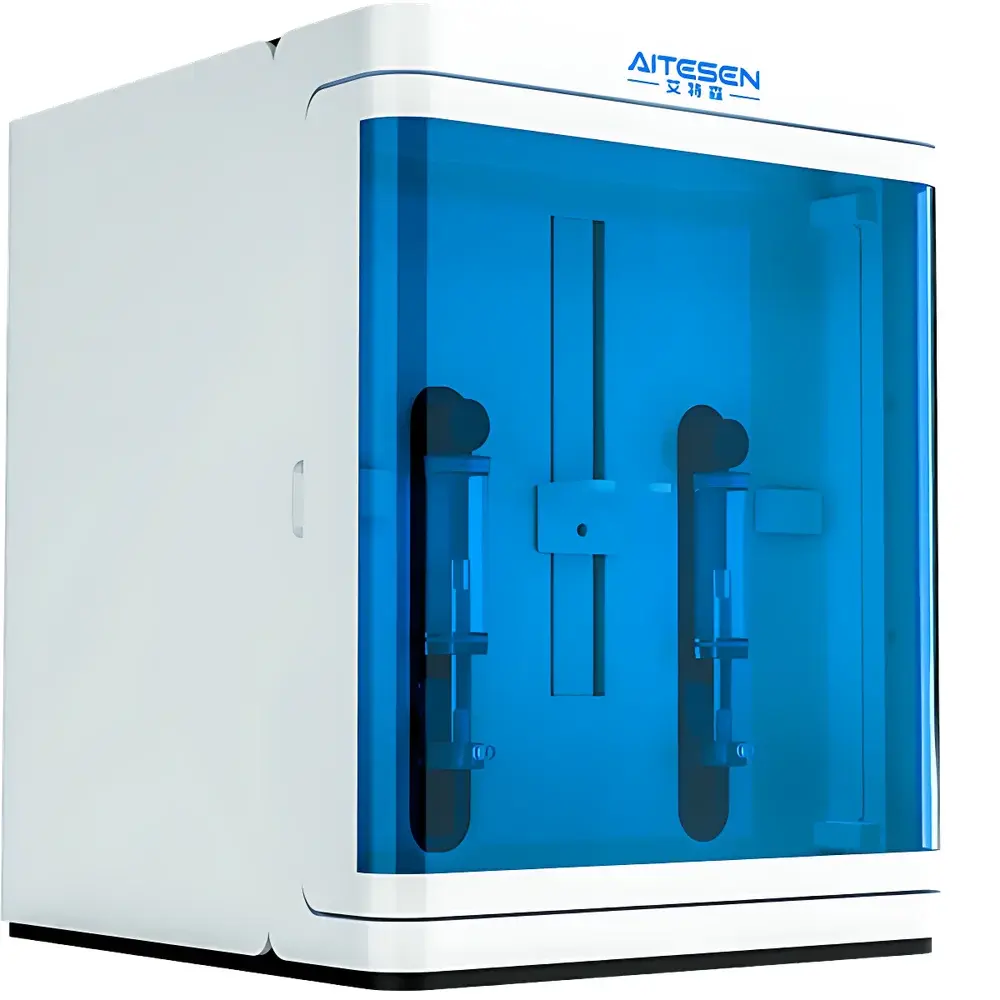
Aitesen MPE-L2 Microfluidic Nanomedicine Production System for Lipid Nanoparticle (LNP) Formulation
| Brand | Aitesen |
|---|---|
| Origin | Jiangsu, China |
| Manufacturer Type | Authorized Distributor |
| Product Category | Domestic |
| Model | MPE-L2 |
| Carrier Type | Liposomes |
| Particle Size Range | <100 nm |
| Polydispersity Index (PDI) | <0.1 |
| Operating Principle | Hydrodynamic Flow-Focusing & High-Pressure Impingement Emulsification |
| Sample Volume per Run | Low-volume (µL–mL scale) |
| In-Process Re-injection Capability | Yes |
| Compliance Context | Designed to support PAT-enabled process development aligned with ICH Q5A, Q5C, and USP <1289> guidelines for nanomedicine characterization |
Overview
The Aitesen MPE-L2 Microfluidic Nanomedicine Production System is an engineered platform for the reproducible, scalable synthesis of lipid nanoparticles (LNPs) and other nanocarrier formulations used in mRNA delivery, siRNA therapeutics, and vaccine development. It operates on two complementary microfluidic principles: (1) laminar flow-focusing for controlled initial mixing and primary emulsification of aqueous (phase A) and organic/lipid-dissolved (phase B) streams; and (2) high-pressure impingement within a dedicated microchannel chip to induce shear- and impact-driven secondary homogenization—enabling precise control over nucleation, particle growth, and final size distribution. Unlike batch-based sonication or extrusion methods, the MPE-L2 implements continuous-flow processing under fully defined hydrodynamic conditions, ensuring thermodynamic stability during self-assembly and minimizing aggregation risks. Its architecture supports early-stage formulation screening, process parameter mapping (e.g., flow rate ratio, total flow rate, pressure), and technology transfer from lab-scale to pilot-scale manufacturing.
Key Features
- Modular dual-pump configuration: Independent syringe pumps for phase A (aqueous buffer/nucleic acid solution) and phase B (ethanolic lipid mixture), enabling precise volumetric control at flow rates from 0.01 to 5 mL/min.
- High-pressure microfluidic chip interface: Integrated with replaceable chips featuring geometrically optimized impingement zones for consistent shear stress application (up to 20,000 psi nominal operating pressure).
- In-process re-injection capability: Allows sequential introduction of additional reagents (e.g., stabilizers, PEG-lipids, or crosslinkers) without interrupting the primary emulsification stream—critical for multi-step LNP assembly protocols.
- Low sample consumption design: Typical formulation volumes range from 100 µL to 5 mL per run, reducing material costs and accelerating iterative DOE cycles.
- Chip-mounting precision stage: Ensures repeatable alignment between fluidic connectors and microchannel inlets, minimizing dead volume and inter-run variability.
- Temperature-stabilized chip holder (optional): Maintains chip surface temperature within ±0.5 °C for thermal-sensitive encapsulation processes.
Sample Compatibility & Compliance
The MPE-L2 accommodates standard LNP formulation components including DSPC, cholesterol, DMG-PEG2000, and ionizable lipids (e.g., ALC-0315, SM-102), dissolved in ethanol or isopropanol, alongside aqueous phases containing mRNA, siRNA, or plasmid DNA buffered at pH 4.0–5.5. It supports preparation of unilamellar and multilamellar vesicles, polymeric nanoparticles (PLGA, chitosan), and hybrid lipid-polymer systems. The system’s operational parameters—including flow rate ratios (FRR), total flow rates (TFR), and backpressure—are fully loggable and exportable for audit trails. While not certified as GMP-compliant out-of-the-box, its design facilitates integration into GLP/GMP environments through traceable calibration records, electronic logbooks, and compatibility with 21 CFR Part 11–compliant data acquisition software (when paired with validated third-party DAQ modules).
Software & Data Management
The MPE-L2 operates via a Windows-based local control interface that records real-time pump status, pressure readings, and elapsed time per run. All experimental metadata—including syringe dimensions, target flow rates, chip ID, ambient temperature, and operator ID—is embedded in CSV-formatted output files. These logs are structured to align with FAIR (Findable, Accessible, Interoperable, Reusable) data principles and can be imported into LIMS platforms or statistical analysis tools (e.g., JMP, Python pandas). Optional API integration enables remote triggering and parameter synchronization with inline DLS (e.g., Malvern Panalytical ZS90) or UV-Vis spectrophotometers for closed-loop PAT workflows.
Applications
- Rapid screening of lipid molar ratios and buffer compositions for mRNA encapsulation efficiency and stability.
- Development of cold-chain-independent LNP formulations via controlled annealing post-emulsification.
- Production of reference standards for regulatory submissions (e.g., FDA IND/IMPD dossiers) requiring documented process consistency.
- Scale-down modeling for clinical manufacturing: MPE-L2-derived process maps directly inform parameters for larger microfluidic systems (e.g., NanoAssemblr® Ignite or Precision Nanosystems NanoAssemblr® GMP).
- Teaching and training in pharmaceutical nanotechnology courses, emphasizing first-principles understanding of nucleation kinetics and colloidal stability.
FAQ
What types of lipids and nucleic acids are compatible with the MPE-L2?
The system supports common ionizable, structural, and PEGylated lipids dissolved in ethanol or IPA, and nucleic acids (mRNA, siRNA, pDNA) in low-pH citrate or acetate buffers. Organic solvent compatibility is limited to Class II solvents per ICH Q3C guidelines.
Can the MPE-L2 produce particles below 80 nm?
Yes—under optimized high-pressure impingement conditions and appropriate lipid-to-nucleic acid ratios, sub-80 nm LNPs with PDI <0.08 have been reported in peer-reviewed literature using this platform configuration.
Is chip cleaning and reuse supported?
Microfluidic chips are designed as single-use, sterilizable components. Reuse is not recommended due to risk of residual lipid deposition and channel fouling, which compromises size distribution reproducibility.
Does the system include particle characterization tools?
No—the MPE-L2 is a preparative instrument only. Users must integrate external analytical instrumentation (e.g., DLS, NTA, TEM, HPLC-SEC) for post-processing characterization per USP and ICH Q5A requirements.
How is process scalability validated?
Scalability is demonstrated via geometric similarity scaling laws: constant Reynolds number (Re), capillary number (Ca), and Weber number (We) across scales. MPE-L2-derived dimensionless parameters serve as anchor points for predicting performance in larger microfluidic reactors or T-junction systems.
Related Products




