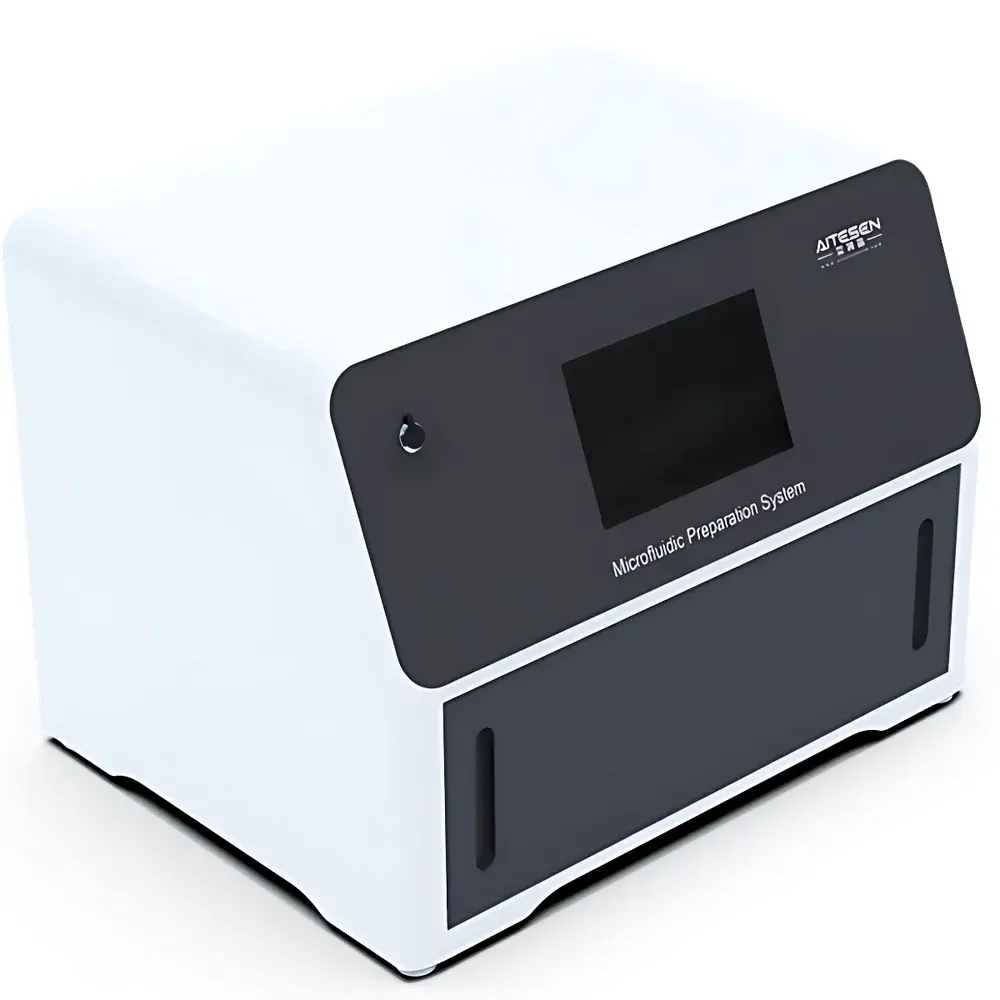
Aitesen MPE-P1 GMP-Compliant Microfluidic Nanomedicine Production System
| Brand | Aitesen |
|---|---|
| Origin | Jiangsu, China |
| Manufacturer Type | Authorized Distributor |
| Product Category | Domestic |
| Model | MPE-P1 |
| Quotation | Upon Request |
| Payload Carrier Type | Lipid Nanoparticles (LNP) |
| Particle Size Range | <100 nm |
| Polydispersity Index (PDI) | <0.1 |
| Flow Control | Dual-Phase Precision Syringe Pumps + High-Pressure Conveying Pump |
| Chip Integration | Customizable Microfluidic Cartridge Architecture |
| Regulatory Alignment | Designed for GMP Process Development per ICH Q5A/Q5B, ISO 13485-aligned engineering controls |
| Data Integrity | Audit-trail-enabled batch records, CSV-compliant data export |
Overview
The Aitesen MPE-P1 is a pilot-scale, GMP-aligned microfluidic nanomedicine production system engineered for the reproducible, continuous preparation of lipid-based and polymer-based nanocarriers under controlled process conditions. It operates on the principle of hydrodynamic focusing and controlled turbulent mixing within precision-machined microfluidic channels—leveraging laminar-to-turbulent transition regimes to govern nucleation, self-assembly, and particle stabilization in real time. Unlike batch-wise bulk mixing methods, the MPE-P1 implements a true continuous-flow platform where fluid dynamics (Reynolds number, Capillary number, and Péclet number) are maintained within defined operational envelopes to ensure thermodynamic and kinetic control over nanoparticle formation. This enables deterministic synthesis of lipid nanoparticles (LNPs), liposomes, PLGA/PEG-PLGA polymeric nanoparticles, oil-in-water emulsions (e.g., vaccine adjuvants, parenteral fat emulsions), and inorganic colloids (e.g., gold nanoparticles). The system is purpose-built for translational development—from early-stage formulation screening through Phase II/III clinical supply chain readiness—supporting regulatory filing with traceable, PAT-integrated process data.
Key Features
- GMP-ready architecture featuring stainless steel wetted parts, Class 10,000 cleanroom-compatible housing, and configurable HEPA filtration integration
- Dual independent syringe pump modules with ±0.5% volumetric accuracy and programmable flow rate gradients (0.01–50 mL/min per channel)
- High-pressure conveying module (up to 200 MPa) coupled with impact-focused microfluidic chips for post-mixing size refinement and PDI reduction
- Integrated 10.1-inch industrial touchscreen HMI with embedded PLC logic, supporting SOP-driven operation modes and user-level access control (admin/operator/auditor roles)
- Real-time monitoring of critical process parameters (CPPs): flow rate ratio, total flow, backpressure, chip temperature (±0.3°C), and elapsed run time
- On-board batch record generation compliant with ALCOA+ principles; data export in CSV, PDF, and XML formats with digital signature support
Sample Compatibility & Compliance
The MPE-P1 accommodates aqueous and organic solvent systems across a broad viscosity range (0.8–500 cP), including ethanol–water LNP formulations, chloroform-based liposome reconstitution solvents, and dichloromethane–acetone PLGA dissolution media. Its microfluidic cartridge design supports single-step or sequential multi-stage processing (e.g., primary emulsification → incubation → secondary homogenization), enabling complex architectures such as multilamellar liposomes or core–shell polymeric particles. From a compliance standpoint, the system’s hardware and firmware architecture aligns with FDA 21 CFR Part 11 requirements for electronic records and signatures. It supports audit trail logging with immutable timestamps, user authentication via encrypted credentials, and role-based data visibility—facilitating GLP/GMP audits and submissions to EMA, PMDA, and NMPA. All fluid-contact materials meet USP Class VI biocompatibility standards and ISO 10993-5 cytotoxicity testing criteria.
Software & Data Management
The proprietary Aitesen NanoControl™ software suite provides closed-loop process orchestration, including pre-programmed method templates (e.g., “mRNA-LNP Standard Protocol v2.1”, “Doxorubicin Liposome Batch Mode”), real-time deviation alerts, and automated parameter locking during active runs. Each batch generates a structured metadata package containing raw sensor logs, operator annotations, environmental chamber readings (if integrated), and final particle characterization summary (size, PDI, zeta potential if interfaced with optional inline DLS). All data files are hashed and stored with SHA-256 integrity verification. Exported datasets include full traceability to instrument serial number, firmware revision, and calibration certificate expiry dates—ensuring full alignment with ICH M4(R4) CTD Section 3.2.P.5.2 (Manufacturing Process Validation).
Applications
- Clinical-grade LNP synthesis for mRNA vaccines and therapeutics (e.g., encapsulation efficiency >92%, encapsulation integrity validated by RNase protection assay)
- Scale-down modeling of commercial liposome manufacturing processes per ASTM E2971-20 guidelines
- Development of siRNA-loaded LNPs with tunable endosomal escape kinetics via ionizable lipid screening
- Rapid prototyping of PLGA microspheres for sustained-release peptide delivery (2–8 week release profiles)
- Preparation of nanoemulsion adjuvants meeting EP 10.0 monograph requirements for droplet size distribution
- Synthesis of citrate-stabilized gold nanoparticles with CV <3% inter-batch size variability
FAQ
Does the MPE-P1 support fully automated cleaning-in-place (CIP) cycles?
Yes—optional CIP module integrates programmable detergent delivery, heated rinse sequences, and conductivity-based endpoint detection per ASME BPE-2022 Annex F.
Can custom microfluidic chips be qualified under GMP for commercial manufacturing?
Absolutely. Aitesen provides IQ/OQ documentation packages for each chip lot, including dimensional metrology reports (CMM-certified), surface roughness validation (Ra <0.4 µm), and functional testing against reference standards.
Is remote monitoring and troubleshooting supported?
The system includes secure TLS 1.3-enabled remote access with zero-trust authentication; diagnostic telemetry is restricted to non-PII operational metrics and requires explicit session authorization.
What level of process analytical technology (PAT) integration is available?
Standard configuration supports analog 4–20 mA outputs for third-party inline DLS, UV-Vis, or pH sensors; optional OEM integration kits enable direct Modbus TCP communication with Malvern Panalytical, Wyatt Technology, or Mettler Toledo platforms.
How does the MPE-P1 handle high-viscosity polymer solutions (e.g., >200 cP PLGA in ethyl acetate)?
The high-pressure conveying pump and tapered chip inlet geometry maintain stable laminar flow up to 350 cP at 15 mL/min; optional heated manifold (up to 60°C) reduces effective viscosity without thermal degradation of payloads.