
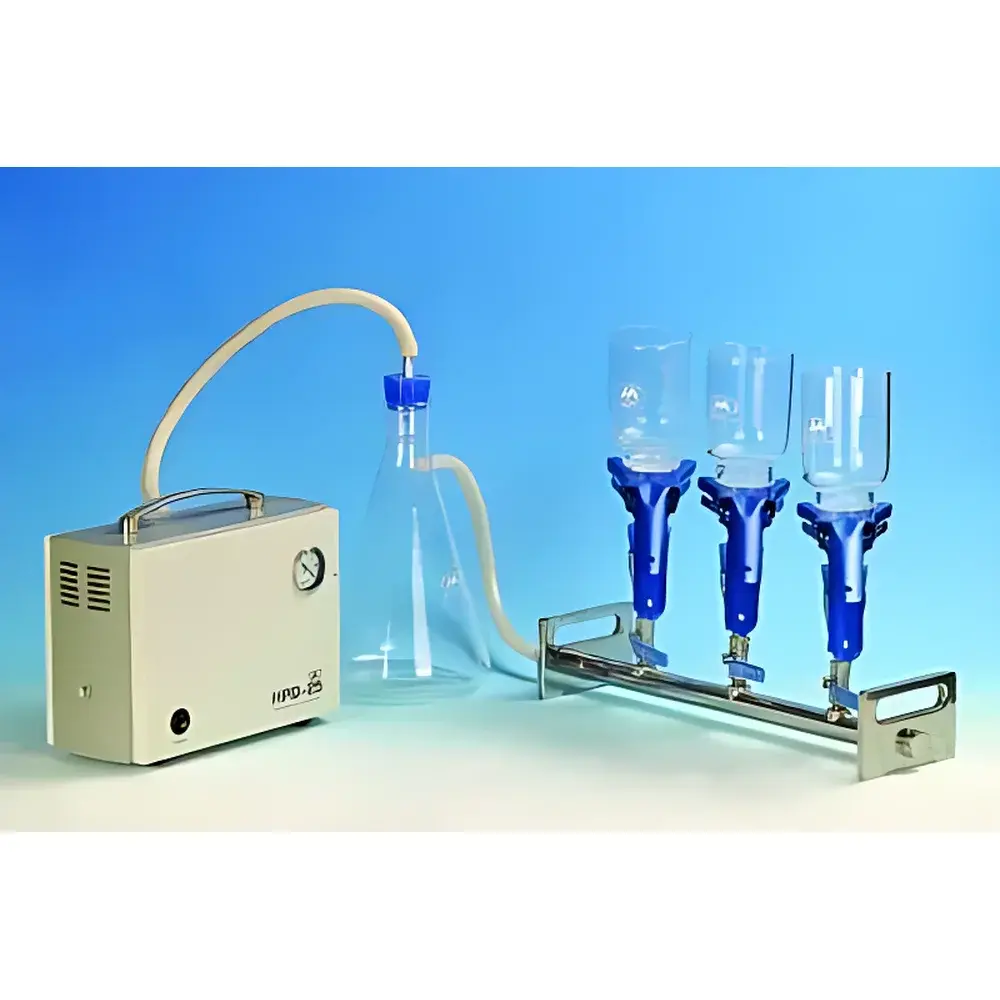
HengAo HSF-G3/G6 Standard Multi-Station Membrane Filtration System for Microbial Analysis in Water
| Brand | HengAo |
|---|---|
| Model | HSF-G3 / HSF-G6 |
| Construction | 316L Stainless Steel Support Frame & Borosilicate Glass Filtration Units |
| Configuration | 3- or 6-position parallel filtration stations |
| Filtration Principle | Vacuum-assisted membrane filtration (negative pressure-driven) |
| Compliance | Meets ISO 7218:2017 (Microbiology of food and animal feeding stuffs — General requirements and guidance for microbiological examinations), USP <61> & <62>, and ASTM D5465-22 (Standard Test Method for Determination of Total Coliforms and Escherichia coli in Water by Membrane Filtration) |
| Sterilization Compatibility | Autoclavable (121 °C, 20 min) and compatible with ethylene oxide (EtO) and vaporized hydrogen peroxide (VHP) decontamination protocols |
| Operating Pressure Range | −0.08 to −0.1 MPa (adjustable via individual inline valves) |
| Filter Diameter | 47 mm standard |
| Maximum Sample Volume per Station | 500 mL |
| Material Certifications | FDA-compliant silicone gaskets |
| Data Integrity | Designed for GLP/GMP environments with optional audit-trail-enabled vacuum controller integration |
Overview
The HengAo HSF-G3 and HSF-G6 Standard Multi-Station Membrane Filtration Systems are engineered for high-throughput, regulatory-compliant microbial enumeration in aqueous matrices—including drinking water, wastewater, pharmaceutical process water, and environmental monitoring samples. These systems operate on the principle of vacuum-assisted membrane filtration: a regulated negative pressure gradient across a sterile 47 mm microporous membrane (typically 0.45 µm or 0.22 µm pore size) drives sample volume through the filter surface, retaining viable microorganisms for subsequent culture-based or molecular detection. The modular architecture—comprising a rigid 316L stainless steel support frame, borosilicate glass filtration units, individually valved inlet ports, and standardized collection bottles—ensures mechanical stability, optical clarity for visual inspection, and resistance to corrosion from aggressive solvents or sanitizing agents. Each station functions independently, enabling true parallel processing without cross-contamination risk—a critical requirement for statistical validity in compliance-driven testing (e.g., EPA Method 1603, ISO 9308-1).
Key Features
- Independent inline vacuum control valves per station—enabling selective activation, real-time flow rate modulation, and immediate isolation during membrane rupture or overflow.
- 316L stainless steel support frame with electropolished finish (Ra ≤ 0.4 µm) meeting ASME BPE surface finish standards for bioprocessing equipment.
- Borosilicate glass filtration units (DIN/ISO 3585 compliant) with calibrated conical funnels and precision-ground sealing surfaces for repeatable gasket compression and leak-free operation.
- Modular filter holder assembly: includes reusable sintered stainless steel or PTFE-coated fritted discs, autoclavable silicone O-rings (USP Class VI), and NSF/ANSI 51-certified polypropylene filter cups.
- Integrated drip tray with sloped drainage channel and removable waste reservoir—designed to contain spills and prevent secondary contamination during high-volume batch processing.
- Compatibility with standard 47 mm membrane formats (grid-marked or plain), including mixed cellulose ester (MCE), polycarbonate (PC), and polyethersulfone (PES) membranes from major suppliers (e.g., Pall, Sartorius, MilliporeSigma).
Sample Compatibility & Compliance
The HSF-G3/G6 system accommodates a broad range of aqueous and low-viscosity liquid samples—potable water, surface water, effluent, saline solutions, buffer preparations, and sterile pharmaceutical rinsates—without requiring pre-filtration or dilution beyond standard method requirements. Its construction materials comply with FDA 21 CFR Part 177 (indirect food additives), EU Regulation (EC) No. 1935/2004, and ISO 10993-5 (biocompatibility). Validation documentation supports IQ/OQ/PQ protocols under GMP Annex 11 and FDA 21 CFR Part 11 when paired with a validated vacuum source and electronic logging system. The system is routinely deployed in laboratories accredited to ISO/IEC 17025:2017 and operates within the performance criteria defined in ISO 7218:2017 for microbiological examination consistency.
Software & Data Management
While the base HSF-G3/G6 configuration is hardware-only, it integrates seamlessly with third-party vacuum controllers (e.g., KNF N86 KT.18, Welch 2055) equipped with RS-485 or Modbus RTU interfaces. When coupled with such controllers, the system supports time-stamped pressure logging, event-triggered alarms (e.g., overpressure, vacuum loss), and CSV export for LIMS ingestion. Optional firmware upgrades enable GLP-compliant audit trails—including user ID, timestamp, valve actuation sequence, and pressure deviation alerts—meeting ALCOA+ data integrity principles. All physical labeling adheres to IEC 62366-1 usability engineering requirements, with engraved model/serial numbers and material traceability markers.
Applications
- Regulatory microbial testing of drinking water per EPA 1603, ISO 9308-1, and GB/T 5750.12–2023.
- Environmental monitoring of surface and groundwater for total coliforms, E. coli, and Pseudomonas aeruginosa.
- In-process bioburden assessment in pharmaceutical water-for-injection (WFI) and purified water (PW) distribution loops.
- Validation of sterilizing-grade filters in aseptic processing environments (per ISO 13408-2).
- Research-scale filtration of cell suspensions, enzyme solutions, and clarified fermentation broths prior to downstream analysis.
- Teaching laboratories conducting standardized microbiology experiments under ISO/IEC 17025-aligned curricula.
FAQ
What vacuum pump specifications are recommended for optimal performance with the HSF-G6?
A two-stage diaphragm pump with ≥60 L/min free air displacement and ultimate vacuum ≤5 mbar is recommended. Oil-free operation is strongly advised to prevent hydrocarbon contamination of membranes and samples.
Can the glass filtration units be sterilized in an autoclave?
Yes—borosilicate glass components and 316L stainless steel frames withstand standard autoclave cycles (121 °C, 20 min, saturated steam). Silicone gaskets require post-cycle inspection for compression set.
Is the system compatible with 0.22 µm pore size membranes for sterile filtration validation?
Yes—provided the membrane is rated for bacterial retention (e.g., certified Bacterial Retention Test per ASTM F838-22) and installed with proper pre-wetting and pressure ramping per manufacturer instructions.
How is cross-contamination prevented between stations during multi-sample runs?
Each station features independent fluid pathways, sealed valve manifolds, and physically isolated collection bottles—eliminating shared conduits. Validation per ISO 11737-2 confirms no detectable carryover (<1 CFU) under worst-case challenge conditions.
Does HengAo provide installation qualification (IQ) documentation?
Yes—standard delivery includes a Factory Acceptance Test (FAT) report, material certification packages (EN 10204 3.1), and a configurable IQ checklist aligned with ISPE Baseline Guide Vol. 5 (Water and Steam Systems).



