
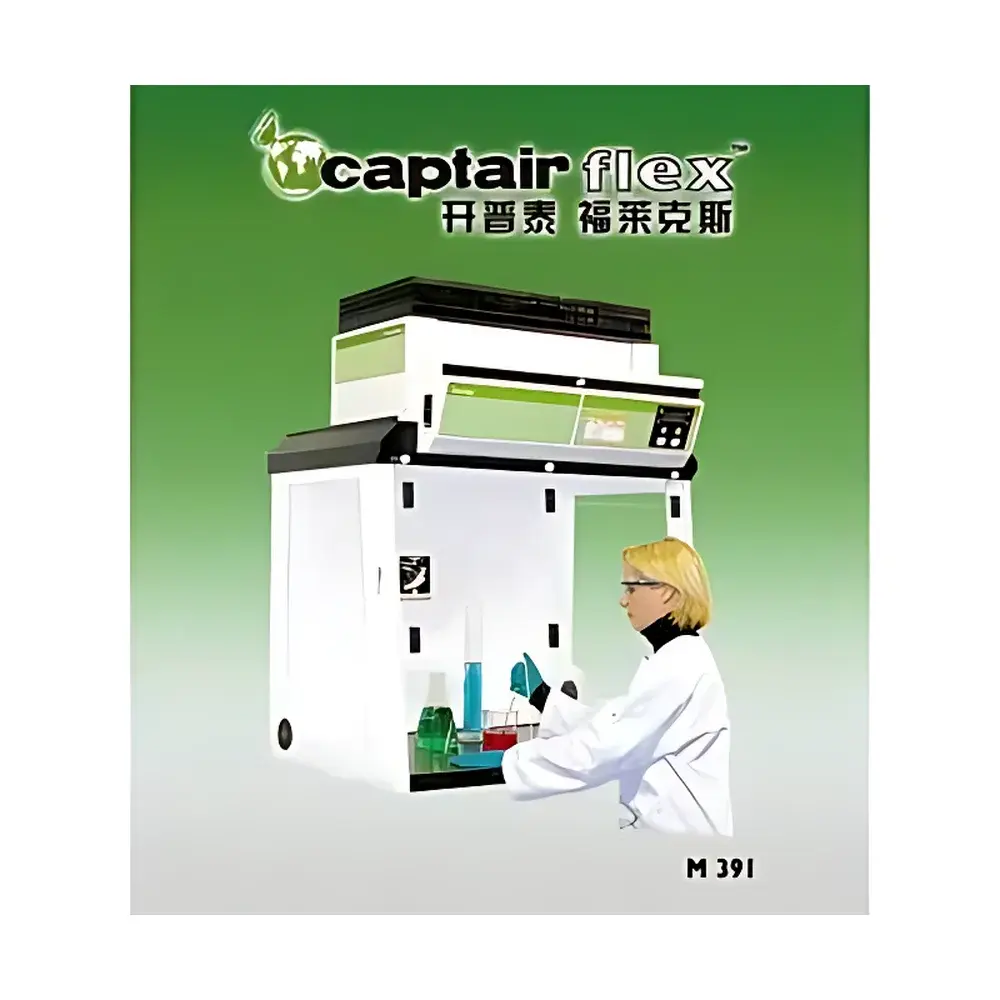
Erlab M391 Ductless Fume Hood
| Brand | Erlab |
|---|---|
| Origin | France |
| Model | M391 |
| Construction | All-Steel Cabinet |
| Configuration | Double-Sided Operation |
| Airflow Capacity | 230 m³/h |
| Face Velocity Range | 0.4–0.6 m/s (compliant with AFNOR NF X 15-211:2009) |
| Filtration System | Dual-Layer Molecular Filter Assembly (Class 1 per NFX 15-211) |
| Power Consumption | 58 W |
| Input Voltage | 100–240 V AC, 50–60 Hz |
| Internal DC Voltage | 24 V DC |
| Sound Pressure Level | 52 dB(A) |
| Dimensions (L×W×H, mm) | 1000 × 620 × 1161–1345 (external), 897 × 522 × 866 (internal) |
| Lighting | IP67-rated fluorescent lamp(s), 18 W, ≥500 lux |
| Ergonomic Features | Tilted front panel, elliptical sash opening, curved work surface edge |
| Certification | Compliant with NFX 15-211:2009 Class 1 |
Overview
The Erlab M391 is a high-performance, ductless (recirculating) fume hood engineered for chemical safety in modern laboratories where infrastructure constraints, energy efficiency, and environmental responsibility are critical considerations. Unlike conventional ducted hoods that exhaust conditioned air outdoors—requiring costly HVAC make-up air—the M391 employs an integrated, closed-loop air purification system based on active molecular filtration. Ambient laboratory air is drawn inward through the sash opening at a controlled face velocity of 0.4–0.6 m/s (validated per AFNOR NF X 15-211:2009), passed across dual-stage molecular filter cartridges, and recirculated as clean, particle- and vapor-free air back into the lab environment. This principle eliminates external ductwork, reduces building energy load by up to 85% compared to traditional systems, and supports sustainable lab operations without compromising operator protection.
Key Features
- Dual-Layer Molecular Filtration Architecture: Two identical, vertically stacked molecular filter cartridges—one upstream and one downstream of the centrifugal blower—provide redundant chemical capture. Should the lower cartridge reach saturation, the upper cartridge continues to intercept volatile organic compounds (VOCs), acids, bases, and aldehydes, ensuring uninterrupted containment integrity and zero breakthrough under normal operating conditions.
- Capteur™ Flex Digital Control Panel: A centralized, microprocessor-based interface manages all operational and safety parameters. Functions include real-time airflow monitoring with audible/visual alarms for velocity deviation, programmable maintenance timers (0–250 operating hours), optional Melecode® S saturation sensor for organic-rich applications, and guided service protocols compliant with GLP documentation requirements.
- Filter Saturation Verification Port: A dedicated sampling port enables non-invasive verification of filter performance using colorimetric indicator tubes (e.g., Dräger or Sensidyne), permitting routine validation of adsorption capacity without filter disassembly.
- Ergonomic Human-Centered Design: The 15° forward-tilted front panel improves posture and visual access; elliptical sash geometry accommodates natural arm movement; and a radiused work surface edge provides forearm support during extended procedures. All structural components are fabricated from corrosion-resistant, electrogalvanized steel with epoxy-polyester powder coating.
- Low-Voltage, Low-Noise Operation: Powered by a 24 V DC motor drive system, the unit consumes only 58 W and operates at ≤52 dB(A)—suitable for open-plan labs and quiet environments such as analytical QC suites or teaching facilities.
Sample Compatibility & Compliance
The M391 is validated for use with liquid reagents, low-dust solid handling (e.g., weighing, dissolution), and controlled powder manipulation in non-sterile environments. It meets Class 1 performance criteria per NFX 15-211:2009 for ductless fume hoods, verified by independent third-party testing (SGS and Intertek). While not intended for radioisotopes, perchloric acid, or uncontained hydrogen sulfide, its filtration configuration is optimized for common laboratory chemicals including acetone, methanol, formaldehyde, hydrochloric acid, ammonia, and ethyl acetate. The unit complies with IEC 61000-6-3 (EMC), IEC 61000-6-1 (immunity), and EN 61000-3-2 (harmonic current limits). Optional accessories—including casters for mobility, LED lighting upgrades, and custom sash height sensors—support integration into ISO 14644-1 Class 7–8 cleanroom-adjacent workflows.
Software & Data Management
The Capteur™ Flex control system logs operational data—including cumulative runtime, airflow deviations, filter usage intervals, and alarm events—in non-volatile memory. Audit trails are exportable via USB for internal quality review. While no cloud connectivity is embedded, the system supports 21 CFR Part 11-compliant record-keeping when paired with laboratory information management systems (LIMS) via RS-485 or Modbus RTU protocol (optional module). All firmware updates are performed locally using encrypted USB keys, maintaining data sovereignty and regulatory alignment with EU GDPR and FDA expectations for instrument qualification (IQ/OQ/PQ).
Applications
The M391 serves laboratories requiring flexible, scalable containment without architectural modification: academic research labs performing synthetic chemistry or material characterization; pharmaceutical QC labs conducting routine titrations and standard preparations; environmental testing facilities handling EPA Method 8270 analytes; and industrial R&D centers managing small-batch formulation development. Its double-sided configuration allows simultaneous operation by two users—ideal for collaborative teaching labs or shared instrumentation spaces. Due to its zero external exhaust requirement, it is especially suited for upper-floor installations, historic buildings, and modular lab expansions where duct routing is impractical.
FAQ
What types of chemicals can the M391 safely handle?
The M391 is validated for VOCs, inorganic acids/bases, and aldehydes within defined concentration thresholds. It is not approved for perchloric acid, hydrogen fluoride, radioactive materials, or nanoparticles without supplemental engineering controls.
How often must the molecular filters be replaced?
Replacement frequency depends on chemical type, concentration, and usage duration. Under typical academic use (4–6 hrs/day, mixed solvents), filters last 6–12 months. The built-in timer and Melecode® S sensor provide objective indicators for scheduled changeouts.
Does the M391 require external ductwork or make-up air systems?
No. It operates as a fully self-contained recirculating unit and does not connect to building exhaust or HVAC systems.
Can the M391 be installed in a cleanroom environment?
Yes—when equipped with HEPA pre-filters and operated within ISO Class 7–8 ambient conditions, it supports low-particulate chemical handling adjacent to clean processes.
Is third-party certification documentation available for audit purposes?
Yes. SGS and Intertek test reports, NFX 15-211 compliance declarations, and CE marking documentation are provided with each unit and accessible via Erlab’s technical portal upon registration.



