
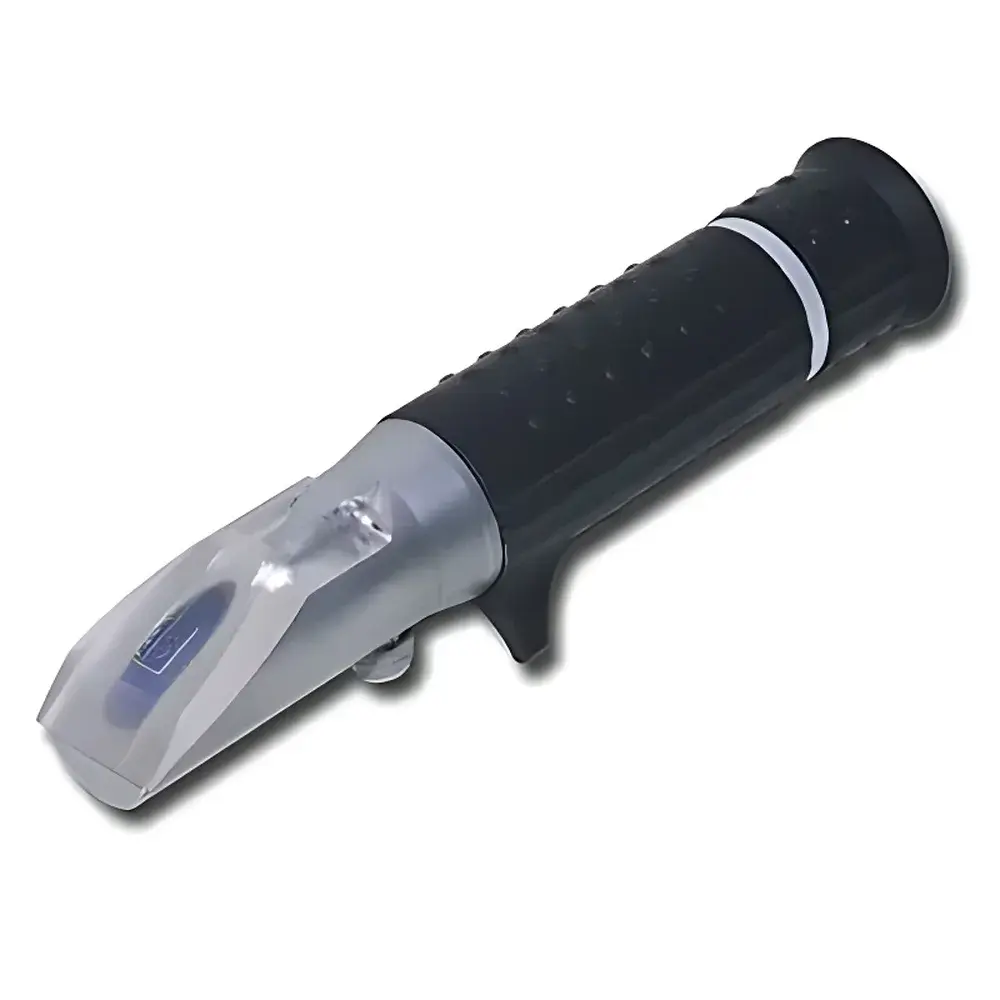
Bellingham + Stanley Eclipse Series Handheld Refractometer
| Brand | Bellingham + Stanley |
|---|---|
| Origin | United Kingdom |
| Model | Eclipse |
| Scale Options | °Brix (0–15 to 45–80), % ABV (10–135), Water-in-Honey (10–30%), Refractive Index (1.330–1.420), Starch (0–30%), Antifreeze (°C/°F, Ethylene/Propylene Glycol % vol), Battery Acid SG (1.1–1.35), Salinity (0–28% NaCl), Wine Scales (°Oechsle CH/D, Baumé) |
| ATC Available | Yes |
| Sample Volume (Standard) | ~0.1 mL |
| Sample Volume (Micro) | ≤1 µL |
| Calibration | Single-point aqueous standard (e.g., distilled water or sucrose reference solution) |
| Construction | Full metal body with heat-insulating rubber grip |
| Compliance | BS EN ISO 9001:2000, CE, UKAS-accredited manufacturing |
Overview
The Bellingham + Stanley Eclipse Series Handheld Refractometer is a precision optical instrument engineered for rapid, field-deployable measurement of refractive index and derived concentration units—including °Brix, % alcohol by volume (ABV), salinity, glycol concentration, battery electrolyte specific gravity, and wine-specific scales (°Oechsle, Baumé). Based on the fundamental principle of total internal reflection at the prism-sample interface, the Eclipse determines refractive index by locating the critical angle boundary between light transmission and cutoff—translated via calibrated optical geometry into linear, temperature-compensated scale readings. Designed and manufactured in the United Kingdom since 1920, B+S refractometers are recognized globally for metrological stability, mechanical robustness, and adherence to international quality standards. The Eclipse series embodies over a century of refinement in Abbe-type optical design, optimized for portability without compromising optical fidelity or repeatability.
Key Features
- Full-metal chassis with heat-insulating rubberized ergonomic grip—minimizes thermal drift during handheld operation and enhances user comfort during extended field use.
- Patented push-to-open prism cover mechanism—ensures precise, repeatable prism alignment and protects the optical surface from abrasion and contamination.
- Anti-roll support feet—stabilizes unit on flat surfaces during benchtop verification or calibration procedures.
- Drop-and-read sample application—requires no syringes or capillary tubes; typical sample volume is ~0.1 mL for standard models, with micro-volume variants (≤1 µL) available for precious or volatile samples.
- Temperature-stable optical path—engineered to maintain consistent focus and scale linearity across ambient conditions from 5 °C to 40 °C.
- ATC (Automatic Temperature Compensation) models incorporate bimetallic thermal compensation elements aligned to ISO 21746:2019 and AOAC guidelines—correcting for sample temperature deviation from 20 °C without electronic components or batteries.
Sample Compatibility & Compliance
The Eclipse refractometer accommodates aqueous, alcoholic, glycolic, saline, acidic (e.g., sulfuric acid in lead-acid batteries), and viscous (e.g., honey, syrup) liquid samples. Its hardened optical glass prism (BK7 or sapphire-coated variants per model) resists corrosion from mild acids, alcohols, and sugars. All Eclipse instruments are manufactured under a UKAS-accredited quality management system compliant with BS EN ISO 9001:2000 and bear CE marking per EU Directive 2014/30/EU (EMC) and 2014/35/EU (LVD). While not intrinsically safe for hazardous areas, select models meet IP54 ingress protection for dust and splash resistance. Calibration traceability follows NPL (National Physical Laboratory, UK) protocols, supporting GLP-compliant documentation when used with certified reference standards (e.g., NIST-traceable sucrose solutions).
Software & Data Management
As an analog optical instrument, the Eclipse requires no firmware, software, or power source—eliminating validation overhead associated with electronic data capture. Readings are interpreted visually through a high-contrast reticle eyepiece with parallax-corrected scale illumination. For regulated environments (e.g., food QC labs operating under FDA 21 CFR Part 11 or ISO/IEC 17025), users may integrate Eclipse measurements into LIMS or ELN systems via manual entry with dual-operator verification and audit-trail logging. Optional accessories include calibration kits (certified 0 °C and 20 °C water standards), prism cleaning tools, and protective carrying cases conforming to ISTA 3A transport testing requirements.
Applications
- Food & Beverage: Rapid °Brix assessment in fruit juices, soft drinks, jams, and maple syrup; alcohol prediction in must and finished wine using °Oechsle or % ABV scales.
- Agriculture & Horticulture: Field monitoring of sugar content in grapes, tomatoes, and citrus; honey moisture analysis per Codex Alimentarius standards.
- Automotive & Industrial Fluids: Glycol-based antifreeze concentration (% v/v) and freeze-point estimation in cooling systems; battery electrolyte specific gravity (1.10–1.35 SG) for state-of-charge evaluation.
- Pharmaceutical & Cosmetic Manufacturing: Excipient concentration checks (e.g., glycerin, propylene glycol) in topical formulations where solvent volatility precludes digital instrumentation.
- Marine & Aquaculture: Seawater salinity (0–28% NaCl) verification for hatchery water management and aquarium maintenance.
FAQ
Does the Eclipse require battery power or electronic components?
No. The Eclipse is a purely optical, analog instrument relying on ambient light and precision-ground prisms—no batteries, LEDs, or circuitry are used.
How is temperature compensation achieved in ATC models?
ATC functionality uses passive bimetallic strips integrated into the prism assembly, physically shifting the optical path to offset refractive index drift between 10 °C and 30 °C per ISO 21746:2019 Annex A.
Can the Eclipse be recalibrated in-house?
Yes—using a certified reference standard (e.g., distilled water at 20 °C for RI = 1.3330 or NIST-traceable sucrose solution), users can adjust the zero point via the calibration screw located beneath the eyepiece cap.
What is the typical measurement repeatability?
Under controlled conditions (stable ambient temperature, clean prism, consistent drop volume), standard deviation is ≤±0.1 °Brix for 0–30 range models and ≤±0.2 °Brix for wider ranges, per B+S factory test reports.
Is prism cleaning solvent-compatible?
Yes—prisms tolerate isopropyl alcohol, ethanol, acetone, and mild detergent solutions; avoid abrasive cloths or chlorinated solvents which may degrade anti-reflective coatings on select high-end variants.




