
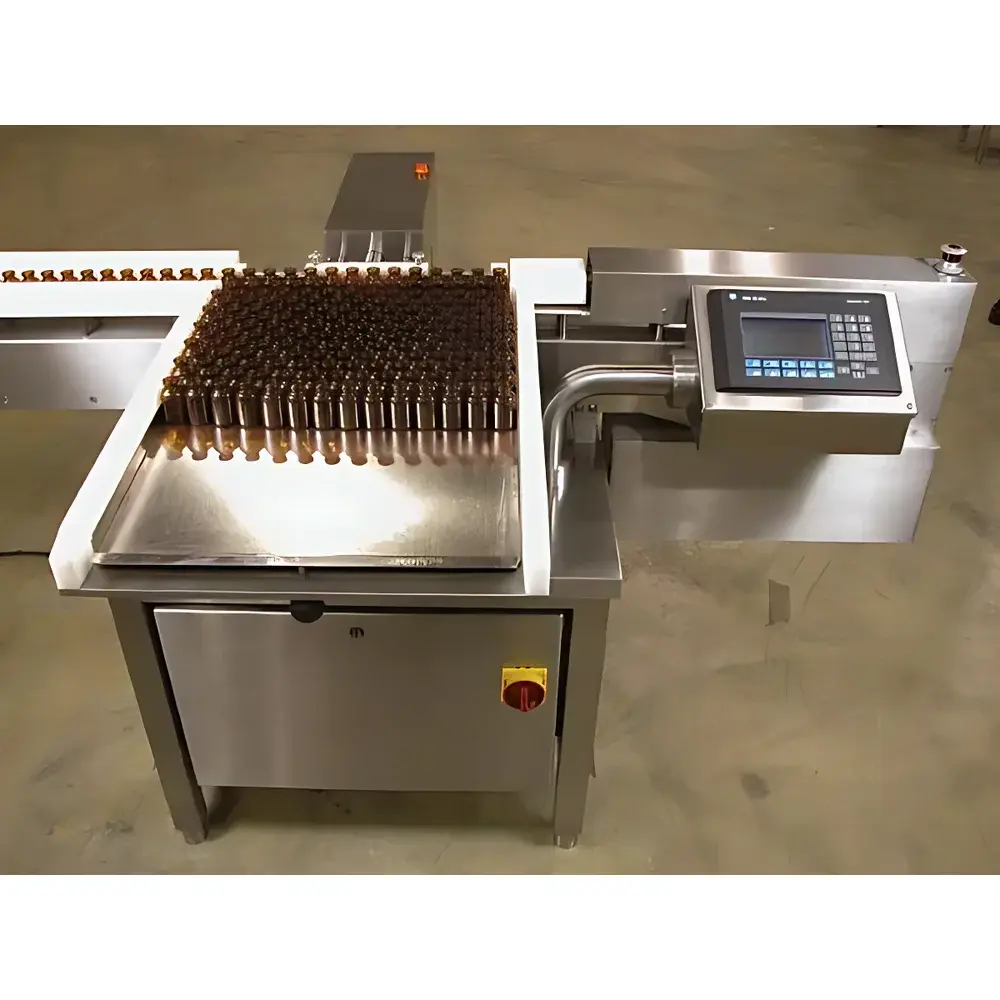
SP PennTech TL-100 / TL-200 / HSTL-200 Tray-Loading Vial Orienting & Singulating System
| Origin | USA |
|---|---|
| Manufacturer Type | Authorized Distributor |
| Origin Category | Imported |
| Model | TL-100, TL-200, HSTL-200 |
| Capacity | Up to 500 vials/min (HSTL-200, dependent on vial geometry and tray configuration) |
| Vial Compatibility | 2–500 mL serum vials & reagent bottles |
| Control System | PLC-based menu-driven HMI with auto-configurable changeover logic |
| Nesting | Fully automatic nested tray loading |
| Dimensions (L×W×D) | Custom-engineered per integration requirements |
| Compliance | Designed in accordance with cGMP, ISO 13485-aligned architecture, FDA 21 CFR Part 11–ready data handling infrastructure |
Overview
The SP PennTech TL-100, TL-200, and HSTL-200 Tray-Loading Vial Orienting & Singulating Systems are engineered for high-integrity pharmaceutical and biotechnology manufacturing environments where precise, repeatable orientation and singulation of serum vials and reagent bottles are prerequisites for downstream aseptic processing. These systems operate on a mechanical–pneumatic–electronic hybrid principle: vials are extracted from standardized ISO/IEC-compliant trays via servo-controlled gripper modules, subjected to multi-axis orientation correction (pitch, yaw, roll), then conveyed as single-file, upright, neck-forward units onto sterile transfer rails or into washers, sterilizers, or fill-finish lines. Unlike gravity-fed or vibratory bowl feeders—whose performance degrades significantly with irregular bottle geometries or low-friction surfaces—the PennTech tray-loader employs deterministic kinematic positioning, eliminating random tumbling and ensuring >99.98% orientation fidelity across 2–500 mL cylindrical glass or polymer vials. The system’s core architecture is validated for Class A/B cleanroom integration (ISO 14644-1) and supports full traceability through embedded audit trails and electronic batch records.
Key Features
- PLC-controlled HMI with intuitive menu-driven interface enabling rapid recipe recall for different vial sizes, tray formats (e.g., 5×5, 6×6, 8×10), and line speeds—no mechanical change parts required
- Auto-nesting capability: dynamically adjusts tray indexing and vial extraction sequence to maintain optimal nesting density without operator intervention
- Modular construction with stainless-steel 316L frame and electropolished contact surfaces meeting ASME BPE-2022 surface finish standards (Ra ≤ 0.4 µm)
- Integrated vision-assisted verification (optional): high-resolution monochrome CCD cameras validate vial orientation, cap presence, and label integrity prior to singulation
- Real-time diagnostics with predictive maintenance alerts via OPC UA connectivity; compatible with MES/SCADA platforms including Siemens SIMATIC, Rockwell FactoryTalk, and Emerson DeltaV
Sample Compatibility & Compliance
The system accommodates standard USP/Ph. Eur.-compliant serum vials (Type I borosilicate glass, molded or tubular) and polymer reagent bottles (PP, COP, COC) ranging from 2 mL micro-vials to 500 mL wide-mouth containers. All models comply with cGMP Annex 1 (2022) requirements for aseptic processing equipment, including closed-system design, no dead-leg piping, and fully drainable fluid paths. Mechanical components meet ISO 13485:2016 design control criteria, while electrical safety conforms to UL 61010-1 and IEC 61000-6-2/6-4 EMC standards. Documentation packages include DQ/IQ/OQ protocols, FAT/SAT reports, and 21 CFR Part 11–compliant electronic signature validation.
Software & Data Management
The embedded Allen-Bradley CompactLogix PLC runs a deterministic real-time OS with dual-channel Ethernet/IP communication. Data logging includes timestamped event records (vial count, orientation pass/fail, jam detection, tray ID scan), all stored locally on encrypted industrial SSD and synchronized to networked SQL databases via TLS 1.2–secured REST APIs. Audit trail functionality satisfies FDA 21 CFR Part 11 Subpart B requirements: user authentication (LDAP/Active Directory integration), immutable log entries, and electronic signature workflows for critical parameter changes. Optional GAMP 5–aligned validation support documentation is available upon request.
Applications
- Pre-wash staging for SP PennTech Bottle Washers (e.g., BW-400 series) in parenteral drug manufacturing
- Feeding isolator-integrated depyrogenation tunnels (e.g., sterilization at ≥250°C for 45 min)
- Upstream conditioning for automated filling lines (per USP and EU GMP Annex 1 §6.40)
- QC lab sample preparation for extractables/leachables testing under ISO 10993-12
- Bioburden reduction workflows compliant with ISO 11737-1 microbiological sampling protocols
FAQ
Can the TL-200 handle both glass and polymer vials without hardware modification?
Yes. The system’s adaptive end-effector and torque-limited servo actuators automatically adjust gripping force and rotation profile based on material modulus and dimensional feedback from integrated load cells.
Is validation support included with purchase?
Standard delivery includes IQ/OQ templates aligned with ISPE Baseline Guide Vol. 4 (2022); PQ protocol development and execution services are available as optional engineering engagement.
What cleanroom classifications are supported?
All models are rated for ISO Class 5 (Class 100) environments when installed with HEPA-filtered laminar airflow enclosures and static-dissipative conveyor belts.
Does the HSTL-200 require additional utilities beyond standard 208–240 VAC/3-phase power?
No compressed air or process water is required for core operation; optional vision inspection or ionized air anti-static modules draw ≤5 SCFM at 60 psi.
How is firmware updated while maintaining 21 CFR Part 11 compliance?
Updates are delivered as digitally signed .pkg files via secure SFTP; installation triggers automatic version-locking of audit logs and generates a new electronic signature event with user credentials and timestamp.
Related Products



