
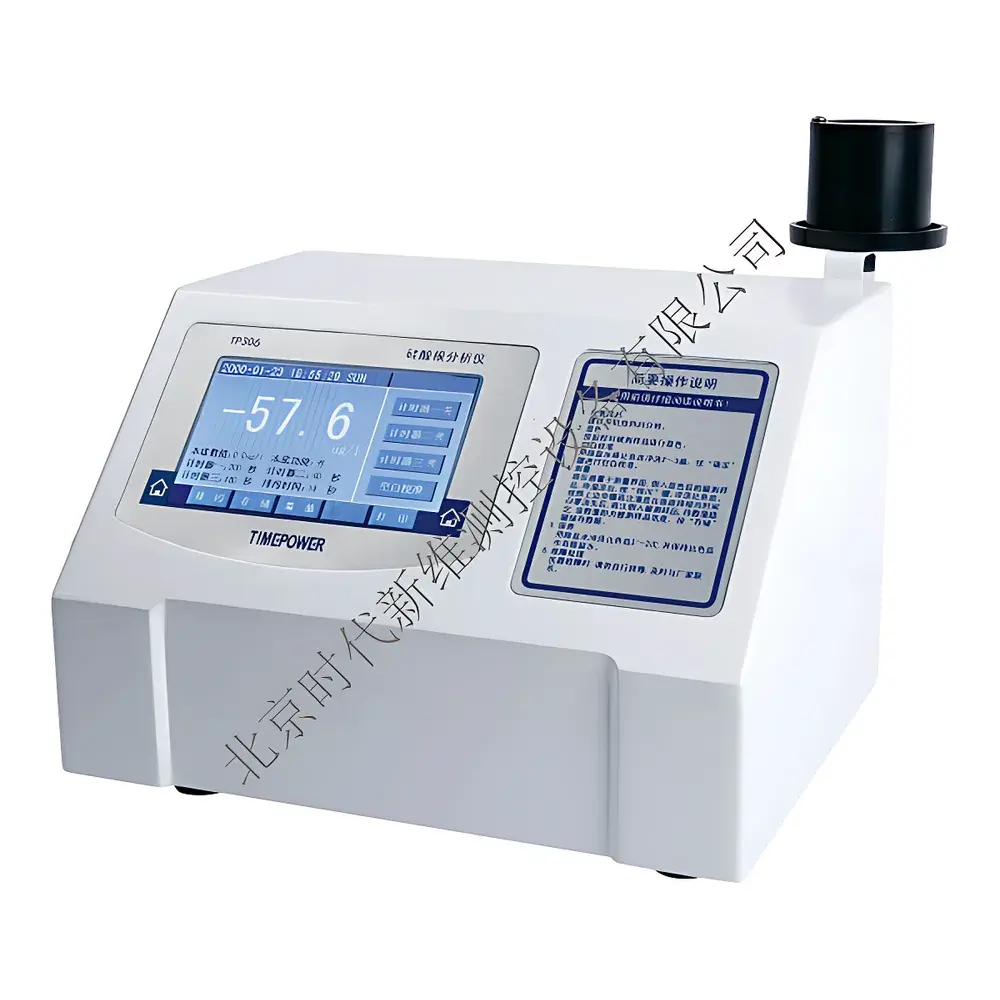
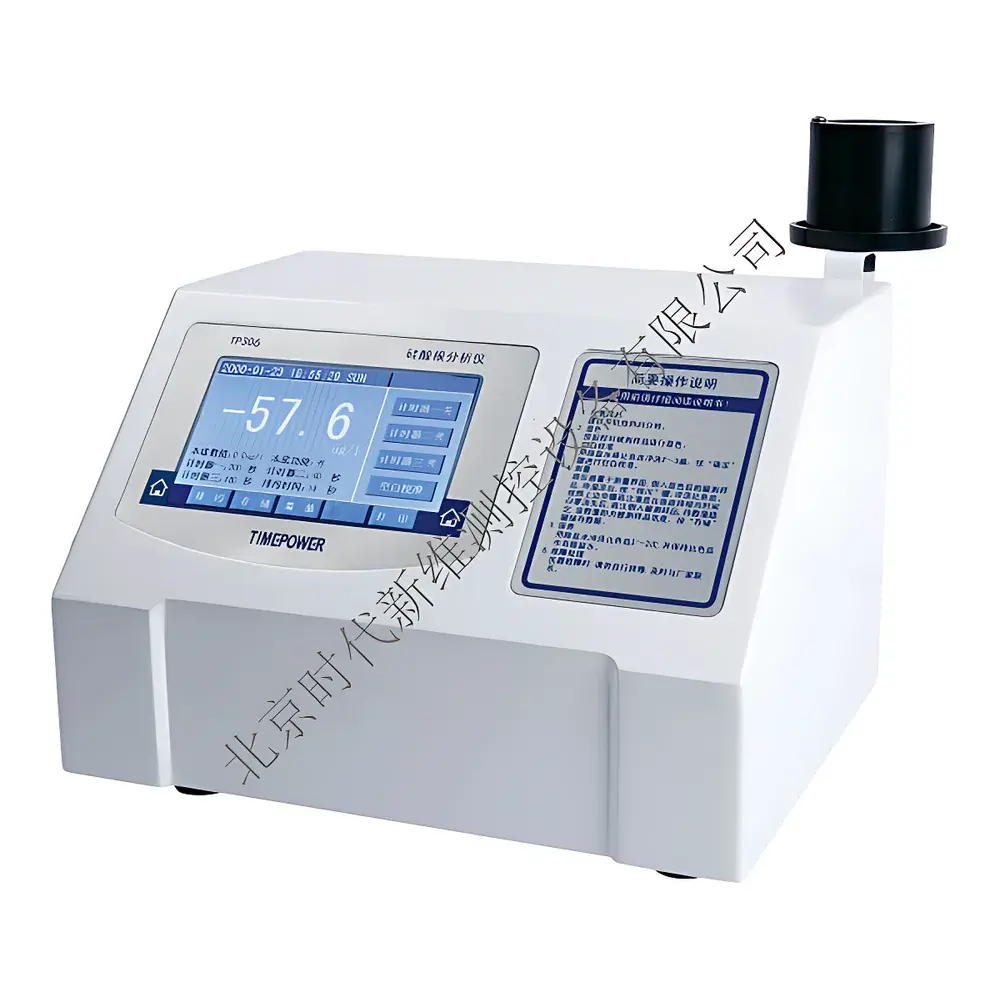
Timepower TP306 Micro-Silica Colorimeter for Silicate Analysis
| Brand | Timepower |
|---|---|
| Origin | Beijing, China |
| Manufacturer Type | Direct Manufacturer |
| Country of Origin | China |
| Model | TP306 |
| Pricing | Upon Request |
Overview
The Timepower TP306 Micro-Silica Colorimeter is a dedicated photometric analyzer engineered for trace-level quantification of soluble silica (SiO₂) and silicates in ultrapure water systems. It operates on the classical molybdenum blue method—a standardized colorimetric procedure widely adopted in power generation, semiconductor manufacturing, pharmaceutical water systems, and high-purity process industries. Under strictly controlled acidic conditions (pH 1.1–1.3), orthosilicic acid reacts with ammonium molybdate to form a yellow heteropoly-molybdosilicic acid complex. Subsequent reduction by 1-amino-2-naphthol-4-sulfonic acid (1-2-4 acid) yields an intensely colored silicon molybdenum blue complex, whose absorbance at ~815 nm is linearly proportional to silica concentration per the Lambert–Beer law. The TP306 integrates optical, electronic, and fluidic subsystems into a compact benchtop platform optimized for routine compliance monitoring in regulated environments—including those governed by ASTM D859, ISO 10523, and USP for purified water quality.
Key Features
- High-stability photometric architecture featuring imported monochromatic cold-light LED source—ensuring low thermal drift, extended operational lifetime (>10,000 h), and minimal power consumption.
- Integrated baseline compensation algorithm specifically designed to correct for matrix interferences and background absorbance in sub-ppb silica measurements, enhancing accuracy in ultra-low-range analysis (0.0–200.0 μg/L).
- Embedded microcontroller unit (MCU) with real-time clock and automatic timing prompts for reaction incubation—eliminating manual stopwatch dependency and reducing operator-induced variability.
- Dual-range measurement capability: user-selectable 0.0–200.0 μg/L (for boiler feedwater, condensate) or 0.0–2000 μg/L (for process rinse water or pretreated influent), both with 0.1 μg/L resolution.
- Onboard blank calibration routine to compensate for zero-point drift from photodetector aging, ambient light leakage, or cuvette surface contamination—critical for GLP/GMP-aligned workflows.
- Non-volatile memory storing up to 256 measurement records with timestamp, auto-rollover overwrite logic, and intuitive touch-screen navigation via 5.0-inch TFT-LCD display (Chinese UI only).
Sample Compatibility & Compliance
The TP306 is validated for use with deionized water, mixed-bed effluent, steam condensate, drum boiler feedwater, and recirculated process water from semiconductor wet benches or biopharmaceutical clean-in-place (CIP) loops. Sample introduction requires manual pipetting into standard 10-mm optical path quartz or high-transmission plastic cuvettes. All reagents—including ammonium molybdate, 1-2-4 acid, and sulfuric acid—must meet ACS-grade or higher purity specifications and be stored in labeled polyethylene containers to prevent silica leaching. Daily blank calibration and biweekly calibration curve verification (using NIST-traceable silica standards) are required to maintain measurement integrity under ISO/IEC 17025 or FDA 21 CFR Part 11–aligned quality systems.
Software & Data Management
While the TP306 operates as a standalone instrument without PC connectivity, its internal firmware supports audit-ready data logging compliant with basic laboratory record-keeping requirements. Each stored entry includes date/time stamp, measured absorbance value, selected range, and calibration status flag. Data export is performed manually via screen review and transcription; for automated reporting, integration with external LIMS or ELN systems requires optional RS232/USB-to-serial adapter (not included). Firmware updates are delivered via SD card—enabling periodic validation of signal processing algorithms and adherence to evolving internal SOPs.
Applications
- Continuous monitoring of silica breakthrough in mixed-bed ion exchange units serving nuclear and fossil-fuel power plants.
- Final rinse water verification in semiconductor wafer cleaning lines where ≤5 μg/L silica is mandated per SEMI F57 guidelines.
- Steam purity assessment in supercritical boilers per ASME PTC 19.11 and IAPWS RP-7.
- Pharmaceutical purified water (PW) and water-for-injection (WFI) system surveillance under EU GMP Annex 1 and USP .
- Process water quality control in synthetic fiber production, where colloidal silica fouling impacts spinneret performance.
FAQ
What is the recommended frequency for calibration verification?
Daily blank calibration and biweekly full-range calibration using certified reference materials are mandatory to ensure ±2% FS accuracy and comply with ASTM D859 Section 8.2.
Can the TP306 measure particulate silica or only dissolved species?
The TP306 quantifies only filterable (dissolved) silica—samples must be pre-filtered through 0.45 µm membrane filters prior to analysis to exclude colloidal or suspended silicates.
Is the instrument suitable for field deployment or strictly lab-based?
Designed for controlled indoor environments (5–45 °C, ≤90% RH non-condensing), the TP306 lacks environmental sealing or battery operation; it is not rated for outdoor or mobile use.
Does the device support multi-point calibration curves?
Yes—the internal calibration routine accepts up to five standard concentrations to generate a linear or quadratic regression model, with correlation coefficient (r²) displayed post-calibration.
How does the instrument handle reagent stability concerns?
The 1-2-4 acid reductant solution degrades rapidly upon exposure to air/light; the TP306’s timed reaction protocol minimizes exposure duration, and users must prepare fresh reagent daily per manufacturer instructions.





