
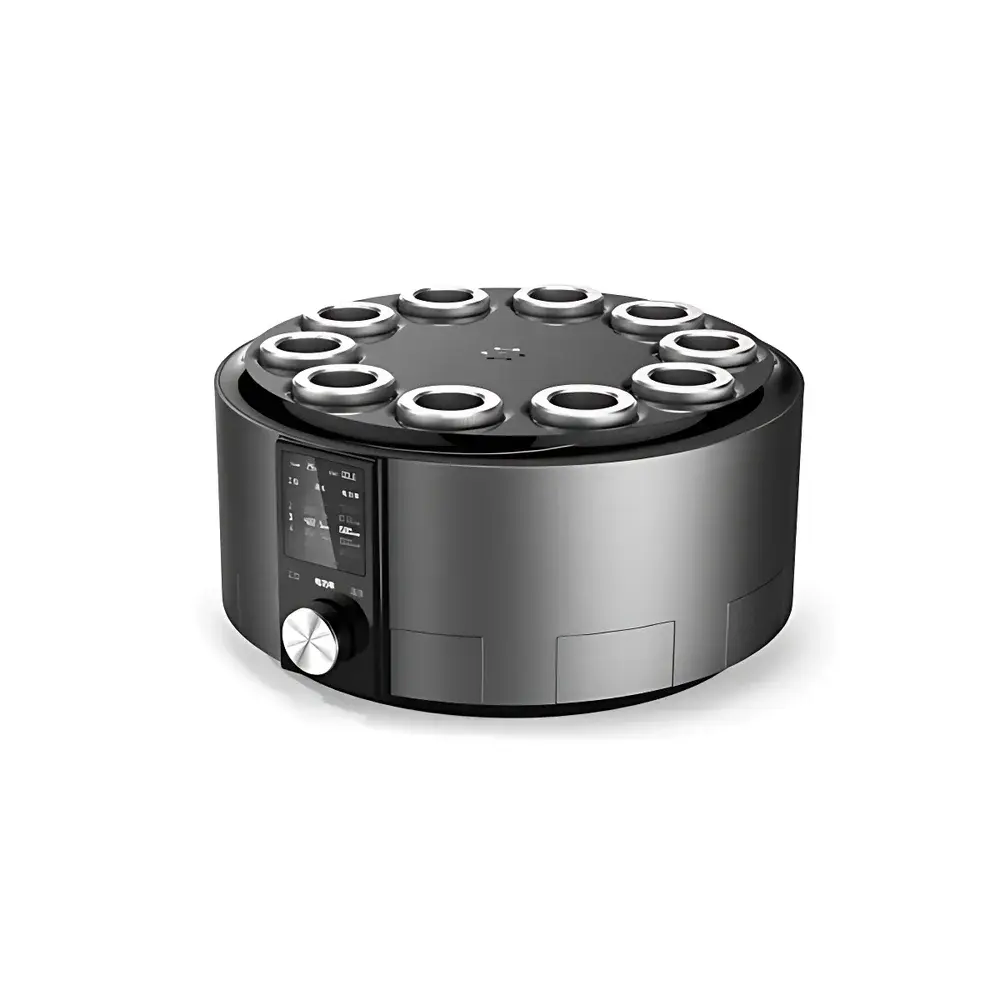
Shan Shi Technology AF(20) Photochemical Reactor
| Brand | Shan Shi Technology / Shanghai 3S Technology Co., Ltd |
|---|---|
| Origin | Shanghai, China |
| Manufacturer Type | Direct Manufacturer |
| Regional Classification | Domestic (China) |
| Model | AF(20) |
| Pricing | Available Upon Request |
| Temperature Control Range | −20 to 80 °C (external chiller/heater required) |
| Light Power Control | 0–12 W or 0–15 W per station (resolution: 0.1 W) |
| Reaction Time Setting | 0–99 h (with preset timing function) |
| Spectral Range | 250–975 nm (≥90 narrow-band LED or filtered lamp options |
| Irradiance Output | Up to 600 mW/cm² (measured at sample plane, typical configuration) |
| Photodegradation Stability | <5% irradiance decay per year |
| Reaction Vessel Compatibility | Standard support for 10 mL, 25 mL, and 50 mL cylindrical quartz or borosilicate reaction tubes |
| Number of Independent Irradiation Stations | 10 |
| Thermal & Mechanical Uniformity | Single-zone temperature bath + synchronized magnetic stirring across all stations |
Overview
The Shan Shi Technology AF(20) Photochemical Reactor is an engineered platform for controlled, parallel photochemical experimentation under precisely defined spectral, irradiance, thermal, and temporal conditions. It operates on the principle of solid-state optoelectronic excitation—utilizing high-purity, narrow-band light sources (LEDs or filtered arc lamps) to deliver quantifiable photon fluxes across the ultraviolet, visible, and near-infrared spectrum (250–975 nm). Unlike conventional batch photoreactors with uncharacterized spectral overlap or thermal drift, the AF(20) integrates calibrated irradiance monitoring, active thermal management via external circulators, and per-station power regulation to ensure photonic dose reproducibility—a critical requirement for kinetic studies, quantum yield determination, and regulatory-compliant process development in synthetic chemistry and environmental catalysis.
Key Features
- Parallel 10-Station Architecture: Enables simultaneous execution of ten independent photochemical reactions under identical thermal and mixing conditions—eliminating inter-run variability caused by sequential irradiation.
- High-Fidelity Spectral Delivery: Supports over 90 discrete wavelength options; UV-C (250–280 nm) and UV-B (280–315 nm) configurations are available as factory-customized modules, ensuring compatibility with demanding photocatalytic and DNA-damage studies.
- Precision Irradiance Control: Each station features digitally regulated output from 0 to 12 W or 0 to 15 W (0.1 W resolution), traceable to NIST-traceable radiometric calibration protocols. Measured irradiance reaches up to 600 mW/cm² at the sample surface under standard 25 mL quartz tube geometry.
- Thermal Integrity System: Combines conductive metal heat-sink blocks with externally coupled temperature control (−20 to 80 °C), enabling exothermic/endothermic reaction stabilization without compromising optical access or gas-tight sealing.
- Temporal Programmability: Reaction duration is programmable from 0 to 99 hours with pre-timed initiation—supporting overnight degradation assays, long-term photocatalyst aging tests, and multi-stage irradiation protocols.
- Low-Drift Optical Performance: Engineered optical path design minimizes reflection loss and thermal lensing; annual irradiance decay is specified at <5%, verified via in-situ photodiode monitoring during routine maintenance.
Sample Compatibility & Compliance
The AF(20) accommodates standard cylindrical reaction vessels (10 mL, 25 mL, 50 mL) fabricated from high-transmission fused quartz (UV-grade) or borosilicate glass, with optional O-ring-sealed caps for inert-atmosphere or pressurized operation. Custom vessel interfaces—including side-arm condensers, gas inlet/outlet ports, and pH/DO probe sleeves—are supported per ISO 9001-certified mechanical design workflows. The system complies with IEC 61000-6-3 (EMC emissions) and IEC 61010-1 (safety requirements for laboratory equipment). While not intrinsically rated for Class I Div 1 environments, it is routinely deployed in GMP-aligned small-molecule synthesis labs where documentation of irradiance history, temperature logs, and user-access timestamps supports FDA 21 CFR Part 11 audit readiness when paired with validated third-party LIMS integration.
Software & Data Management
The AF(20) operates via a dedicated embedded controller with local touchscreen interface and optional Ethernet/RS-485 connectivity. All operational parameters—including setpoints, real-time irradiance feedback (where equipped), bath temperature, elapsed time, and user ID—are timestamped and stored internally for ≥30 days. Export formats include CSV and XML for traceable data migration into ELN systems (e.g., LabArchives, Benchling) or statistical analysis platforms (JMP, Python pandas). Audit trails record parameter changes, session starts/stops, and firmware updates—enabling GLP-compliant experiment reconstruction. Remote monitoring and alarm notification (via SMTP or Modbus TCP) are configurable for unattended operation in centralized facility management infrastructures.
Applications
- Pharmaceutical Photostability Testing: Compliant with ICH Q1B guidelines for forced degradation under UV/visible light; supports bracketing studies across multiple wavelengths to identify photolabile functional groups.
- Heterogeneous Photocatalysis Research: Evaluates TiO₂, g-C₃N₄, MOFs, and perovskite-based catalysts for H₂ evolution, CO₂ reduction, and pollutant mineralization under standardized photon flux conditions.
- Agrochemical Photodegradation Kinetics: Quantifies half-lives of pesticides and plant growth regulators in aqueous and soil-simulant matrices per OECD 316 and EPA OPPTS 835.2210 protocols.
- Advanced Oxidation Process (AOP) Development: Optimizes UV/H₂O₂, UV/Cl₂, and UV/persulfate systems for trace organic contaminant removal in water treatment R&D.
- Materials Photochemistry: Screens photo-initiators, crosslinkers, and luminescent dopants for polymer curing, OLED fabrication, and solar cell interfacial layer engineering.
FAQ
Does the AF(20) include integrated radiometric calibration?
No—the base configuration relies on factory-applied calibration certificates for each light module. Optional add-on calibrated photodiode sensors (traceable to PTB or NIST) are available for in-situ irradiance validation.
Can the system operate under inert or vacuum conditions?
Yes—reaction tubes may be sealed with PTFE-faced septa or fitted with Swagelok-compatible gas manifolds. Vacuum-rated versions (≤10⁻² mbar) require custom flange integration and are subject to mechanical review.
Is firmware update capability included?
Yes—updates are delivered via USB flash drive or network upload and retain all historical log files and user-defined protocols post-installation.
What safety interlocks are implemented?
The unit features hardware-enforced door-open shutoff for UV-emitting modules, overtemperature cutout (±2 °C hysteresis), and current-limiting circuitry for all driver channels to prevent LED burnout.
How is temperature uniformity verified across the 10 stations?
Uniformity is characterized during final QA using 10-channel thermocouple mapping under steady-state conditions; typical deviation is ≤±0.5 °C at 25 °C and ≤±1.2 °C at 80 °C.



