
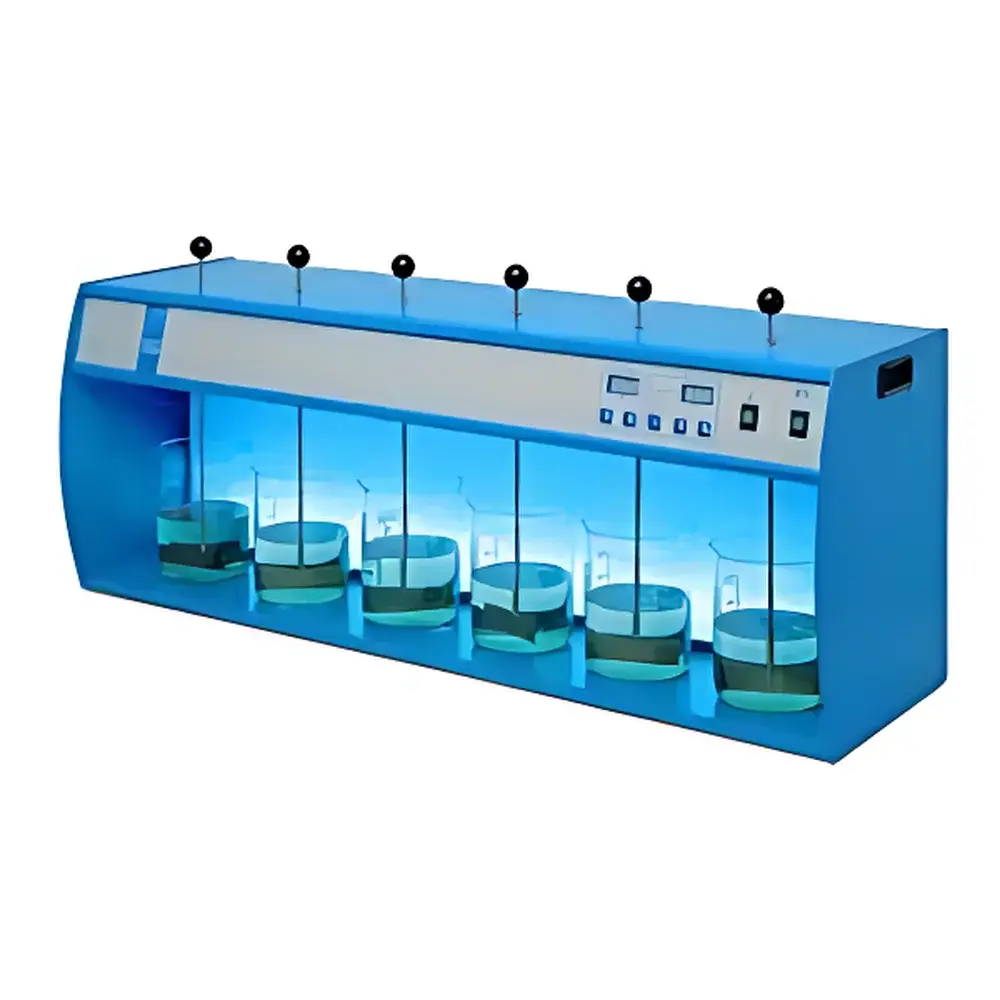
VELP JLT6 and FC6S Settleable Solids Analyzers
| Brand | VELP |
|---|---|
| Origin | Italy |
| Model | JLT6, FC6S |
| Construction | Epoxy-coated steel housing |
| Stirrer speed range (JLT6) | 10–300 rpm, 1 rpm resolution |
| Stirrer speed steps (FC6S) | 10, 15, 30, 45, 60, 90, 120, 150, 200 rpm |
| Microprocessor-controlled timer (JLT6) | 0–999 min or 0–99 h |
| Power consumption | 11 W (JLT6), 23 W (FC6S) |
| Net weight | 17 kg (JLT6), 18 kg (FC6S) |
Overview
The VELP JLT6 and FC6S Settleable Solids Analyzers are precision-engineered laboratory instruments designed for standardized evaluation of suspended solids sedimentation behavior in wastewater, surface water, and process streams. Based on the fundamental principle of gravitational settling under controlled hydrodynamic conditions—aligned with ASTM D3730, ISO 11923, and EPA Method 160.2—the systems replicate bench-scale coagulation-flocculation-sedimentation processes critical to optimizing chemical dosing, clarifier design, and sludge management strategies. The JLT6 employs a single-motor, multi-position rotating stirrer platform with microprocessor-based timing and continuous speed adjustment; the FC6S implements a true parallel configuration with six independent DC motors, enabling simultaneous, non-interfering evaluation of six distinct coagulant/flocculant formulations or dosage gradients. Both models maintain strict adherence to GLP-compliant experimental protocols through traceable timing, reproducible agitation profiles, and mechanically stable sample geometry.
Key Features
- Epoxy-coated steel chassis ensures long-term resistance to acidic, alkaline, and oxidizing reagents commonly used in coagulation trials (e.g., FeCl₃, Al₂(SO₄)₃, polyacrylamides)
- Illuminated acrylic rear panel provides uniform backlighting for high-contrast visual assessment of floc formation, settling front progression, and interface clarity
- Height-adjustable stainless-steel stirrers (316 grade) with positive-lock positioning enable precise control of shear zone depth relative to sample volume—critical for simulating hydraulic retention time and velocity gradients
- JLT6 offers continuously variable rotational speed from 10 to 300 rpm (1 rpm resolution), supporting both rapid mixing (flash mixing) and gentle flocculation phases within a single run
- FC6S delivers discrete, pre-calibrated speeds (10, 15, 30, 45, 60, 90, 120, 150, 200 rpm) per station, with full independence between all six positions—eliminating cross-talk and enabling statistically robust factorial experiments
- Integrated timer with dual-range operation (0–999 minutes or 0–99 hours) supports extended settling observations required for slow-settling colloidal suspensions or low-turbidity source waters
Sample Compatibility & Compliance
The JLT6 and FC6S accommodate standard 1-L or 2-L cylindrical glass or borosilicate settling columns (not included), conforming to dimensions specified in Standard Methods 2540D and APHA 2130B. Each unit is CE-marked and compliant with IEC 61000-6-3 (EMC) and IEC 61010-1 (safety). When operated within defined environmental parameters (15–30°C ambient, <80% RH), the systems support audit-ready documentation for ISO/IEC 17025-accredited laboratories. All electronic controls meet EN 61326-1 requirements for laboratory equipment in industrial environments.
Software & Data Management
While the JLT6 and FC6S operate as standalone hardware platforms without proprietary software, their deterministic mechanical design and calibrated speed/timing outputs ensure full compatibility with external data acquisition systems. Users routinely integrate digital stopwatches, high-resolution time-lapse imaging rigs, and turbidity sensors (e.g., Hach 2100N, ABB AMU300) via analog voltage outputs or TTL triggers. For regulated environments, the units’ fixed operational parameters—such as speed step fidelity, timer accuracy (±0.1%), and mechanical repeatability (<±0.5 mm stirrer vertical positioning)—support validation protocols under FDA 21 CFR Part 11 when paired with compliant electronic lab notebooks (ELNs) and audit-trail-enabled image analysis software.
Applications
- Optimization of coagulant and flocculant selection and dosage in municipal and industrial wastewater treatment plants
- Performance screening of novel polymeric flocculants and bio-based coagulants under variable pH and ionic strength conditions
- Settleability assessment of activated sludge (SVI determination) and anaerobic granular sludge
- Heavy metal precipitation efficiency testing (e.g., Pb²⁺, Cd²⁺, Cr⁶⁺ removal via hydroxide or sulfide precipitation)
- Validation of jar test protocols prior to full-scale pilot trials or regulatory submission packages
- Teaching sedimentation kinetics and colloid stability theory in environmental engineering curricula
FAQ
What standards do the JLT6 and FC6S comply with?
Both models support method execution aligned with ASTM D3730 (Standard Test Method for Determination of Settleable Solids), ISO 11923 (Water Quality — Determination of Settleable Matter), and EPA Method 160.2 (Settleable Solids by Imhoff Cone).
Can the FC6S run different speeds simultaneously across its six positions?
Yes—each of the six stations is driven by an independent DC motor with dedicated speed selection, allowing concurrent testing at six distinct rotational velocities.
Is calibration required before use?
No routine calibration is mandated; however, users should verify stirrer tip speed using a handheld tachometer annually or after mechanical maintenance, per ISO/IEC 17025 clause 6.5.2.
Are sample cylinders included?
No—standard 1-L or 2-L Imhoff cones or cylindrical settling columns must be sourced separately to match local regulatory or institutional specifications.
What maintenance is recommended?
Monthly inspection of epoxy coating integrity, biannual lubrication of stirrer height adjustment mechanism, and annual verification of timer accuracy against a NIST-traceable reference clock.







