
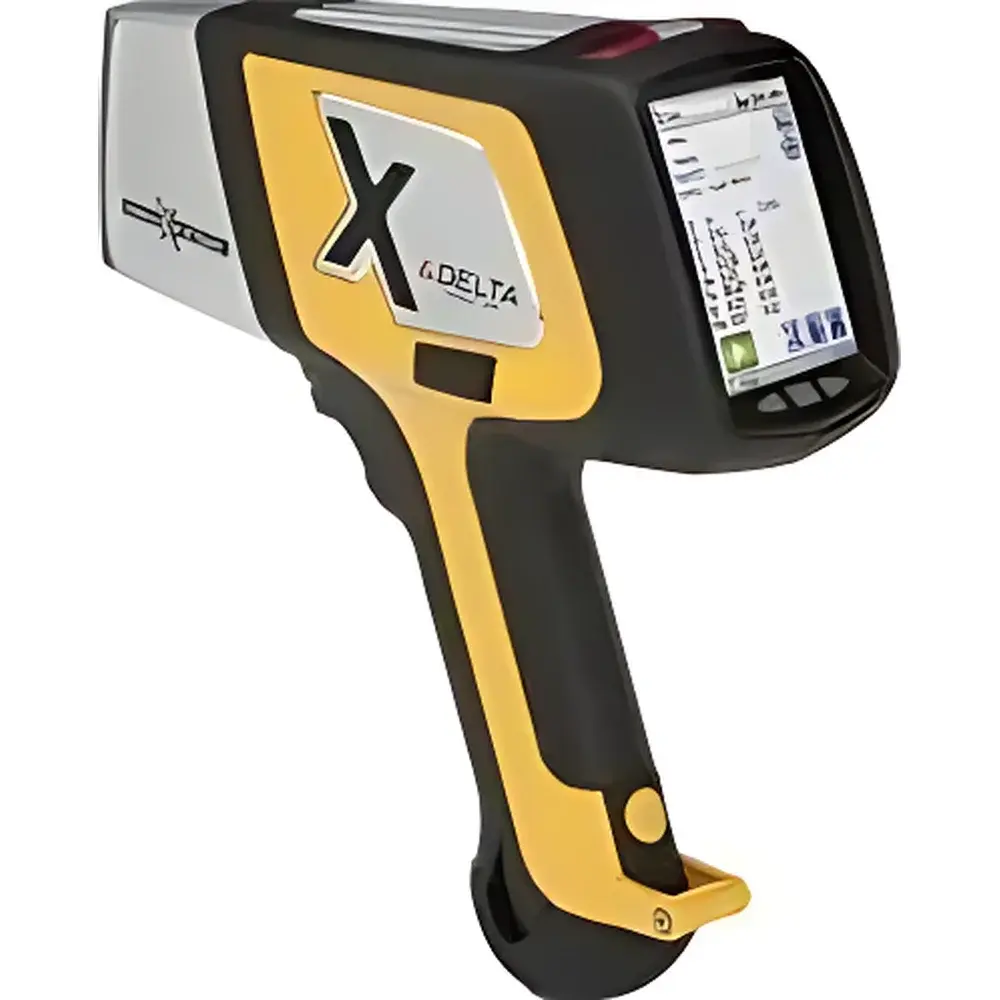
Innov-X DELTA Series Handheld Energy Dispersive X-Ray Fluorescence Spectrometer
| Brand | Innov-X |
|---|---|
| Origin | USA |
| Model | DELTA Series |
| Portability | Handheld |
| Elemental Range | Mg to U |
| Detection Limit | 1 ppm |
| Quantification Range | 1 ppm – 99.99% |
| Energy Resolution | <165 eV |
| Repeatability | ≥95% |
| Excitation Source | Micro-focus X-ray Tube (10–40 kV) |
| Detector | High-Performance Silicon Drift Detector (SDD) |
| Weight | <1.5 kg |
| Operating System | Microsoft Windows Embedded CE |
| Battery Life | >4 hours continuous operation |
| Hot-Swap Battery Support | Yes |
| Display | 32-bit color touchscreen |
| Sample Targeting | Integrated camera + collimated beam optics |
| Trigger Options | Mechanical trigger, Deadman safety trigger, or external PC control |
Overview
The Innov-X DELTA Series Handheld Energy Dispersive X-Ray Fluorescence (ED-XRF) Spectrometer is an industrial-grade field analytical instrument engineered for rapid, non-destructive elemental identification and quantification in situ. Based on fundamental XRF physics—where primary X-rays excite atoms in the sample, inducing characteristic secondary (fluorescent) X-ray emission—the DELTA platform leverages a micro-focus X-ray tube (10–40 kV) and high-resolution silicon drift detector (SDD) to deliver laboratory-grade spectral fidelity in a portable form factor. Its ability to detect elements from magnesium (Mg, Z=12) through uranium (U, Z=92) without vacuum or helium purge enables robust light-element analysis—particularly critical for Mg-Al alloy verification, soil screening, and catalyst composition assessment—under ambient environmental conditions. Designed for compliance-driven workflows, the system supports trace-level detection down to 1 ppm for many transition metals and heavy elements, with quantification accuracy validated across concentration ranges spanning four orders of magnitude (1 ppm to 99.99 wt%).
Key Features
- Ruggedized IP54-rated enclosure with sealed-back high-contrast color touchscreen—resistant to dust, moisture, and mechanical shock encountered in field deployment.
- Intelligent electronics architecture integrating real-time pulse processing, adaptive gain control, and low-noise preamplification—optimized for signal-to-noise ratio enhancement and improved light-element sensitivity (e.g., Al, Si, P, S, Cl).
- No vacuum pump or helium gas required: proprietary beam filtration and detector cooling enable reliable Mg and Al detection at ambient pressure—reducing operational complexity and consumable dependency.
- Hot-swap battery system allows uninterrupted operation during extended surveys; rechargeable Li-ion pack delivers >4 hours of continuous analysis on a single charge.
- Integrated 2 MP autofocus camera and motorized collimation optics provide visual sample registration and precise beam targeting—critical for heterogeneous materials, small components, or irregular surfaces.
- Multiple trigger configurations: ergonomic mechanical trigger, Deadman-style safety trigger (requires sustained pressure), or remote initiation via USB/Bluetooth-connected host PC.
Sample Compatibility & Compliance
The DELTA Series accommodates solid, powdered, and coated samples—including alloys, soils, ores, catalysts, electronic components, and painted substrates—without requiring homogenization or pelletization. Its fixed geometry and factory-calibrated fundamental parameters algorithm ensure consistent performance across diverse matrices. The instrument meets international regulatory frameworks for field-deployed analytical instrumentation: certified per IEC 61000-6-3 (EMC emissions), IEC 61000-6-2 (immunity), and RoHS Directive 2011/65/EU. For regulated environments—including EPA-led site assessments (SW-846 Method 6200), RCRA waste characterization, and EU WEEE/RoHS screening—the system supports audit-ready data logging with timestamped spectra, operator ID tagging, and configurable reporting templates aligned with ISO/IEC 17025 documentation requirements.
Software & Data Management
Running Microsoft Windows Embedded CE, the onboard software provides intuitive touch-driven navigation, real-time spectrum visualization, and on-device calibration management. Quantitative analysis employs empirically optimized calibrations (e.g., Alloy, Soil, Mining, Consumer Goods) with matrix-matched standards traceable to NIST SRMs. All spectral data, metadata (GPS coordinates, operator ID, environmental conditions), and quantitative reports are stored in encrypted SQLite databases compliant with FDA 21 CFR Part 11 principles—including electronic signatures, audit trails, and user-access controls. Data export supports CSV, PDF, and ASTM E135-compliant XML formats for integration into LIMS or enterprise QA/QC systems.
Applications
- Environmental Monitoring: Field screening of contaminated soils, sediments, and dredged materials for EPA priority pollutants (Pb, As, Cd, Cr, Hg); RCRA waste classification; post-remediation verification.
- Metallurgical QC: Positive material identification (PMI) of stainless steels, Ni-alloys, Ti grades, and Al-Mg alloys in pipeline, aerospace, and power generation infrastructure.
- Consumer Product Safety: Screening for restricted substances (Cd, Pb, Hg, Br, Cl) in plastics, coatings, and children’s toys per CPSIA, EN71-3, and GB 6675.
- Geosciences & Mining: In-field grade control of base metal ores (Cu, Zn, Ni), rare earth element (REE) prospecting, and lithological mapping using multi-element fingerprinting.
- Recycling & Scrap Sorting: Real-time segregation of Cu/Ni/Al/Zn-bearing scrap streams based on alloy chemistry and contaminant thresholds.
- Academic & Cultural Heritage Research: Non-invasive compositional analysis of archaeological artifacts, pigments, and historical metallurgy without sampling.
FAQ
Does the DELTA require helium purging or vacuum for light-element analysis?
No. The DELTA Series utilizes optimized X-ray tube output, advanced SDD energy resolution (<165 eV), and atmospheric-pressure measurement geometry to achieve reliable Mg and Al detection without auxiliary gases or vacuum systems.
How is measurement repeatability verified and maintained?
Repeatability ≥95% is validated using certified reference materials (CRMs) per ASTM E2857. Daily verification checks can be performed with built-in check sources; long-term stability is tracked via internal calibration drift logs and scheduled recalibration against NIST-traceable standards.
Can the instrument be integrated into a centralized QA/QC data infrastructure?
Yes. Through USB, Bluetooth, or optional Wi-Fi module, spectral datasets and reports export directly to LIMS, ERP, or cloud-based analytics platforms. Audit trail functionality satisfies GLP/GMP and ISO/IEC 17025 record-keeping mandates.
What safety certifications apply to field use?
The DELTA complies with IEC 62471 (photobiological safety), FDA 21 CFR 1020.40 (X-ray equipment), and carries CE marking for electromagnetic compatibility and low-voltage directive conformity. Operator training and dose monitoring protocols align with ANSI N43.3 recommendations.
Is firmware and calibration update support available post-purchase?
Yes. Innov-X provides periodic firmware releases via secure download portal, including new calibrations, spectral deconvolution improvements, and regulatory method updates (e.g., EPA Method 6200 revisions). Calibration services are offered through authorized service centers with NIST-traceable verification.





