
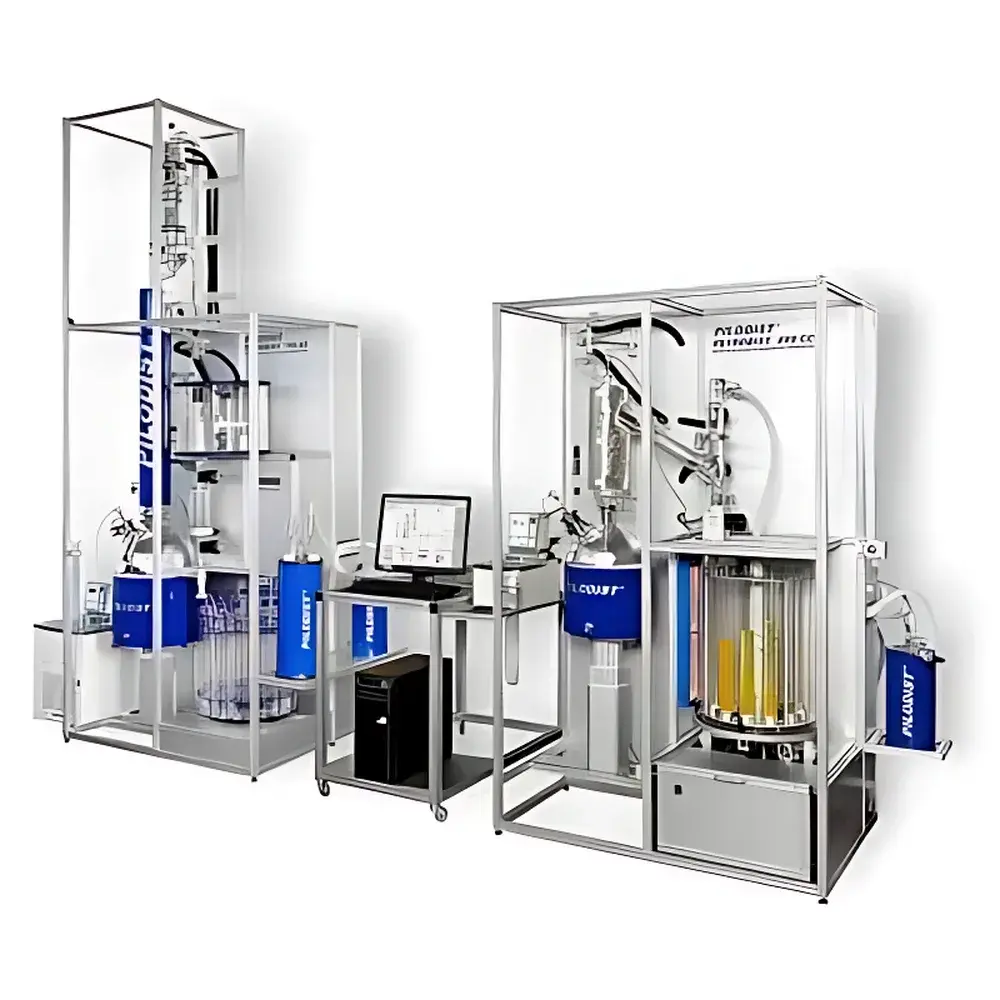
Pilodist PD 400CC Automated True Boiling Point (TBP) Distillation Apparatus
| Brand | Pilodist |
|---|---|
| Origin | Germany |
| Model | PD 400CC |
| Standards Compliance | ASTM D2892 & ASTM D5236 |
| Distillation Capacity | 6 L (standard), optional 2–20 L |
| Max Operating Temperature | 420 °C (AET) |
| Pressure Range | 1–760 mmHg |
| Control System | Windows-based PC automation with real-time monitoring and safety interlocks |
| Safety Features | Overtemperature shutdown, vacuum overpressure protection, power-fail emergency cooling, level/leak detection, automatic condenser and pot cooldown |
Overview
The Pilodist PD 400CC is a fully automated, computer-controlled true boiling point (TBP) distillation apparatus engineered for precise hydrocarbon fractionation of crude oil and heavy petroleum fractions. It implements the fundamental thermodynamic principle of equilibrium-stage distillation under controlled pressure and temperature gradients, enabling high-resolution separation according to ASTM D2892 (atmospheric TBP) and ASTM D5236 (vacuum potstill) methodologies. Unlike empirical distillation methods such as ASTM D86 or D1160, the PD 400CC performs continuous, dynamic fractionation across a defined boiling point range—delivering weight- and volume-based TBP curves with traceable reproducibility. Its design centers on process integrity: glassware constructed from borosilicate 3.3 (DIN ISO 3585), ground-glass joints with fluoropolymer gaskets, and vacuum-tight quick-connect fittings eliminate grease-dependent sealing—reducing contamination risk and ensuring long-term pressure stability during extended runs (up to 72 h). The system operates as a closed-loop process: real-time feedback from temperature, pressure, flow, and level sensors drives adaptive control of heating power, coolant bath setpoints, and fraction cut timing—minimizing operator intervention while maximizing analytical consistency.
Key Features
- Fully automated operation under Windows-based control software with graphical system flow diagram—displaying live status of all subsystems (heating mantle, condensers, vacuum pump, fraction collectors, and pressure transducers)
- Adaptive thermal management: distillation pot power modulated in real time based on measured distillate rate; recirculating chiller temperature dynamically adjusted to maintain optimal condensation efficiency across varying vapor loads
- Integrated AET (Average Endpoint Temperature) calculation engine: automatically converts observed vacuum distillation temperatures to equivalent atmospheric boiling points using rigorous vapor pressure correlations (e.g., Antoine equation parameters embedded per fraction group)
- Precision fraction cutting and volumetric measurement: motorized fraction collector with gravimetric or volumetric (±0.1 mL resolution) quantification, synchronized to AET thresholds
- Comprehensive hardware safety architecture: dual-stage overtemperature cutoff (pot and column), vacuum overpressure relief, uninterruptible power-triggered emergency cooldown of pot and main condenser, low-level and leak detection circuits, and self-diagnostic routines for thermal and vacuum integrity
- Grease-free glass assembly: standardized DIN/ISO ground joints with chemically inert elastomeric seals ensure repeatable vacuum integrity down to 1 mmHg without maintenance-induced variability
Sample Compatibility & Compliance
The PD 400CC accommodates feedstocks ranging from whole crudes to atmospheric residues and vacuum gas oils (VGO), with viscosity limits up to 500 cSt at 100 °C. Its 6 L standard pot (expandable to 20 L) supports representative sampling per ASTM guidelines, minimizing compositional bias. All operational protocols align with regulatory and quality frameworks: data acquisition meets FDA 21 CFR Part 11 requirements for electronic records (audit trail, user authentication, data immutability); test reports comply with ISO/IEC 17025 documentation standards; and method execution satisfies refinery QA/QC specifications for crude assay reporting (e.g., API RP 2552, IP 174). Optional GLP-compliant configuration includes electronic signature support and full metadata logging (ambient conditions, calibration history, maintenance logs).
Software & Data Management
The native Pilodist Control Suite provides ISO 17025-aligned data handling: raw sensor streams (time-stamped at 100 ms intervals), calculated AET values, fraction mass/volume tables, and TBP curves are stored in structured binary archives with SHA-256 checksums. Export formats include native .pdx (readable via Pilodist Viewer), CSV, and native Excel (.xlsx) with embedded charts—enabling direct integration into refinery LIMS or petrophysical modeling workflows (e.g., PVTsim, HYSYS assays). Software enforces role-based access control (administrator, analyst, reviewer), automatic backup to network drives, and configurable report templates compliant with ASTM reporting conventions (e.g., Table 1 in D2892). Audit trails record every parameter change, manual override, or system alert—with timestamps traceable to NIST-synchronized network time.
Applications
- Crude assay for refinery process simulation (e.g., FCC, hydrocracking feed characterization)
- Blending component evaluation—quantifying naphtha, kerosene, diesel, and vacuum residue cuts by true boiling point distribution
- Quality control of atmospheric and vacuum tower side-streams
- Research on heavy oil upgrading pathways (e.g., coking feedstock screening, solvent deasphalting yield prediction)
- Regulatory compliance testing for fuel specification development (e.g., EN 590, ASTM D975)
- Calibration reference for near-infrared (NIR) and GC-based rapid TBP prediction models
FAQ
Does the PD 400CC support ASTM D1160 (high-vacuum distillation) in addition to D2892/D5236?
Yes—the system’s pressure control module covers 0.1–760 mmHg, enabling seamless transition between atmospheric TBP, vacuum potstill, and high-vacuum applications. Optional high-stability vacuum transducers and cryogenic cold traps extend capability to sub-0.5 mmHg operation.
Can the software generate ASTM D2892-compliant tabular output directly?
Yes—reports include cumulative wt% and vol% distilled vs. AET (°C), with interpolation to standard 5 °C or 10 °C intervals, plus summary statistics (IBP, FBP, 10–90% points) formatted per ASTM Annex A1.
What maintenance is required for long-term vacuum integrity?
No routine vacuum grease application is needed. Annual verification includes joint seal compression testing, pressure decay validation (<0.5 mmHg/min at 1 mmHg), and calibration of RTDs and pressure transducers per ISO/IEC 17025 procedures.
Is remote monitoring supported?
The control system includes OPC UA server functionality, allowing secure read-only access to live process variables and alarm states via corporate SCADA or cloud-based dashboards (TLS 1.2 encrypted).






