
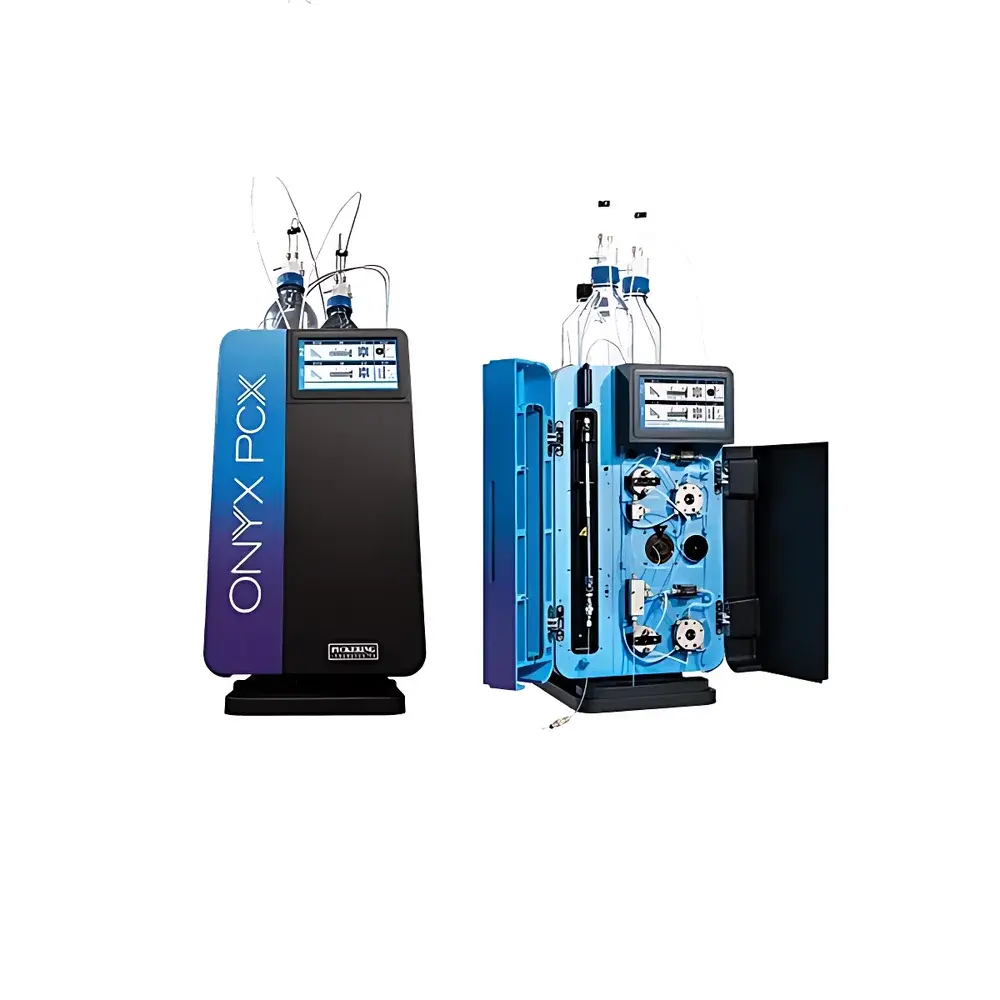
Pickering Onyx PCX Post-Column Derivatization System
| Brand | Pickering |
|---|---|
| Origin | USA |
| Model | Onyx PCX |
| Temperature Range | 5 °C to 130 °C (ambient +5 °C) |
| Derivatization Reagent Flow Rate | 50 µL/min – 1500 µL/min |
| Reaction Coil Volume | 0.1–3 mL |
Overview
The Pickering Onyx PCX Post-Column Derivatization System is an engineered solution for high-sensitivity, reproducible post-column derivatization in high-performance liquid chromatography (HPLC) and ultra-high-performance liquid chromatography (UHPLC) workflows. Based on over 35 years of domain-specific design expertise, the Onyx PCX implements a precisely controlled chemical reaction environment downstream of the analytical column—enabling detection of non-chromophoric or weakly fluorescent analytes via selective derivatization. Its core architecture integrates thermally regulated reaction coils, pulseless reagent delivery, and programmable temperature gradients synchronized with HPLC gradient elution—making it especially suited for demanding applications such as amino acid profiling, mycotoxin quantification, pesticide residue analysis (e.g., glyphosate, carbamates), and trace-level metal speciation (e.g., Cr(VI)). Unlike generic reagent infusion modules, the Onyx PCX is purpose-built for analytical rigor: all fluidic pathways employ inert ceramic pump heads and chemically resistant tubing; thermal control adheres to ASTM E2931-compliant stability specifications; and system timing resolution supports sub-second synchronization between column effluent arrival and reagent mixing.
Key Features
- Pulseless electronic syringe pump with ceramic plunger and pump head—ensures stable, low-dead-volume reagent delivery across the full flow range (50–1500 µL/min), minimizing baseline noise and improving quantitative reproducibility.
- Programmable reaction coil heater with ±0.2 °C thermal stability from 5 °C above ambient to 130 °C—supports temperature-gradient derivatization protocols aligned with HPLC gradient profiles to reduce analysis cycle time without compromising reaction completeness.
- Electronically actuated, chemically inert valves replace mechanical check valves—enabling automated pump priming, solvent flushing, and reagent line purging without manual intervention or risk of cross-contamination.
- Modular, open-architecture design compatible with all major HPLC/UHPLC platforms (Agilent, Waters, Thermo Fisher, Shimadzu)—requires no proprietary interface hardware or firmware modification.
- Dual-display operation: real-time parameter monitoring via front-panel LCD matches identically with software GUI—supporting both standalone operation and computer-controlled method execution.
Sample Compatibility & Compliance
The Onyx PCX accommodates diverse analyte classes requiring post-column chemistry, including primary/secondary amines (e.g., amino acids, antibiotics), aldehydes/ketones (e.g., aflatoxins), hydrazides (e.g., carbamates), and reactive metal species (e.g., hexavalent chromium). Reaction coil volumes (0.1–3 mL) are selected based on required residence time and diffusion kinetics—validated per ICH Q2(R2) guidelines for method robustness. The system meets material compatibility requirements for common derivatization reagents (OPA, OPA/2-ME, ninhydrin, dansyl chloride, benzoyl chloride) and organic/aqueous mobile phases. It supports GLP/GMP-aligned workflows through audit-trail-enabled software logging (21 CFR Part 11 compliant when used with validated Pickering Chromatography Software v5.2+), and its thermal and flow performance is documented per ISO/IEC 17025 calibration traceability standards.
Software & Data Management
Controlled via Windows 7 or later operating systems, the Onyx PCX communicates natively over USB or RS-232 using ASCII-based command protocol—ensuring seamless integration into existing LIMS or CDS environments (e.g., Empower, Chromeleon, OpenLab). The included Pickering Control Suite provides method editor, real-time status dashboard, event logging with timestamped parameter changes, and exportable CSV reports for QC review. All instrument settings—including temperature ramps, flow rate profiles, valve switching sequences, and alarm thresholds—are stored as encrypted .pcx method files. Audit trails record user login, method load, run start/stop, and critical parameter modifications—fully compliant with FDA 21 CFR Part 11 requirements when deployed with appropriate electronic signature configuration.
Applications
- Amino acid analysis in clinical, food, and fermentation samples using o-phthalaldehyde (OPA) or ninhydrin chemistry.
- Carbamate pesticide quantification (e.g., carbaryl, carbofuran) via post-column hydrolysis and diazotization.
- Glyphosate and AMPA detection using FMOC-Cl derivatization under alkaline conditions.
- Mycotoxin screening (aflatoxins, ochratoxin A, fumonisins) with enhanced fluorescence yield post-reaction.
- Hexavalent chromium speciation in environmental water matrices following diphenylcarbazide derivatization.
- Antibiotic residue testing (e.g., sulfonamides, tetracyclines) where native UV absorbance is insufficient for regulatory LODs.
FAQ
Is the Onyx PCX compatible with UHPLC systems operating at 1000 bar?
Yes—the fluidic path is rated to 1200 bar, and the low-dispersion reaction coil design maintains peak integrity even at sub-2-µm particle separations.
Can multiple derivatization reagents be delivered sequentially within a single run?
Yes—using the built-in multi-valve sequencing logic, up to four independent reagent streams can be programmed with timed switching events.
Does the system support method transfer between laboratories?
Yes—method files include embedded calibration constants and hardware configuration metadata, enabling consistent performance across installations when paired with NIST-traceable temperature and flow verification.
What maintenance intervals are recommended for long-term reliability?
Ceramic pump heads require no lubrication and are specified for >10,000 hours of continuous operation; annual verification of thermal accuracy and flow linearity is advised per ISO/IEC 17025 internal quality procedures.
Related Products






