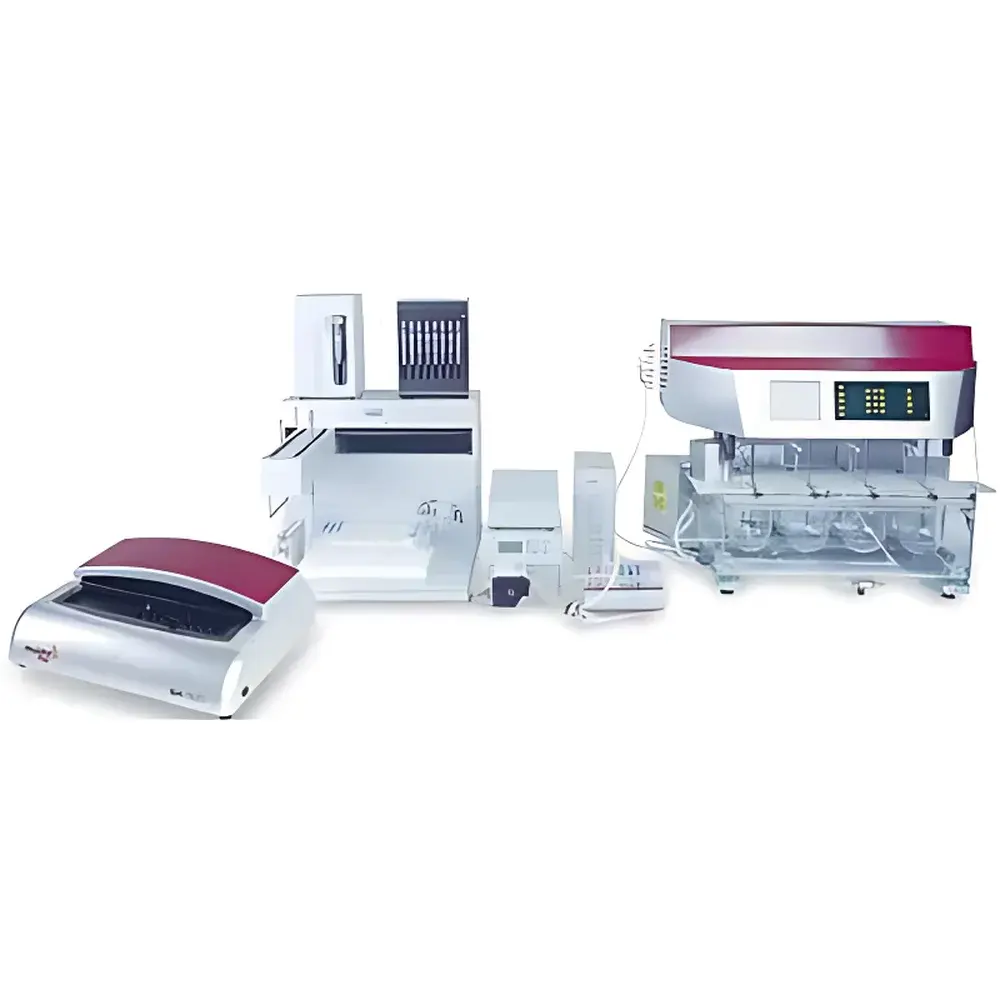
Pharma-test ASP2000 Online/Offline Hybrid Dissolution System
| Brand | Pharma-test |
|---|---|
| Origin | Germany |
| Model | ASP2000 |
| Instrument Type | Offline Dissolution System with Online Detection Capability |
| Sampling Capacity | 50 positions |
| Online Dilution Ratio | up to 1:100 |
| Compatible Detection Methods | UV-Vis Spectrophotometry and HPLC |
| Control Software | WinDiss32 |
| Integration | Designed for seamless coupling with all Pharma-test dissolution testers (e.g., PT-DT series) |
Overview
The Pharma-test ASP2000 Online/Offline Hybrid Dissolution System is an engineered platform for pharmaceutical dissolution testing that bridges the operational gap between traditional offline sampling and real-time analytical integration. Based on the USP , , and EP 2.9.3 dissolution methodology frameworks, the ASP2000 implements a precisely timed, valve-driven fluid handling architecture to automate sample acquisition, conditioning, and transfer—without manual intervention—while preserving sample integrity across variable time points. Unlike conventional offline systems requiring post-sampling processing, the ASP2000 enables direct, programmable routing of dissolution media aliquots either to external UV-Vis spectrophotometers or HPLC systems via dedicated flow paths and pressure-regulated peristaltic pumping. Its hybrid architecture supports both scheduled offline collection (into vials or microplates) and on-demand online injection, ensuring method flexibility without hardware reconfiguration.
Key Features
- Modular dual-path fluidic design: Independent, chemically resistant tubing lines for UV and HPLC transfer, each equipped with solenoid-driven 6-port switching valves for precise flow direction control.
- Automated sample conditioning: Integrated temperature-controlled dilution module enabling programmable 1:2 to 1:100 dilution ratios with volumetric accuracy ≤±1.5% CV (validated per USP ).
- WinDiss32 software integration: Full system orchestration—including dissolution tester synchronization, sampling timing, valve sequencing, dilution factor assignment, and instrument handshake protocols—with audit-trail-enabled user access levels compliant with FDA 21 CFR Part 11 requirements.
- Universal compatibility: Mechanical and communication interface alignment with all Pharma-test dissolution apparatuses (PT-DT 700, PT-DT 800, PT-DT 900 series), supporting paddle, basket, reciprocating cylinder, and flow-through cell configurations.
- 50-position sample management: Robust carousel-based sample rack accommodating standard 12 × 75 mm glass vials or 96-well plates; includes barcode reader option for GLP-compliant sample traceability.
Sample Compatibility & Compliance
The ASP2000 accommodates aqueous, organic-aqueous, and surfactant-containing dissolution media—including pH-adjusted buffers, SDS solutions, and simulated gastric/intestinal fluids—within standard operating temperature ranges (37.0 ± 0.2 °C). All wetted components (valves, tubing, syringes, dilution chamber) are constructed from PTFE, PEEK, and sapphire-reinforced stainless steel to ensure chemical inertness and minimize adsorption artifacts. The system meets ISO 9001 manufacturing standards and is designed to support validation under ICH Q5C, Q2(R2), and USP Analytical Instrument Qualification guidelines. Data integrity features include electronic signatures, change history logging, and forced session timeouts—fully aligned with GMP Annex 11 and EU GMP Annex 11 expectations for regulated environments.
Software & Data Management
Controlled exclusively by WinDiss32 v5.3+ (Windows 10/11 64-bit), the ASP2000 provides synchronized timeline-based method programming: dissolution start triggers automatic timer initiation, while pre-defined sampling intervals (e.g., 5, 10, 15, 30, 45, 60 min) drive coordinated actuation of sampling pumps, valves, and detection instruments. Raw chromatographic or absorbance data is imported directly into WinDiss32 via vendor-neutral .csv or .txt ingestion protocols, enabling integrated concentration calculation using built-in calibration curve models (linear, quadratic, cubic). All raw and processed datasets—including valve state logs, pump cycle counts, and temperature timestamps—are stored in a relational SQLite database with optional SQL Server export for enterprise LIMS integration. Audit trails are immutable and exportable in PDF/A-1b format for regulatory submission.
Applications
- Comparative dissolution profiling of immediate- and extended-release solid oral dosage forms per FDA Guidance for Industry (2015).
- Biowaiver-supporting studies requiring high-resolution time-course data under discriminatory conditions.
- Stability-indicating dissolution method development where online HPLC separation mitigates degradation product interference.
- Quality-by-Design (QbD) workflows integrating dissolution kinetics with multivariate process analysis (e.g., PCA, PLS regression).
- Regulatory filing submissions (IND, NDA, ANDA) requiring full instrument qualification documentation and 21 CFR Part 11–compliant data handling.
FAQ
Can the ASP2000 operate independently without a Pharma-test dissolution tester?
No—the ASP2000 is not a standalone dissolution apparatus. It functions exclusively as an automated sampling and analytical interface module and requires mechanical and electrical integration with a certified Pharma-test dissolution instrument.
Does the system support sequential UV and HPLC analysis of the same sample?
No—each sample aliquot is routed to one detection path only, determined at method setup. Dual detection requires parallel sampling streams or discrete method runs.
Is the 1:100 dilution ratio applicable to all dissolution media types?
Yes, provided the medium viscosity remains below 10 mPa·s and particulate load does not exceed 0.5 µm filtration threshold; higher-viscosity or turbid media may require method-specific validation of dilution linearity.
What validation documentation is supplied with the ASP2000?
Factory-issued IQ/OQ documentation, including valve timing verification, pipetting accuracy reports, temperature uniformity mapping, and WinDiss32 security configuration summaries—all traceable to NIST-calibrated standards.
Can third-party HPLC systems be interfaced without custom firmware?
Yes—standard RS-232 or Ethernet-based command sets (e.g., Agilent, Waters, Shimadzu) are supported via configurable ASCII protocol templates within WinDiss32; no OEM SDK licensing is required.