
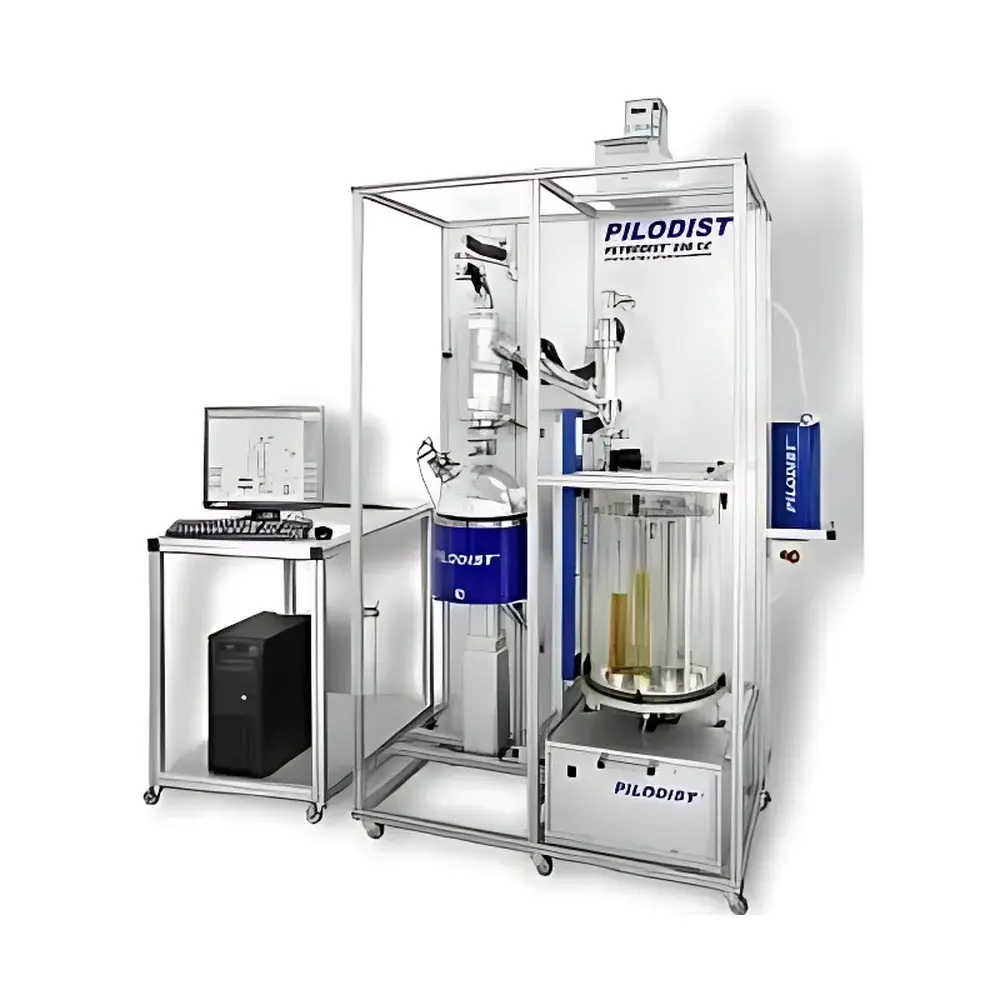
Pilodist PD 200CC Vacuum Batch Distillation System
| Brand | Pilodist |
|---|---|
| Origin | Germany |
| Model | PD 200CC |
| Standard Compliance | ASTM D5236 |
| Control System | Windows-based PC-controlled automation |
| Collection Capacity | 12 fraction receivers with IR heating and level tracking |
| Safety Features | Overtemperature shutdown, nitrogen purge activation, user-definable alarm thresholds |
| Distillation Mode | Vacuum batch distillation with automatic AET conversion and cut-point assignment |
| Material Construction | High-purity borosilicate glass (DIN/ISO 3585), ground-glass joints with elastomeric seals (no vacuum grease required) |
| Thermal Management | Adaptive heating power modulation and dynamic coolant temperature control |
| Data Output | Native Excel export (.xlsx), real-time curve visualization (volume % vs. AET °C), GLP-compliant audit trail |
Overview
The Pilodist PD 200CC Vacuum Batch Distillation System is a fully automated, computer-controlled laboratory-scale apparatus engineered for precise true boiling point (TBP) characterization of petroleum fractions under reduced pressure. Designed in strict accordance with ASTM D5236 (“Standard Test Method for Distillation of Petroleum Products at Reduced Pressure”), the system performs high-resolution vacuum batch distillation to determine volume-percent recovery versus atmospheric equivalent temperature (AET). Its core architecture integrates a jacketed glass distillation pot, programmable vacuum regulation, adaptive thermal management, and real-time fraction collection with volumetric monitoring — all coordinated via a dedicated Windows-based control platform. Unlike conventional manual or semi-automated setups, the PD 200CC eliminates operator-dependent variability through closed-loop feedback control of heating rate, condenser temperature, and vacuum setpoint — ensuring repeatability across replicate runs and compliance with regulatory data integrity requirements.
Key Features
- Full ASTM D5236 compliance with integrated AET calculation engine and automatic cut-point assignment based on user-defined temperature intervals
- 12-position fraction collector with infrared heating elements to prevent condensate solidification in heavy ends; each receiver equipped with optical liquid-level sensors for real-time volume tracking
- Vacuum system featuring digitally regulated two-stage rotary vane pump and absolute pressure transducer (range: 0.1–100 mbar), enabling precise residual pressure setting without vacuum grease
- Borosilicate glass construction (DIN ISO 3585) with standardized ground-glass joints (ISO K series) and fluorosilicone O-rings — eliminating need for vacuum grease and minimizing contamination risk
- Adaptive thermal control: distillation pot heating power dynamically adjusted per distillate rate; coolant temperature modulated in real time to maintain optimal condensation efficiency
- Comprehensive safety architecture including dual independent overtemperature detection, automatic nitrogen purge initiation upon critical threshold breach, and configurable alarm limits for pressure, temperature, and level
- Automated end-of-run protocol: system terminates heating, initiates controlled cooldown, vents vacuum safely, and archives full dataset with timestamped metadata
Sample Compatibility & Compliance
The PD 200CC accommodates feedstocks ranging from light naphthas to vacuum gas oils and deasphalted residues (up to 500 °C initial boiling point under atmospheric conditions). It supports sample volumes of 100–200 mL, with viscosity tolerance up to 1000 cSt at 40 °C. All operational parameters — including vacuum ramp profiles, heating rate gradients, and fraction cut logic — are fully configurable to align with internal method SOPs or regional specifications such as IP 199, ISO 3405, or GB/T 6536 (with appropriate AET conversion mapping). The system’s software architecture meets ALCOA+ principles for data integrity and is compatible with 21 CFR Part 11-compliant electronic signature modules when deployed in regulated GxP environments.
Software & Data Management
The proprietary Windows-based control software provides a graphical system flow diagram with live status indicators for all subsystems (vacuum, heating, cooling, collection, pressure, temperature). Users define distillation protocols via intuitive parameter entry — including target vacuum level, maximum heating rate, AET interval width, and hold times. During operation, the software logs >200 data channels at 1 Hz resolution, generating native Excel-compatible reports (.xlsx) containing volume % recovered, AET curves, mass balance summaries, and fraction-by-fraction density/refractive index metadata (when interfaced with optional peripheral analyzers). Audit trails record all parameter changes, operator logins, alarm events, and system state transitions — supporting GLP/GMP traceability and FDA inspection readiness.
Applications
- True boiling point (TBP) analysis of crude assay fractions for refinery process simulation (e.g., LP/NLP modeling)
- Characterization of vacuum residue for coker feed evaluation and asphaltene solubility studies
- Quality control of lubricant base stocks and specialty distillates requiring narrow-cut specification
- Research into vapor–liquid equilibrium (VLE) behavior of multicomponent hydrocarbon mixtures
- Method development and validation for alternative distillation standards (e.g., simulated distillation by GC, where TBP serves as reference)
- Supporting ASTM D2892/D5236 interlaboratory study programs and proficiency testing schemes
FAQ
What vacuum range does the PD 200CC support, and how is pressure stability maintained?
The system operates between 0.1 and 100 mbar absolute pressure, regulated via a digital vacuum controller coupled to a two-stage rotary vane pump. Stability is ensured by continuous pressure feedback and joint sealing using fluorosilicone gaskets — eliminating drift caused by grease degradation.
Can the system be integrated with LIMS or enterprise data systems?
Yes — raw data exports in .xlsx format are structured for direct ingestion into LIMS platforms. Optional OPC UA server module enables real-time tag-based data streaming to MES or SCADA infrastructures.
Is operator training included with system commissioning?
Pilodist provides on-site installation, IQ/OQ documentation, and two-day hands-on operator training covering method setup, safety protocols, troubleshooting, and report generation — delivered by certified application engineers.
How is calibration verified for temperature and pressure sensors?
All RTDs and pressure transducers are supplied with NIST-traceable calibration certificates. Onboard verification routines allow daily functional checks against reference standards without disassembly.
What maintenance intervals are recommended for long-term reliability?
Vacuum pump oil change every 500 operating hours; glassware inspection prior to each run; annual recalibration of temperature and pressure sensors — documented in the included Preventive Maintenance Logbook.





