
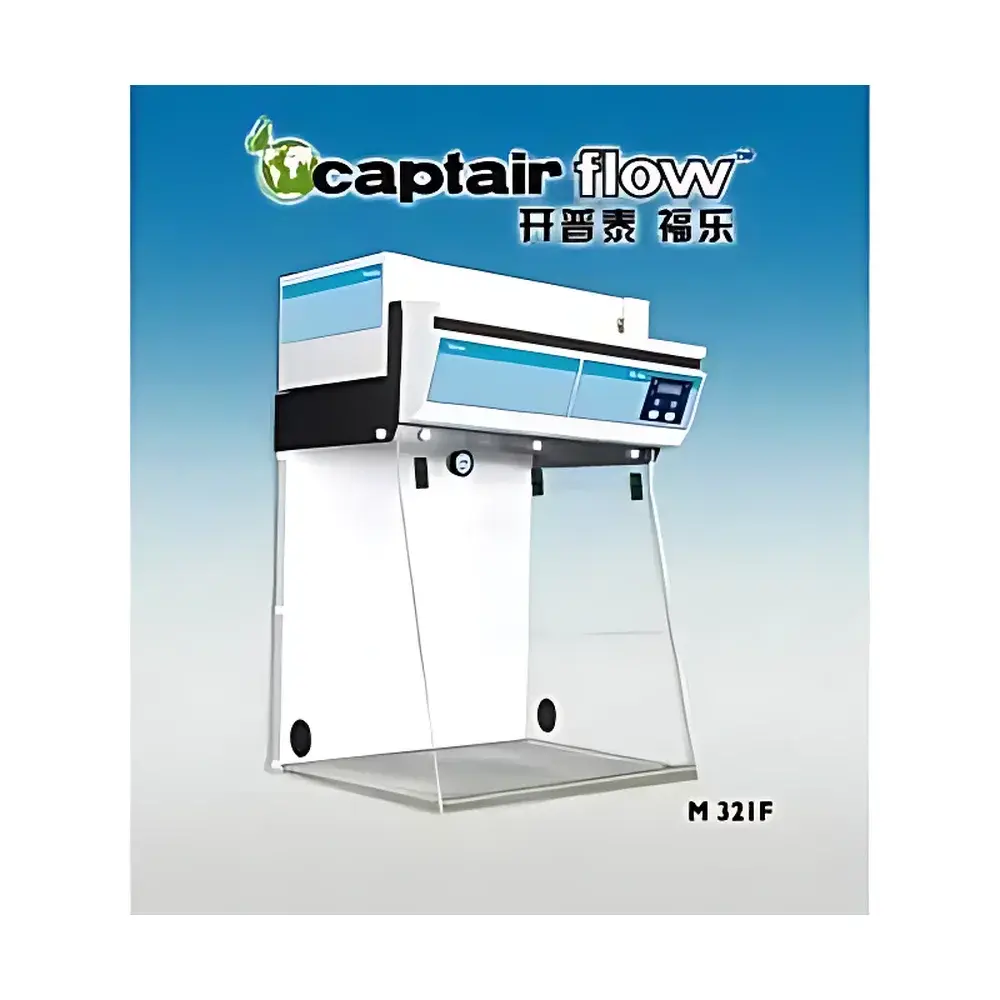
Erlab M321F Vertical Laminar Flow Clean Bench
| Brand | Erlab |
|---|---|
| Origin | France |
| Model | M321F |
| Airflow Type | Vertical Laminar Flow |
| Filtration Class | ISO Class 5 (equivalent to US Federal Standard 209E Class 100) |
| Filter Efficiency | ≥99.995% @ 0.3 µm (EN 1822-1, MPPS method) |
| HEPA Filter Grade | H14 |
| Face Velocity | >0.3 m/s |
| Airflow Volume | 230 m³/h |
| Sound Pressure Level | 52 dB(A) |
| Power Supply | 100–240 V, 50–60 Hz |
| Total Power Consumption | 58 W |
| Dimensions (W×D×H, mm) | External 800 × 620 × 1161–1246 |
| Internal Work Area (W×D×H, mm) | 764 × 546 × 866 |
| Pre-filter Monitoring | Integrated differential pressure gauge |
| Alarm System | Audible and visual fan failure alert |
| Standard Work Surface Options | 2 mm brushed 304 stainless steel or 25 mm solid phenolic resin with chemical-resistant finish and integral spill containment trough |
| Optional Add-ons | Fixed-height ergonomic workbench with leveling feet |
Overview
The Erlab M321F is a vertically oriented laminar flow clean bench engineered for precision-controlled, particle-free laboratory operations. It operates on the principle of unidirectional vertical airflow: ambient air is drawn through a pre-filter, conditioned by a low-vibration, energy-efficient EC motor-driven centrifugal fan (IP44 rated), and then passed through an H14 high-efficiency particulate air (HEPA) filter compliant with EN 1822-1 at the Most Penetrating Particle Size (MPPS) of 0.3 µm. This ensures ≥99.995% filtration efficiency, delivering ISO Class 5 (formerly Class 100) clean air across the entire working surface—meeting both EN ISO 14644-1 and US FED-STD-209E requirements. The unit’s aerodynamic cabinet design minimizes turbulence and recirculation, maintaining consistent face velocity (>0.3 m/s) and uniform laminar flow profile. Its structural integrity, electrical safety (IEC 61010-1), and material compatibility support routine use in regulated environments including GLP-compliant labs and pharmaceutical R&D facilities.
Key Features
- Single EC motor-driven fan system (IP44 rating) with integrated thermal overload protection and real-time operational status monitoring
- H14 HEPA filter certified per EN 1822-1, validated for ≥99.995% efficiency at 0.3 µm; typical service life up to 4 years depending on ambient particulate load
- Dual-stage filtration architecture: washable aluminum pre-filter upstream of HEPA; optional GF4BE+ activated carbon filter module for adsorption of organic and inorganic vapors (e.g., solvents, acids, aldehydes)
- Intelligent control panel featuring audible/visual fan failure alarm and differential pressure sensor for predictive maintenance—alerts users when pre-filter or HEPA filter resistance exceeds threshold
- Ergonomic height-adjustable external dimensions (1161–1246 mm H) with fixed internal work height (866 mm); front sash opening optimized for operator comfort and containment
- Work surface options include electropolished 304 stainless steel (2 mm thick, radius-edged) or solid phenolic resin (25 mm thick, non-conductive, chemically inert, with built-in spill containment trough)
Sample Compatibility & Compliance
The M321F is designed for non-hazardous, non-toxic applications requiring particulate-free manipulation—including aseptic handling of non-pathogenic cell cultures, microbiological plating, optical component assembly, semiconductor wafer inspection, and analytical weighing in controlled environments. It complies with ISO 14644-1 (Class 5), EN 1822-1 (H14), IEC 61010-1 (safety), and supports alignment with EU GMP Annex 1 (Grade A/B environments) when integrated into appropriate facility HVAC systems. While not intended for biohazard containment (i.e., no personnel or environmental protection), its airflow performance and filter validation documentation facilitate audit readiness for FDA 21 CFR Part 11–aligned data logging systems when paired with optional digital controllers.
Software & Data Management
The base M321F operates via hardware-integrated analog controls; however, it is compatible with Erlab’s optional SmartControl digital interface—a CE-marked module enabling USB/RS-485 connectivity, time-stamped event logging (fan status, filter delta-P, alarm triggers), and export of CSV-formatted operational records. This configuration supports traceability requirements under GLP and GMP frameworks, including electronic signature capability and audit trail generation per ALCOA+ principles. Filter replacement history, calibration dates, and airflow verification logs can be archived and retrieved for internal quality reviews or regulatory inspections.
Applications
- Cell culture preparation and passaging (non-pathogenic lines)
- Microbiological media pouring and colony isolation
- Precision weighing of reference standards and pharmaceutical excipients
- Assembly and inspection of micro-optical components and MEMS devices
- Electronics prototyping involving soldering flux-sensitive substrates
- Cosmetic formulation development under particle-controlled conditions
- Plant tissue culture and sterile seed germination protocols
FAQ
What certification standards does the M321F meet for cleanroom classification?
It achieves ISO 14644-1 Class 5 and US FED-STD-209E Class 100 performance, verified through in-situ airflow uniformity and particle count testing per ISO 14644-3.
Can the M321F be used for chemical handling?
Yes—when equipped with the optional GF4BE+ activated carbon filter module, it mitigates gaseous contaminants during solvent-based weighing or low-volatility reagent handling; however, it is not rated for volatile organic compound (VOC) exhaust or toxic fume containment.
How often must the H14 HEPA filter be replaced?
Filter lifetime depends on ambient air quality and usage frequency; under typical laboratory conditions (ISO Class 8 ambient), replacement is recommended every 3–4 years, guided by differential pressure monitoring and periodic integrity testing (e.g., DOP/PAO scanning).
Is the stainless steel work surface electropolished?
Standard configuration uses mechanically brushed 304 stainless steel; electropolishing is available as a custom order option to enhance corrosion resistance and ease of decontamination.
Does the unit support integration with building management systems (BMS)?
Via the SmartControl digital interface (optional), Modbus RTU protocol enables BMS communication for remote status monitoring, though direct actuation commands are not supported for safety-critical functions.



