
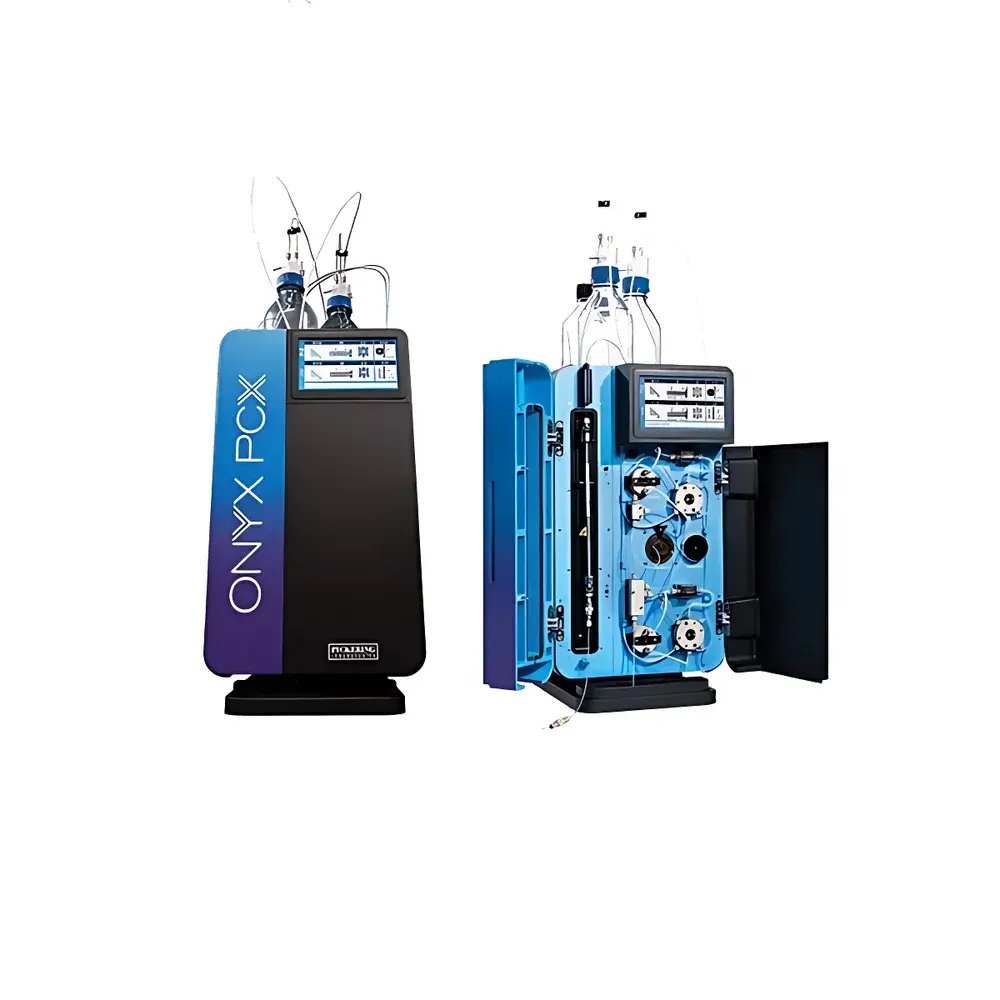
Pickering Onyx Post-Column Derivatization System for Amino Acid Analysis
| Brand | Pickering |
|---|---|
| Origin | USA |
| Manufacturer Type | Authorized Distributor |
| Product Category | Imported Instrument |
| Model | Onyx |
| Instrument Type | Post-Column Derivatization System |
| Derivatization Chemistry | Ninhydrin-based (Trione® reagent) |
| Detection Mode | Visible Absorbance (570 nm & 440 nm) |
| Compatible HPLC Platforms | Standard UV/Vis-equipped HPLC systems |
| Amino Acid Coverage | Up to 50 free amino acids |
| Typical Detection Sensitivity | ≤10 pmol (ninhydrin), ≤2 pmol (OPA alternative) |
| Resolution | ≥1.5 for Leu/Ile, ≥1.2 for all other standard amino acids |
| Equilibration Time | 9 min |
| Run Time | 30 min (hydrolysates), 70 min (free amino acids) |
| Reagent Stability | Trione® ninhydrin reagent exhibits enhanced thermal and oxidative stability vs. conventional ninhydrin solutions |
Overview
The Pickering Onyx Post-Column Derivatization System is a modular, high-performance solution engineered for precise, reproducible amino acid quantification in complex biological matrices. Unlike integrated amino acid analyzers, the Onyx operates as a dedicated post-column reaction module compatible with standard HPLC platforms equipped with visible absorbance or fluorescence detection. It implements classical ion-exchange chromatography followed by on-line derivatization using Pickering’s proprietary Trione® ninhydrin reagent—a stabilized, high-purity formulation optimized for consistent colorimetric response at 570 nm (primary α-amino acids) and 440 nm (proline and hydroxyproline). This architecture enables rigorous compliance with pharmacopeial methods (USP , EP 2.2.46) and supports GLP/GMP workflows where traceability, method robustness, and reagent lot consistency are critical. The system is particularly suited for QC laboratories performing routine analysis of cell culture media, fermentation broths, nutritional supplements, feed formulations, and hydrolyzed protein samples.
Key Features
- Modular integration: Designed for seamless coupling with existing HPLC systems—no proprietary pump or detector required.
- Trione® ninhydrin reagent: Chemically stabilized formulation delivering superior shelf life (>12 months refrigerated), reduced baseline drift, and minimized reagent degradation during long-run sequences.
- Programmable reaction coil temperature control (ambient to 135 °C): Enables optimization of derivatization kinetics for diverse amino acid profiles and matrix interferences.
- Dual-wavelength photometric detection support: Simultaneous monitoring at 570 nm and 440 nm ensures accurate quantitation across all 22 proteinogenic amino acids, including imino acids.
- Low operational cost per analysis: Consumables cost <USD 25/sample—approximately 40–60% lower than integrated amino acid analyzers—without compromising data quality or regulatory acceptability.
- Method flexibility: Supports both ninhydrin- and OPA-based derivatization protocols; validated methods available for USP, AOAC, and ISO-compliant applications.
Sample Compatibility & Compliance
The Onyx system accommodates a broad range of sample types, including acid-hydrolyzed proteins (e.g., food, feed, pharmaceutical excipients), free amino acid mixtures (e.g., cell culture supernatants, plasma, urine), and specialized analytes such as glycine-containing antidiabetics (e.g., voglibose), free formaldehyde, and certain β-lactam antibiotics. All separations utilize Pickering’s certified AAA-SCX cation-exchange columns (3 µm, 150 × 4.6 mm), fully compliant with USP L14 classification. Method validation documentation—including specificity, linearity (r² ≥ 0.999), LOD/LOQ, precision (RSD < 2.5% intra-day), and robustness—is provided per ICH Q2(R2) guidelines. The system architecture supports 21 CFR Part 11-compliant software configurations when paired with validated CDS platforms.
Software & Data Management
While the Onyx hardware operates independently of proprietary software, it is fully interoperable with industry-standard Chromatography Data Systems (CDS), including Waters Empower, Thermo Chromeleon, Agilent OpenLab, and Shimadzu LabSolutions. Pickering provides comprehensive method templates, calibration standards (NIST-traceable amino acid reference materials), and SOPs aligned with ISO/IEC 17025 requirements. Audit trail functionality, electronic signature support, and raw data integrity are maintained at the CDS level. Optional Pickering Method Development Suite (PMDS) offers automated gradient optimization, peak tracking, and resolution modeling for method transfer and troubleshooting.
Applications
- Biopharmaceutical process development: Real-time monitoring of essential amino acid depletion in CHO and HEK293 cell culture media.
- Nutritional product QC: Quantification of fortified amino acids in infant formula, sports nutrition powders, and animal feed premixes.
- Food authenticity and labeling verification: Detection of adulteration via amino acid fingerprinting (e.g., collagen hydrolysates, soy vs. whey protein).
- Clinical research: High-throughput profiling of plasma/urine amino acids in metabolic disorder screening (e.g., PKU, MSUD).
- Regulatory submissions: Generation of stability-indicating data for amino acid-containing APIs per ICH Q5C and Q6B.
FAQ
Can the Onyx system be used with fluorescence detection?
Yes—the system supports OPA/FMOC pre-column or post-column derivatization modes when configured with a fluorescence detector (Ex 340 nm / Em 450 nm). Pickering supplies validated OPA reagents and reaction coils optimized for this configuration.
Is Trione® reagent compatible with all standard HPLC-grade solvents and tubing materials?
Trione® is formulated for compatibility with stainless steel, PEEK, and fluoropolymer fluidic paths. It is miscible with water, methanol, and acetonitrile but requires careful pH control (buffered at pH 4.25–4.35) prior to mixing with post-column streams.
What column dimensions and particle sizes are recommended for optimal resolution?
Pickering recommends the AAA-SCX column (150 × 4.6 mm, 3 µm) for routine analysis. For higher throughput or UHPLC compatibility, the 100 × 3.0 mm, 2.5 µm variant is available with equivalent selectivity and pressure rating up to 600 bar.
Does Pickering provide application support for method transfer from integrated amino acid analyzers?
Yes—Pickering’s Applications Lab offers documented method conversion packages, including retention time alignment, gradient adjustment, and sensitivity recalibration protocols for migration from legacy systems (e.g., Biochrom 30+, Sykam S-433D).
How is reagent stability verified across production lots?
Each Trione® lot undergoes accelerated stability testing (40 °C/75% RH for 6 weeks), spectrophotometric purity assessment (A280/A570 ratio), and performance qualification against NIST SRM 2389a (Amino Acid Mixture Standard). Certificates of Analysis include full chromatographic test reports.



