
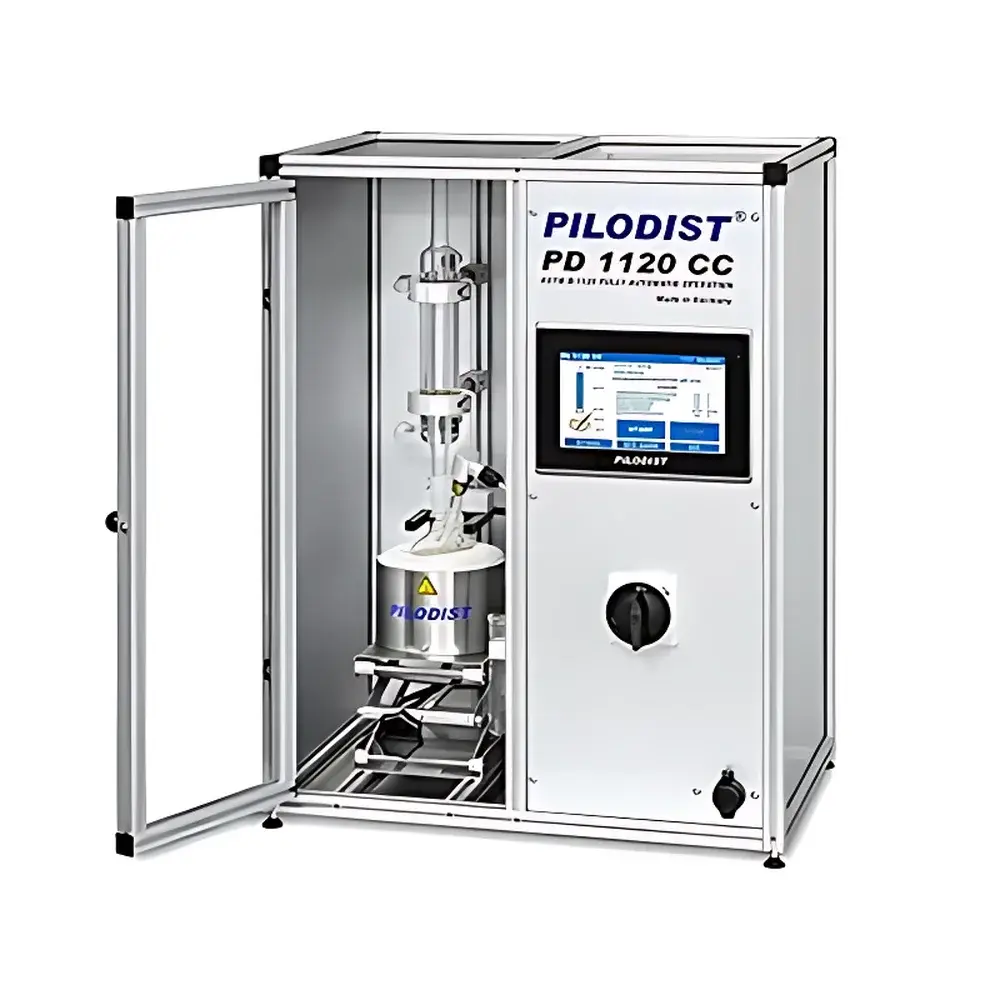
Pilodist PD1120CC Engine Coolant Boiling Point Analyzer
| Brand | Pilodist |
|---|---|
| Origin | Germany |
| Model | PD1120CC |
| Standard Compliance | ASTM D1120, SAE J1704 |
| Automation Level | Fully Automated |
| Test Duration | 8–15 min per sample |
| Output | Permanent thermal print + network-enabled PDF export |
| Regulatory Context | Designed for GLP-compliant laboratories |
| Application Scope | Engine coolant and brake fluid equilibrium boiling point (EBP) determination |
Overview
The Pilodist PD1120CC Engine Coolant Boiling Point Analyzer is a fully automated, benchtop distillation system engineered specifically for the precise and reproducible determination of the equilibrium boiling point (EBP) of engine coolants and brake fluids in accordance with ASTM D1120 and SAE J1704. Unlike general-purpose distillation apparatuses, the PD1120CC implements a closed-loop, pressure-regulated micro-distillation protocol optimized for low-volatility, high-boiling glycol-based formulations. The instrument operates on the principle of dynamic equilibrium vapor-phase temperature measurement under controlled atmospheric conditions—ensuring that the reported EBP reflects the true thermodynamic boiling behavior of the sample at ambient pressure, without superheating artifacts or carryover interference. Its design eliminates manual intervention during heating ramp, vapor condensation, and endpoint detection, thereby minimizing operator-induced variability and supporting audit-ready data integrity.
Key Features
- Fully automated ASTM D1120-compliant workflow—from sample loading to final EBP calculation and reporting
- Integrated pressure-compensated temperature sensing with traceable Pt100 sensor (±0.1 °C accuracy over 100–200 °C range)
- Patented vapor condensation management system preventing droplet re-evaporation and ensuring stable distillate collection
- Self-calibrating heating block with programmable ramp profiles and thermal inertia compensation
- Thermal-printed hardcopy output with permanent record of test parameters, time-stamped results, and operator ID
- Ethernet-enabled interface supporting remote monitoring, PDF report generation, and integration into LIMS environments
- Compact footprint (W×D×H: 320 × 450 × 410 mm) suitable for standard fume hood installation
Sample Compatibility & Compliance
The PD1120CC accepts standard 50 mL glass distillation flasks and accommodates neat ethylene glycol, propylene glycol, and inhibited coolant concentrates—including OEM-specified formulations (e.g., G12+, OAT, HOAT). It is validated for use with DOT 3, DOT 4, and DOT 5.1 brake fluids per SAE J1704 Annex A. All operational sequences adhere strictly to the procedural constraints defined in ASTM D1120—particularly regarding initial sample volume, heating rate control (≤2 °C/min up to 100 °C), and endpoint definition (first sustained vapor temperature plateau ≥30 s). The system’s firmware embeds built-in compliance checks (e.g., temperature ramp validation, pressure deviation alerts) and supports 21 CFR Part 11–ready electronic signatures when paired with authorized laboratory software.
Software & Data Management
The PD1120CC runs on embedded real-time OS with deterministic timing control. No external PC is required for basic operation; however, optional Ethernet connectivity enables secure HTTP/HTTPS access to the onboard web server for configuration, diagnostics, and report retrieval. Each test generates a timestamped XML metadata file containing raw temperature/time series, heating power logs, and endpoint decision flags—retained locally for ≥10,000 cycles. PDF reports include full traceability: instrument serial number, calibration certificate IDs, user login context, and digital signature fields. Audit trails are immutable and exportable in CSV format for QA review. Optional firmware updates are digitally signed and verified prior to installation.
Applications
- Quality control of antifreeze/coolant formulations in manufacturing and blending facilities
- Verification of EBP stability after thermal aging or contamination exposure (e.g., oil ingress, hard water scaling)
- Regulatory submission testing for OEM coolant approval programs (e.g., VW TL 774-G, GM 6277M)
- Comparative analysis of inhibitor package efficacy across glycol base stocks
- Supporting failure analysis in field-return investigations involving overheating or boil-over incidents
- Method transfer and validation studies in contract testing laboratories accredited to ISO/IEC 17025
FAQ
What standards does the PD1120CC directly support?
ASTM D1120, SAE J1704, and ISO 4623-2 (equivalent method for coolant EBP) — all implemented via pre-validated instrument methods.
Is external calibration required before first use?
Yes: Initial verification requires NIST-traceable thermometer calibration at three points (100 °C, 150 °C, 190 °C) using certified reference materials per ASTM E77.
Can the system be integrated into an existing LIMS?
Yes: Through HTTP API or direct PDF/XML file polling via shared network drive; no proprietary middleware required.
Does the PD1120CC meet GLP documentation requirements?
Yes: All test records include electronic audit trail, operator authentication, instrument status snapshot, and tamper-evident digital signatures.
What maintenance intervals are recommended?
Quarterly optical path inspection, annual Pt100 sensor recalibration, and biannual condenser cleaning using ASTM D93-compliant solvent rinse protocol.





