
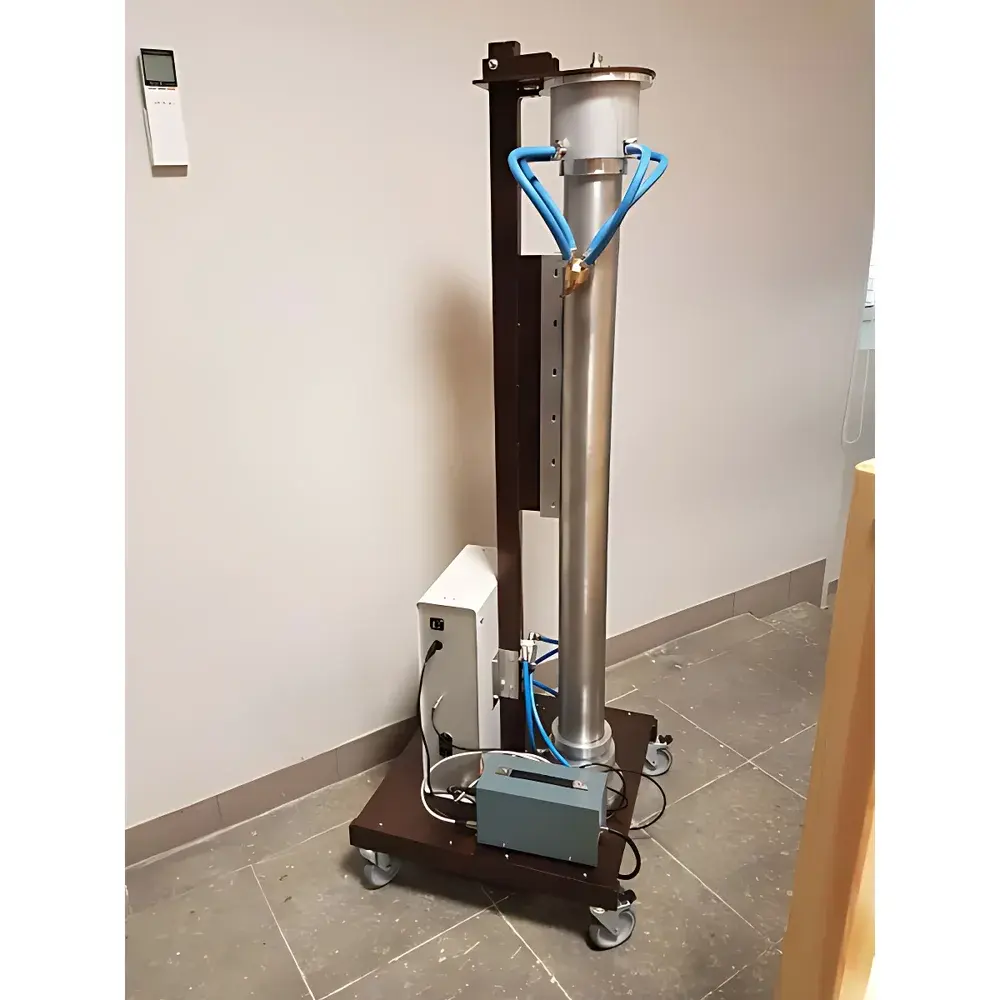
Airel VLDMA Ultra-Long Differential Mobility Analyzer
| Brand | Airel |
|---|---|
| Model | VLDMA |
| Type | Differential Mobility Analyzer (DMA) |
| Maximum Particle Diameter | 8,000 nm |
| Upper Mobility Range | 1.2 × 10⁻⁶ cm²/V·s |
| High-Voltage Range | ±10 kV |
| Sheath Flow Rate | 2–20 L/min |
| Sheath-to-Sample Flow Ratio | 1:10 |
| Gravity Drift Compensation | Automated for particles >4 µm |
| Interface | RJ45, Ethernet (LAN) |
| Dimensions | 165 × 57 × 57 cm |
| Weight | Not specified |
| Compatibility | Airel Aerosol Electrometer Model 202 (native), third-party CPCs/SMPS systems (optional) |
| Control Software | Integrated DMA controller with step-scan and time-delay correction modes |
Overview
The Airel VLDMA Ultra-Long Differential Mobility Analyzer is a precision-engineered electrostatic classification instrument designed for high-fidelity size-selective separation of airborne aerosol particles in the submicron to coarse mode range. Operating on the principle of differential mobility analysis, the VLDMA exploits the relationship between particle electrical mobility (Zp) and its physical diameter under defined electric field and gas flow conditions. Its defining architectural feature—a 1200 mm axial separation between inlet and exit slits—enables extended residence time and enhanced resolution for particles up to 8,000 nm (8 µm) in aerodynamic diameter, significantly exceeding the upper limit of conventional short-column DMAs (typically ≤1 µm). This ultra-long geometry reduces diffusion broadening and improves classification sharpness, particularly critical for low-mobility, high-mass particles where gravitational settling and drag forces dominate transport behavior. The system is engineered for laboratory-based aerosol metrology, serving as both a primary classification tool and a reference-grade transfer standard in traceable calibration workflows.
Key Features
- Ultra-long column design (1200 mm slit-to-slit distance) enabling robust classification of particles up to 8 µm diameter
- Bipolar high-voltage source (±10 kV) for precise, continuous control of central electrode potential—supporting classification of both positively and negatively charged species
- Digitally regulated sheath airflow (2–20 L/min) via integrated software-controlled blower, ensuring stable laminar flow profiles across the full operational range
- Automated gravity drift compensation algorithm embedded in firmware—dynamically adjusts voltage sweep parameters for particles >4 µm to maintain classification accuracy
- Native integration with Airel Aerosol Electrometer Model 202 for direct charge-based particle number concentration measurement
- Flexible interface architecture supporting third-party condensation particle counters (CPCs), scanning mobility particle sizers (SMPS), and electrometers via standardized LAN (RJ45/Ethernet) protocol
- Two operational modes: discrete step-scan for high-resolution size distribution mapping and continuous sweep mode for rapid profiling
- Time-delay correction function synchronizes classification output with downstream detector response latency—essential for alignment with variable-counting-efficiency instruments
Sample Compatibility & Compliance
The VLDMA accepts polydisperse aerosol streams delivered via standard 1/4″ OD stainless steel or conductive PFA tubing. It is compatible with dry, non-reactive gases (e.g., N2, synthetic air, zero air) as sheath and sample carriers. Particles must carry sufficient unipolar or bipolar charge (typically achieved via soft X-ray or radioactive neutralizers such as 85Kr or 210Po) for effective mobility-based separation. The instrument meets mechanical and electrical safety requirements per IEC 61010-1:2010 and supports audit-ready operation under GLP and GMP frameworks when paired with compliant data acquisition software. While not certified to ISO 17025 out-of-the-box, its traceable voltage and flow calibration paths align with ISO 27891 (aerosol instrumentation) and ASTM D6631 (standard practice for calibrating aerosol spectrometers).
Software & Data Management
The VLDMA is operated through a dedicated Windows-based controller application providing real-time monitoring of voltage ramping, sheath flow stability, temperature, and pressure differentials. All scan parameters—including start/end voltage, dwell time, step size, and flow setpoints—are programmable and stored with metadata (date, operator ID, instrument serial number). Raw classification data export to CSV or HDF5 formats preserves timestamped voltage–flow–count tuples for post-processing in MATLAB, Python (Pandas/NumPy), or commercial aerosol analysis suites. Audit trails record all parameter changes, user logins, and calibration events. Optional 21 CFR Part 11 compliance packages are available upon request, including electronic signatures, role-based access control, and immutable data archiving.
Applications
- Primary calibration of optical particle counters (OPCs), laser aerosol spectrometers (LAS), and aerodynamic particle sizers (APS) against monodisperse standards
- Fundamental studies of coarse-mode aerosol dynamics—including dust, pollen, spores, and industrial fumes—in atmospheric physics and occupational hygiene research
- Validation of computational fluid dynamics (CFD) models for particle transport in DMA geometries
- Development and intercomparison of charging efficiency models for particles >1 µm
- Traceable generation of monodisperse test aerosols for filter efficiency testing (per ISO 16890, EN 1822)
- Supporting regulatory aerosol monitoring programs requiring size-resolved mass concentration reconstruction
FAQ
What is the smallest particle size the VLDMA can classify?
The lower detection limit is governed by instrumental noise floor and charging probability—not by the DMA geometry itself. With optimal neutralizer configuration and electrometer sensitivity, reliable classification begins at approximately 10 nm.
Can the VLDMA operate without the Airel Model 202 electrometer?
Yes. It functions as a standalone classifier; any downstream particle counter with compatible signal input (TTL, analog, or Ethernet) may be used, provided time-delay correction is applied.
Is the ±10 kV voltage range adjustable in fine increments?
Yes. Voltage resolution is 0.1 V over the full ±10 kV range, enabling sub-angstrom-level mobility binning for high-resolution size distribution analysis.
Does the system require external vacuum or compressed gas sources?
No. All pneumatic functions—including sheath flow generation and internal pressure regulation—are self-contained within the DMA controller unit.
How is calibration traceability maintained?
High-voltage output is calibrated annually against NIST-traceable DC voltage standards; flow sensors are verified using primary rotameters or thermal mass flow calibrators accredited to ISO/IEC 17025.







