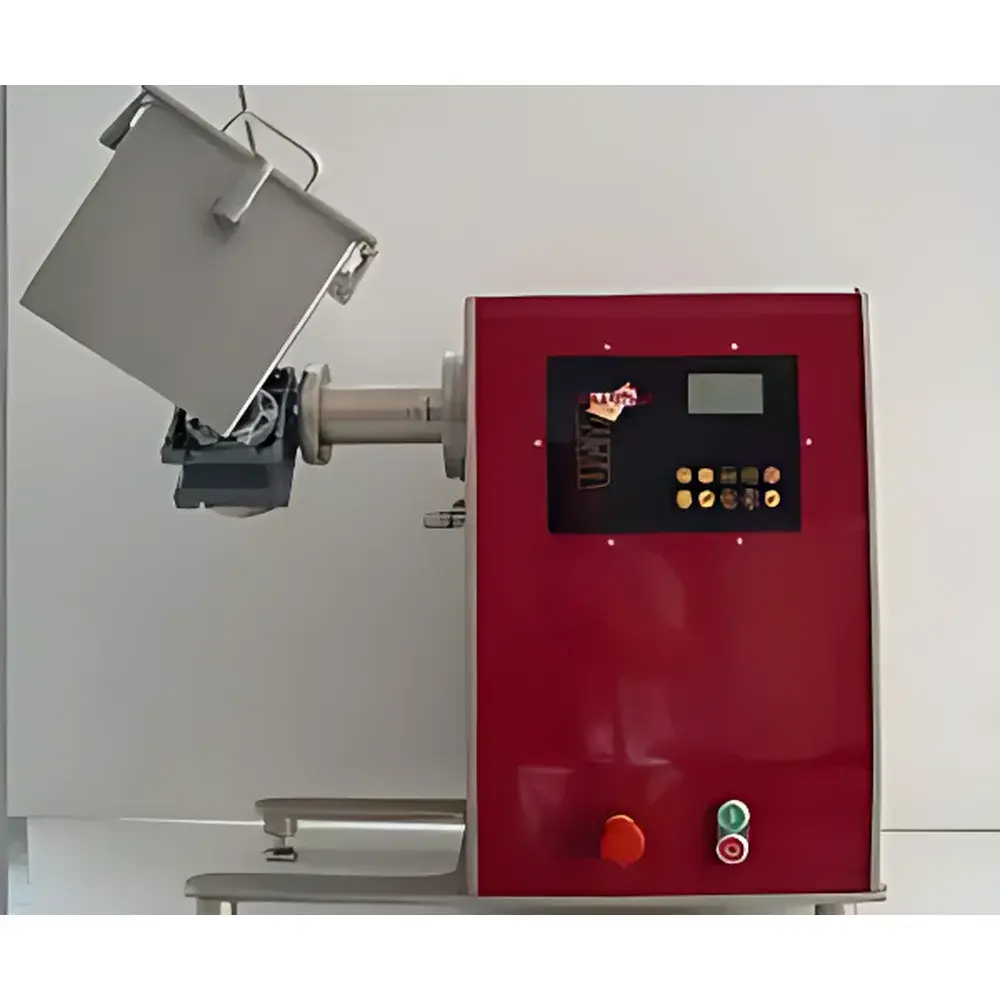
Pharmag Cube Mixing Rotational Mixer
| Brand | Pharmag |
|---|---|
| Origin | Germany |
| Model | Cube Mixing |
| Capacity Range | 3–12 L |
| Construction Options | Stainless Steel or Resin Cubes |
| Drive Mechanism | UGD Gear-Driven Inversion System |
| Motion Type | Gentle, End-Over-End Rotational Tumbling |
Overview
The Pharmag Cube Mixing Rotational Mixer is a precision-engineered laboratory mixing system designed for gentle, reproducible homogenization of sensitive biological, pharmaceutical, and cell culture samples. Unlike orbital shakers or vortex mixers that impose shear stress through rapid circular motion, the Cube Mixer operates on a controlled end-over-end tumbling principle—mimicking natural sedimentation reversal—thereby minimizing foaming, cell lysis, and protein denaturation. Its core mechanism relies on a UGD (Universal Gear Drive) transmission system that delivers consistent angular velocity and precise positional repeatability across all rotation cycles. Engineered in Germany to DIN EN ISO 9001-certified manufacturing standards, the device supports Good Manufacturing Practice (GMP) and Good Laboratory Practice (GLP) workflows where sample integrity and process traceability are critical.
Key Features
- Gentle, low-shear mixing via programmable end-over-end rotational inversion—ideal for suspension cultures, antibody formulations, hydrogels, and fragile particulates.
- Modular cube design with interchangeable 3 L, 6 L, and 12 L vessels—available in electropolished stainless steel (AISI 316L) for autoclavable applications or chemically resistant polymer resin for lightweight, non-metallic handling.
- UGD gear-driven actuation ensures zero belt slippage, minimal vibration transmission, and long-term torque stability—even under variable load conditions.
- Integrated microprocessor controller with real-time RPM monitoring, elapsed time tracking, and programmable run cycles (up to 999 minutes per session).
- IP54-rated enclosure with reinforced polycarbonate housing, emergency stop button, and interlocked lid safety switch compliant with EN 61000-6-2/6-4 EMC directives.
Sample Compatibility & Compliance
The Cube Mixing system accommodates a broad range of sample types—including mammalian cell suspensions, microbial cultures, liposomal dispersions, buffer solutions, and viscous biopolymer gels—without compromising viability or structural fidelity. Its low-acceleration tumbling profile (typically 5–30 rpm, adjustable in 0.5-rpm increments) avoids cavitation and air entrapment common in high-speed agitation. The mixer is compatible with standard ISO 8573-1 Class 3 compressed air interfaces for optional pneumatic tilt-lock integration. All wetted components meet USP Class VI biocompatibility requirements; stainless steel cubes conform to ASTM A967 passivation specifications. Documentation packages include Factory Acceptance Test (FAT) reports and EU Declaration of Conformity (2014/30/EU EMC and 2014/35/EU LVD).
Software & Data Management
While the base model features standalone operation via front-panel keypad, an optional USB-C data logging interface enables export of timestamped operational logs (start/stop times, RPM history, cycle count) in CSV format. When deployed in regulated environments, the system supports 21 CFR Part 11-compliant audit trail generation through third-party LIMS or ELN integrations—requiring external validation of user access controls, electronic signatures, and data immutability protocols. Firmware updates are performed offline via secure firmware image files, with version rollback capability retained for traceability during qualification revalidation.
Applications
- Pre-formulation blending of monoclonal antibody (mAb) drug substances prior to sterile filtration.
- Uniform resuspension of cryopreserved primary cells without mechanical stress-induced apoptosis.
- Homogenization of alginate-based 3D bioprinting bioinks prior to extrusion.
- Buffer exchange and dialysate equilibration in membrane-based purification setups.
- Stabilization of nanoparticle suspensions (e.g., PLGA, lipid nanoparticles) during storage conditioning studies.
FAQ
What is the maximum recommended viscosity range for optimal mixing performance?
The Cube Mixer achieves uniform dispersion up to 15,000 mPa·s (measured at 25°C using a Brookfield RV spindle); beyond this, extended cycle times or reduced fill volumes may be required.
Can the mixer be validated for use in GMP manufacturing environments?
Yes—full IQ/OQ documentation templates, calibration certificates for speed verification, and risk assessments aligned with ICH Q9 principles are available upon request.
Is remote monitoring or network connectivity supported natively?
No native Ethernet or Wi-Fi module is included; however, analog 4–20 mA output signals for RPM and status can be interfaced with PLC-based SCADA systems.
Are custom cube geometries or material certifications available?
Custom machining of stainless steel cubes—including laser-etched lot traceability marks and ASME BPE surface finish certification—is offered under NDA for OEM integration projects.
Related Products