
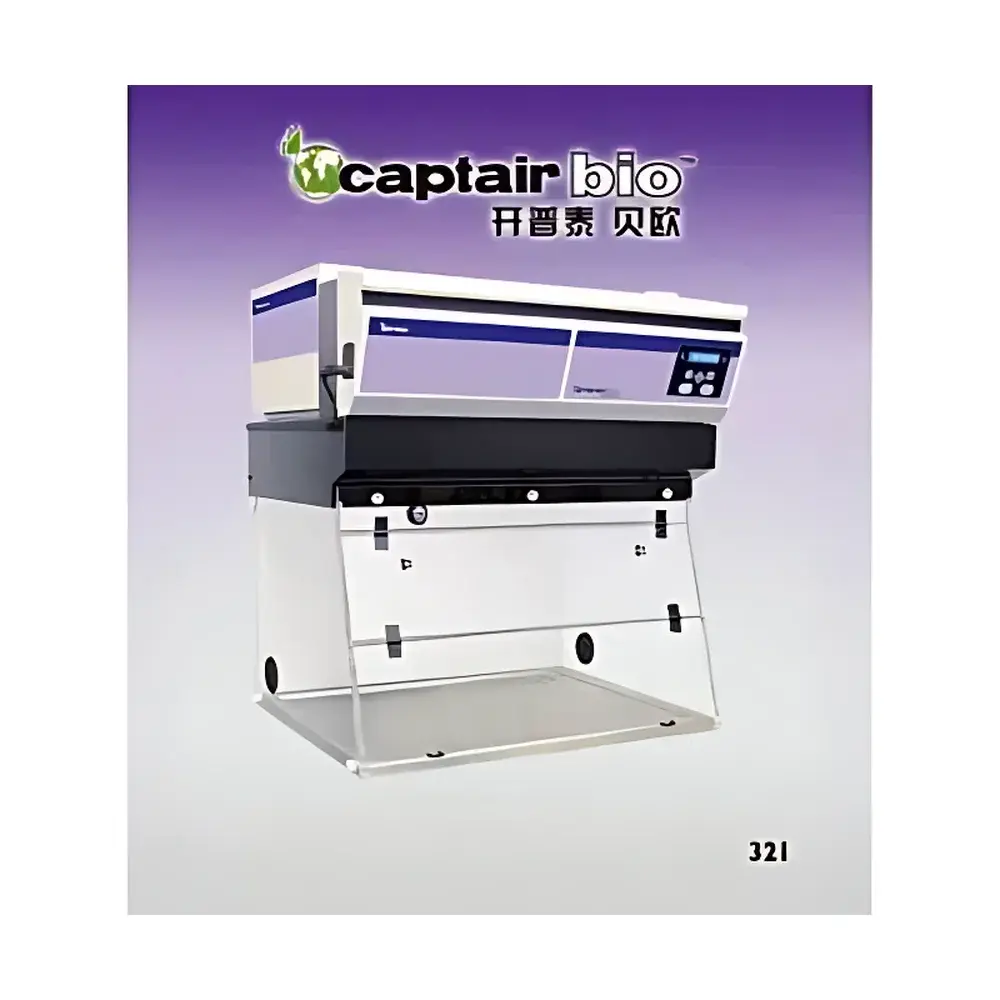
Erlab Biocap 321 PCR Purification Workstation
| Brand | Erlab |
|---|---|
| Origin | France |
| Model | Biocap 321 |
| Instrument Type | Vertical Laminar Flow Clean Bench |
| Cleanliness Class | ISO Class 5 (Class 100) |
| Airflow Velocity | ≥0.3 m/s |
| Airflow Volume | 230 m³/h |
| Filter Class | H14 HEPA (EN 1822-1:2022, ≥99.995% @ 0.1 µm) |
| UV Lamp | Timer-Controlled, 254 nm |
| External Dimensions (W×D×H) | 800 × 657 × 890 mm |
| Internal Dimensions (W×D×H) | 767 × 530 × 600 mm |
| Power Supply | 100–240 V AC, 50–60 Hz |
| Total Power Consumption | 58 W |
| Sound Pressure Level | 52 dB(A) |
| Fan Quantity | 1 |
| Compliance | EN 14644-1, EN 1822-1, IEC 61000-6-3, IEC 61000-6-4 |
Overview
The Erlab Biocap 321 is a purpose-engineered vertical laminar flow PCR purification workstation designed exclusively for molecular biology laboratories performing sensitive nucleic acid amplification procedures. Unlike general-purpose biosafety cabinets or standard clean benches, the Biocap 321 implements a unidirectional, downward airflow architecture optimized to eliminate exogenous DNA and RNA contamination—particularly human-derived DNases and RNases carried by operators or ambient room air. Its core principle relies on ISO Class 5 (equivalent to Federal Standard 209E Class 100) laminar flow: ambient air is drawn through a single, certified H14 HEPA filter (EN 1822-1:2022, ≥99.995% efficiency at 0.1 µm), then delivered vertically across the work surface at a uniform velocity of ≥0.3 m/s. Critically, exhaust air is directed forward toward the operator—not recirculated—minimizing re-entrainment of aerosolized nucleic acids or enzymatic contaminants. This configuration aligns with best practices outlined in ISO/IEC 17025:2017 and CLSI EP25-A guidelines for contamination control in PCR pre-amplification zones.
Key Features
- Single-stage H14 HEPA filtration system certified per EN 1822-1:2022, ensuring removal of sub-100 nm biological particulates including viral particles and enzyme-laden microdroplets.
- Integrated, timer-controlled 254 nm UV-C lamp with safety interlock—automatically deactivates when sash is opened—to decontaminate interior surfaces between runs and prevent carryover between PCR setups.
- Optimized ergonomic footprint (800 × 657 × 890 mm external) with 767 × 530 × 600 mm usable workspace, supporting dual-pipette operation and standard 96-well plate handling without compromising laminar integrity.
- Low-noise centrifugal fan (52 dB(A)) operating at stable 230 m³/h volumetric flow, maintaining consistent face velocity under variable ambient pressure conditions.
- Universal power input (100–240 V AC, 50–60 Hz) with energy-efficient design (58 W total draw), compliant with IEC 61000-6-3 (EMI emission) and IEC 61000-6-4 (immunity) standards.
- No recirculation path: 100% of filtered air is exhausted forward—eliminating risk of cross-contamination from cabinet-integrated ductwork or plenum re-use.
Sample Compatibility & Compliance
The Biocap 321 is validated for use with all standard PCR consumables—including low-bind tubes, master mix aliquots, primers, probes, and cDNA templates—without inducing thermal or electrostatic artifacts. It is not rated for containment of biohazards (i.e., does not meet NSF/ANSI 49 or EN 12469 requirements for BSL-2 applications) and must not be used for handling infectious agents or live cultures. Its design strictly adheres to ISO 14644-1:2015 (cleanroom classification), EN 1822-1:2022 (filter performance), and EU Machinery Directive 2006/42/EC. Documentation includes full traceable filter certification, airflow validation reports, and electrical safety compliance (IEC 61010-1). For GLP/GMP environments, optional audit-trail-ready UV usage logs and filter lifetime tracking are supported via third-party integration.
Software & Data Management
The Biocap 321 operates as a standalone hardware platform with no embedded firmware or proprietary software. All operational parameters—including UV exposure duration, fan runtime, and maintenance alerts—are managed manually via front-panel controls. However, it is fully compatible with laboratory information management systems (LIMS) and electronic lab notebooks (ELN) via optional RS-232 or USB-to-serial adapters (sold separately). Integration enables timestamped logging of UV activation events and cumulative fan operating hours—supporting 21 CFR Part 11-compliant record retention when paired with validated data acquisition software. Filter replacement intervals (typically 18–24 months under continuous use) are tracked using physical log tags affixed to the unit.
Applications
- Pre-PCR setup: Master mix preparation, primer dilution, template addition, and reaction plate loading.
- Cloning workflows requiring nuclease-free environments: Restriction digests, ligation, transformation plate streaking.
- NGS library preparation steps prior to amplification—especially tagmentation and adapter ligation.
- qPCR standard curve preparation and serial dilution series where carryover risk compromises quantification accuracy.
- CRISPR guide RNA complex assembly and RNP delivery setup under RNase-free conditions.
FAQ
Can the Biocap 321 replace a Class II biosafety cabinet for PCR work?
No. Biosafety cabinets protect personnel and environment from biological hazards but introduce inward airflow that may entrain operator-borne nucleases. The Biocap 321 prioritizes sample purity over personnel protection.
Is H14 filtration necessary for PCR contamination control?
Yes. H14 provides ≥99.995% retention of 0.1 µm particles—critical for capturing RNase A (13.7 kDa, hydrodynamic diameter ~3.5 nm) bound to submicron aerosols generated during pipetting.
How often must the H14 filter be replaced?
Under typical academic or clinical lab usage (8 hrs/day, 5 days/week), replacement is recommended every 24 months—or sooner if differential pressure exceeds 250 Pa, as measured via integrated manometer port.
Does the forward exhaust require ducting?
No. The Biocap 321 is free-standing and designed for non-ducted operation. Exhaust air is safely dispersed into the laboratory environment at low velocity and noise level.
Can UV irradiation damage plasticware or reagents left inside?
Prolonged direct UV exposure (>30 min) may degrade certain fluorophores or modify surface chemistry of polystyrene. Always remove consumables before initiating UV cycle; standard 15-min cycles are validated for surface decontamination only.



