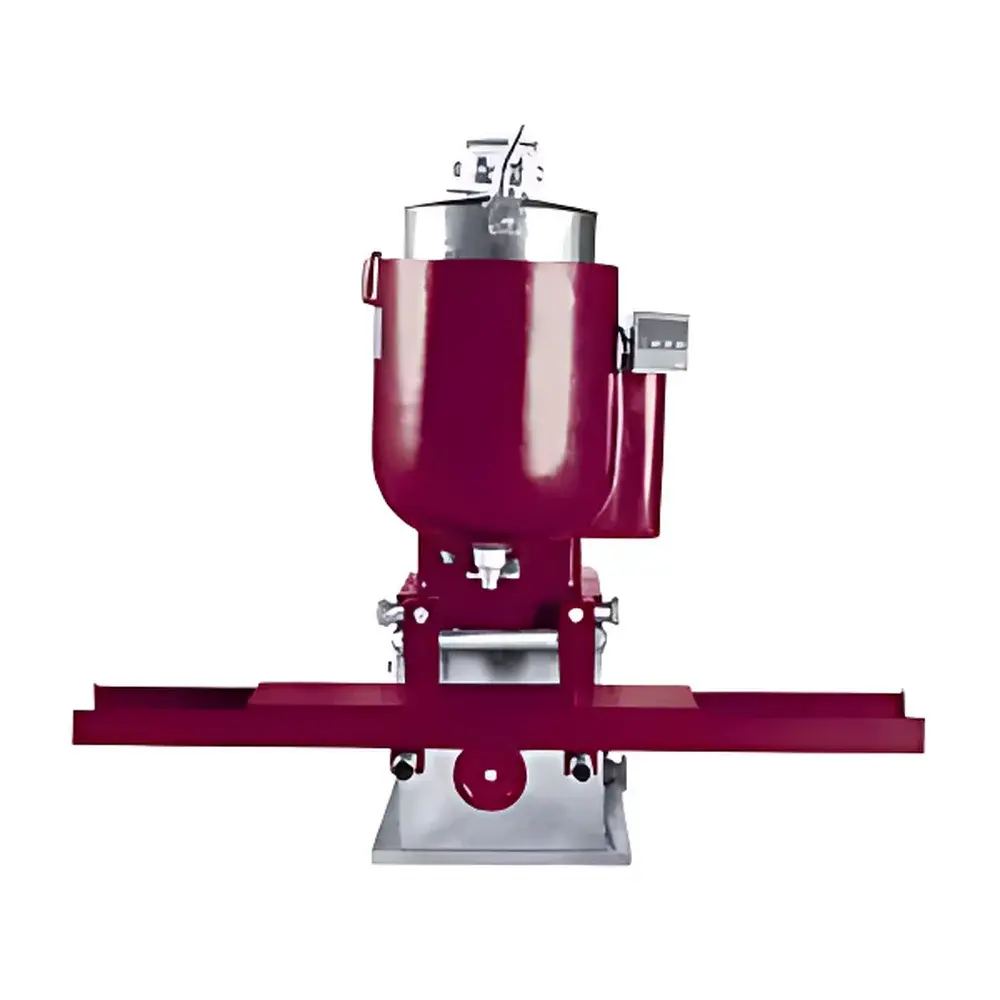
Pharmag Suppository Filling Machine
| Brand | Pharmag |
|---|---|
| Origin | Germany |
| Manufacturer Type | Authorized Distributor |
| Origin Category | Imported |
| Model | Suppository Filling |
| Pricing | Upon Request |
| Production Capacity | Up to 4,000 units/hour (dependent on formulation rheology and mold geometry) |
| Total Tank Volume | 5 L |
| Usable Working Volume | 3–3.5 L |
| Blade Orientation | Manually Adjustable |
Overview
The Pharmag Suppository Filling Machine is an industrial-grade, thermally controlled semi-automatic filling system engineered for the precise, hygienic, and repeatable production of solid-dose pharmaceutical suppositories and cosmetic sticks (e.g., lip balms, deodorant sticks). Based on a continuous melt-processing architecture, the machine integrates temperature-regulated melting, homogenization via mechanical agitation, and volumetric piston-driven filling—all within a single compact unit. Its core operational principle relies on maintaining molten formulation integrity through precise thermal management (typically 40–80 °C range, configurable per base composition), followed by controlled shear mixing and gravity-assisted or pressure-assisted transfer into pre-chilled molds. Designed in accordance with EU GMP Annex 1 fundamentals for non-sterile solid dosage forms, the system supports validated manufacturing workflows in both pilot-scale development and commercial batch production environments.
Key Features
- Integrated heating, stirring, and filling functions within a single monolithic platform—eliminating intermediate transfer steps and minimizing thermal degradation risk.
- 5 L stainless steel (AISI 316L) reservoir with jacketed heating and PID-controlled temperature regulation (±1.5 °C stability over full operating range).
- UAM-coupled high-torque motor driving a detachable, polished stainless steel impeller; optimized for low-shear mixing of waxy, fatty, or polyethylene glycol (PEG)-based matrices.
- Adjustable stainless steel scraping blade mounted on the impeller shaft—configurable in angular orientation to ensure complete tank evacuation and prevent material build-up on vessel walls.
- Volumetric filling head with precision-machined stainless steel pistons and PTFE-sealed cylinders; fill volume adjustable from 0.5 g to 5.0 g per cycle with ≤±2.5% repeatability (per ISO 8573-1:2010 calibration protocol).
- Modular design compliant with EHEDG Guideline Doc. 8 for cleanability; all product-contact surfaces electropolished (Ra ≤ 0.4 µm) and fully drainable.
Sample Compatibility & Compliance
The Pharmag Suppository Filling Machine accommodates a broad spectrum of suppository bases—including cocoa butter, hydrogenated vegetable oils, Witepsol®, Suppocire®, and water-soluble PEG 1000–6000 formulations—as well as cosmetic stick matrices (e.g., beeswax/carnauba blends, synthetic wax emulsions). All wetted components meet USP Class VI biocompatibility requirements. The system supports compliance with ICH Q5C (stability of biotechnological products), ASTM D6342 (standard test method for suppository dissolution), and European Pharmacopoeia 2.9.36 (suppository uniformity of mass). Documentation packages include FAT/SAT protocols, material traceability dossiers (EN 10204 3.1), and optional IQ/OQ validation support aligned with EU GMP Annex 15 and FDA Process Validation Guidance (2011).
Software & Data Management
While the base configuration operates via analog HMI with manual parameter setting, optional digital upgrade kits provide RS-485/Modbus RTU connectivity for integration into MES or SCADA environments. Audit-trail-enabled controllers (optional) comply with FDA 21 CFR Part 11 requirements—including electronic signatures, user-level access control (three-tier privilege model), and immutable event logging of temperature setpoints, agitation speed, fill count, and operator ID. Batch records are exportable in CSV or PDF format with embedded digital signatures and time-stamped metadata.
Applications
- Pharmaceutical R&D labs: Formulation screening of novel suppository bases under GxP-compliant conditions.
- Clinical trial manufacturing: Small-batch (100–5,000 units) production of investigational medicinal products requiring strict mass uniformity (USP ).
- Contract development and manufacturing organizations (CDMOs): Scalable process transfer from lab-scale to commercial batches using identical thermal and rheological parameters.
- Cosmetic OEM facilities: High-integrity filling of anhydrous stick formats with minimal oxidation exposure and consistent surface finish.
- Academic pharmacotechnology laboratories: Teaching and research on solid dosage processing, thermal behavior of lipid matrices, and melt rheology modeling.
FAQ
What types of suppository bases are compatible with this machine?
Cocoa butter, hydrogenated oils, Witepsol®, Suppocire®, Massa Estarinum®, and PEG-based systems (PEG 1000–6000) have been validated across multiple installations. Silicone oil-based or highly viscous polymer melts require prior rheological assessment.
Is the system suitable for GMP manufacturing?
Yes—when equipped with optional validation documentation, audit trail firmware, and calibrated instrumentation, it meets EU GMP Annex 1 and FDA 21 CFR Part 211 requirements for non-sterile solid dosage forms.
Can the machine be integrated into an automated production line?
The standard unit supports manual mold loading/unloading; however, optional robotic interface kits (including servo-indexed mold conveyors and vision-guided alignment) enable full integration with PLC-controlled packaging lines.
What maintenance intervals are recommended?
Daily cleaning-in-place (CIP) with warm ethanol/water; quarterly inspection of piston seals and impeller bearings; annual recalibration of temperature sensors and fill-volume actuators per ISO/IEC 17025-accredited service providers.