
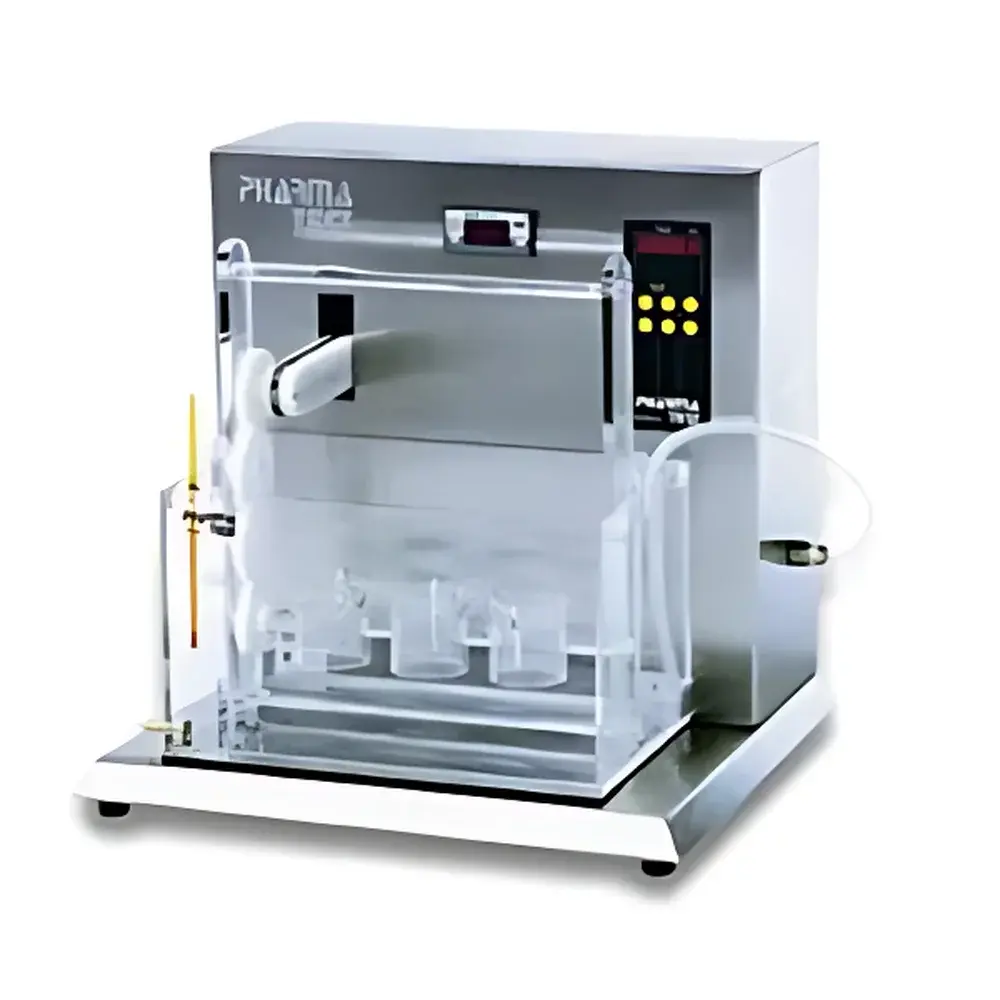
Pharma-test PTS 3E Disintegration Tester
| Brand | Pharma-test |
|---|---|
| Origin | Germany |
| Model | PTS 3E |
| Sample Capacity | 3 units simultaneously |
| Temperature Range | 30–40 °C |
| Temperature Accuracy | ±0.5 °C (typical for pharmacopeial disintegration systems) |
| Water Bath Volume per Station | 1.2 L |
| Test Duration Range | 1 min – 10 h |
| Flip Cycle Interval | 1–10 min (programmable 180° rotation) |
| Acoustic Emission | <35 dB(A) (fully silent operation) |
| Heating System | PTC ceramic with overheat protection |
| Grease-Resistant Sealing | Integrated hydrophobic barrier at sample holder interface |
| Compliance | Designed to meet USP <701>, Ph. Eur. 2.9.1, and JP 6.05 disintegration requirements |
Overview
The Pharma-test PTS 3E Disintegration Tester is a precision-engineered, fully automated instrument designed specifically for pharmaceutical quality control laboratories requiring strict adherence to international pharmacopeial standards. It operates on the principle of mechanical agitation combined with controlled thermal immersion to assess the time required for solid oral dosage forms—including suppositories, tablets, and capsules—to disintegrate under defined physiological conditions. The system replicates in vivo dissolution dynamics through synchronized vertical immersion, programmable 180° flip cycles, and tightly regulated water bath temperature (30–40 °C), ensuring high reproducibility across batches and operators. Its fully silent architecture—achieved via brushless DC motor actuation and vibration-damped mounting—eliminates acoustic interference in noise-sensitive QC environments, while its sealed mechanical design prevents lipid migration from suppository matrices into critical actuation zones.
Key Features
- Triple-station parallel testing: Simultaneously evaluates three suppositories or tablets under identical thermal and mechanical conditions, improving throughput without compromising inter-unit comparability.
- Programmable flip mechanism: Precise 180° rotation at user-defined intervals (1–10 min), enabling method customization for both fast- and slow-dissolving formulations per USP Annex guidelines.
- Stable thermal environment: Independent PTC-heated water baths (1.2 L each) maintain temperature within ±0.5 °C across the full 30–40 °C range; integrated digital PID control ensures minimal overshoot and drift during extended tests (up to 10 h).
- Grease-resistant sample interface: Patented hydrophobic sealing gasket isolates the drive shaft and pivot assembly from fatty excipients, eliminating lubricant ingress and extending maintenance intervals.
- Real-time temporal feedback: Onboard LCD displays elapsed test time and remaining duration with second-level resolution; automatic termination triggers upon completion or timeout.
- Passive safety architecture: Dual-stage thermal cutoff (electronic + mechanical) and dry-run detection prevent heater activation without adequate fluid level.
Sample Compatibility & Compliance
The PTS 3E accommodates standard suppository molds (e.g., oval, bullet, and torpedo shapes) and tablet formats up to 25 mm in diameter using interchangeable stainless-steel holders. It supports both aqueous and lipid-based media—including purified water, simulated vaginal fluid (SVF), and polyethylene glycol (PEG) 1500 solutions—without modification. The instrument is validated for compliance with USP Disintegration of Dosage Forms, Ph. Eur. 2.9.1 Disintegration, and JP 6.05 Dissolution and Disintegration Testing. Its mechanical repeatability (RSD <1.2% for triplicate n=6 runs) satisfies GLP audit requirements for method validation documentation, and its non-networked embedded controller meets FDA 21 CFR Part 11 data integrity expectations for non-electronic records when paired with printed test logs.
Software & Data Management
The PTS 3E operates via an embedded microcontroller with no external PC dependency. All test parameters—including start time, target duration, flip interval, and final status—are stored in non-volatile memory with timestamping (YYYY-MM-DD HH:MM:SS). A dedicated RS-232 port enables direct connection to laboratory printers for immediate hardcopy output compliant with ALCOA+ principles (Attributable, Legible, Contemporaneous, Original, Accurate). While the unit does not feature Ethernet or USB connectivity, its deterministic real-time firmware ensures zero data loss during power interruption, and all configuration changes require physical key-lock engagement to prevent unauthorized parameter modification.
Applications
- Suppository formulation development: Quantifying the impact of base composition (e.g., cocoa butter vs. PEG blends) on disintegration kinetics under simulated body temperature.
- Batch release testing: Routine QC verification of suppositories prior to distribution, aligned with pharmacopeial acceptance criteria (e.g., complete disintegration within 30 min for rectal suppositories per Ph. Eur.).
- Stability-indicating method support: Monitoring disintegration profile shifts across accelerated stability studies (40 °C/75% RH) to detect polymorphic transitions or excipient degradation.
- Excipient compatibility screening: Evaluating interactions between active pharmaceutical ingredients (APIs) and melting-point modifiers in lipid matrices.
- Regulatory submission dossier generation: Providing traceable, auditable disintegration datasets for ANDA, MAA, or NDA filings requiring ICH Q5C and Q5D supporting data.
FAQ
Does the PTS 3E comply with 21 CFR Part 11 requirements for electronic records?
The PTS 3E does not generate or store electronic records in a computerized system; it maintains parameter settings and timestamps in internal flash memory and outputs results via RS-232 to a printer. As such, it falls outside the scope of Part 11 but supports ALCOA+-compliant paper-based documentation when used with a validated thermal printer.
Can the instrument be used for vaginal or urethral suppositories?
Yes—the temperature range (30–40 °C) and programmable agitation profile are suitable for testing suppositories intended for mucosal administration, provided the test medium matches the relevant pharmacopeial specification (e.g., simulated vaginal fluid per USP).
Is calibration traceable to national standards?
Temperature sensors are factory-calibrated against PTB-traceable references; users receive a certificate of conformance with NIST-traceable uncertainty values (±0.3 °C at 37 °C). Annual recalibration is recommended using certified thermistor probes.





